

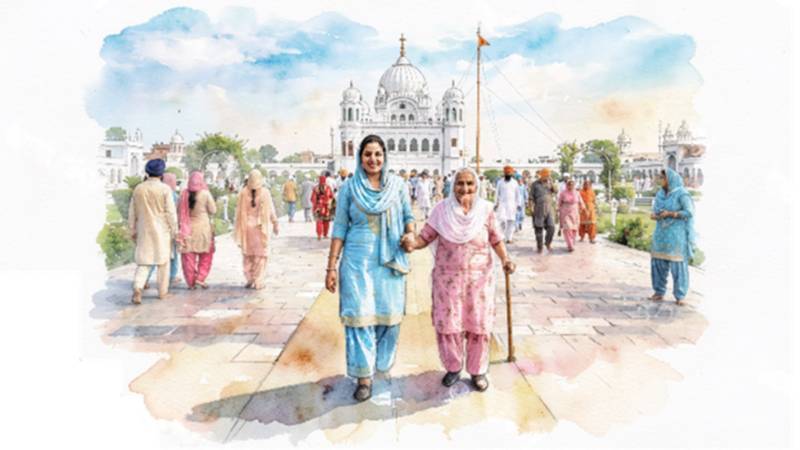
Almost 100 Pakistani Sikh pilgrims stood at Faisalabad airport on the 11th of September, holding valid Indian visas and nowhere to go. They were booked to fly to Sharjah, then Delhi, then north to Gurdwara Sri Hemkund Sahib. There are no direct flights for that route, no functioning rail link either. And apparently, as of that night, no clear paperwork. Immigration officials pointed to a missing no-objection certificate. Islamabad's Foreign Office later disputed even that much, saying it hadn't known India had issued the visas at all, and that they fell outside the 1974 bilateral protocol governing shrine visits. Two governments couldn't agree on the rules of their own agreement, and a hundred people paid for it by standing in an airport.
This would be a strange, isolated story if it weren't the second half of something already underway. The Kartarpur Corridor, the visa-free crossing that lets Indian Sikhs reach Gurdwara Darbar Sahib without the exact bureaucracy that stranded the Faisalabad group, has been closed since May 2025. India suspended it days after the Pahalgam attack and hasn't reopened it since. The only explanation offered has been “prevailing tensions,” with no timeline attached. Indian pilgrims who still want to cross now have to do precisely what the corridor was built in 2019 to make unnecessary: apply for a Pakistani visa and take the older, harder Attari-Wagah route. India and Pakistan renewed their formal agreement on the corridor through 2029 this August anyway, a peace gesture kept alive on paper while the actual gate stays welded shut.
Two governments couldn't agree on the rules of their own agreement, and a hundred people paid for it by standing in an airport
I put both incidents to Ramesh Singh Arora, Pakistan's first sitting Sikh minister. His response was considered and conciliatory. On Kartarpur, he said Pakistan has kept the facility ready and wants it reopened “at the earliest,” framing the closure as entirely India's doing. On Faisalabad, he didn't dodge the specifics. The pilgrims held valid Indian visas, he confirmed, but lacked the required no-objection certificate and return tickets for the route they'd chosen, which made it, in his telling, a documentation problem rather than deliberate obstruction. He said he understood the pilgrims' disappointment, and that he'd rather fix the procedural gaps than let the episode turn into a political fight. Given how easy this story would be to politicise, that's a good-faith answer.
Mahinderpal Singh doesn't see it that way, or at least isn't willing to find out. A former Punjab parliamentary secretary whose family has represented Sikhs in the Nankana Sahib area since 1947, he's taken the sharpest public line on the incident. In a video statement, he gave an ultimatum: fix the pilgrims' situation before the pilgrimage season ends, or he'll start naming the officials he holds responsible. Strip away the threat and the grievance underneath it is simple. These pilgrims did nothing wrong beyond booking a route through a third country. They got stranded by paperwork nobody warned them about, and nobody in government seemed to own the fix.
Arora's good faith is real, and it still doesn't answer the harder question. His account of Faisalabad as a documentation issue is plausible. But the pilgrims were stranded anyway, with no warning and no one to call that night, and a promise to do better next season doesn't explain why this season went wrong. A minister saying the right things matters. It just isn't the same as a pilgrim knowing, before they book the flight, that the paperwork will actually hold.
Arora made his case again on the 22nd of September, this time at the border itself. Pakistani Sikhs marked Guru Nanak's Jyoti Jyot Gurpurab with a Nagar Kirtan procession to the Zero Line, performing Ardas, Shabad Kirtan, and Aarti within sight of the crossing. On the other side, the corresponding jatha, led by the acting Jathedar of Akal Takht Sahib, was stopped by India's own border security before it could reach that same spot. Arora, addressing the Pakistani side of the gathering, called the corridor a gift Pakistan had given the Sikh community in 2019 and pointed to the constitution's guarantee of religious freedom. It made for a strange picture: pilgrims praying at a closed gate on one side, blocked from approaching that same gate by their own government's forces on the other. Not Pakistan keeping Sikhs out, this time, but India keeping its own pilgrims from getting close enough to pray.
Even before the closure, Kartarpur was a strange kind of success. Pakistan's own visitor data shows that of the more than 680,000 people who visited Gurdwara Darbar Sahib between late 2021 and mid-2023, fewer than a quarter were Indian nationals, the pilgrims the corridor was actually built for. The rest were Pakistani. A crossing conceived as a rare act of cross-border generosity had quietly turned into, in practice, a domestic heritage site. That was true while the corridor worked. It's truer now that it doesn't.
Faisalabad and Kartarpur aren't connected by bad luck. They're connected by what happens when two states treat pilgrimage as a diplomatic lever instead of a right, something to switch on or off depending on the political weather, with no reference to faith at all. Arora's own language gives this away. Pakistan's readiness to reopen the corridor is framed entirely as a response to India's decision to close it, which means neither government is treating a six-year-old peace gesture as something it actually controls. A corridor that can be switched off unilaterally, without explanation, and reopened only when it suits the side that closed it, was never really a right. It was a privilege, handed out and taken back by people who will never have to explain themselves to the pilgrims standing at the gate.