

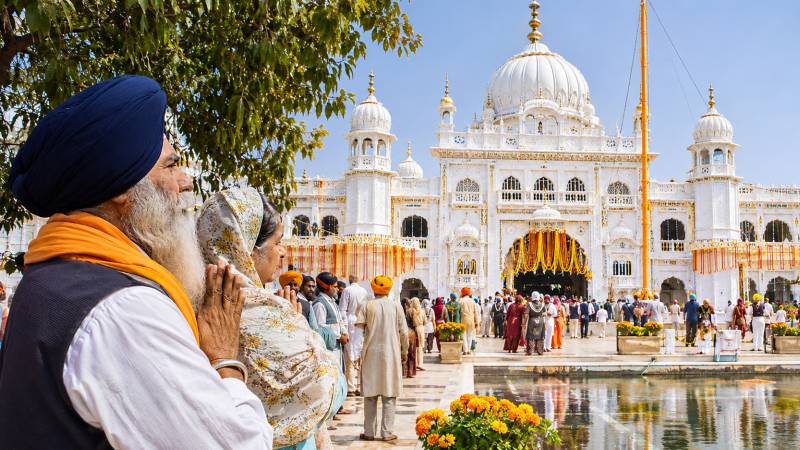
From Nankana Sahib to Kartarpur, from the mystics of Punjab to the Sufi poets of Sindh, Guru Nanak's poetry continues to unite hearts beyond the boundaries of religion, language and nation. The historic town of Nankana Sahib in Pakistan is once again illuminated by devotion, music and the spirit of fellowship as Sikh pilgrims from across the world gather to celebrate the 557th birth anniversary, or Parkash Purab, of Guru Nanak Dev Ji. On this sacred occasion, the birthplace of one of the greatest mystic poets of the subcontinent becomes a meeting place of faith, history and humanity. The celebration is not only a moment of reverence for Sikhs but also an occasion for the people of this region to rediscover a shared spiritual heritage that belongs to the whole of humanity.
Guru Nanak was born at Rai Bhoi Ki Talwandi, now Nankana Sahib. His father, Mehta Kalu, was associated with revenue administration, and his mother was Mata Tripta. His elder sister, Bebe Nanaki, recognised his spiritual qualities from childhood and became his early supporter. He married Mata Sulakhni around 1487, and they had two sons, Sri Chand and Lakhmi Das. Yet Nanak's spiritual journey did not demand withdrawal from family or society. He believed that one could live an ordinary life while remaining committed to truth, honest labour, compassion and service.
The intellectual world of his time was rich with philosophical and spiritual traditions. Ancient India had developed the six orthodox schools of Nyaya, Vaisheshika, Samkhya, Yoga, Mimamsa and Vedanta, alongside non-Vedic traditions such as Charvaka, Jainism, Buddhism and Ajivika. Later, the Bhakti and Sant movements gave new expression to devotion and social equality, while Sufism cultivated the language of divine love within the Islamic tradition. Guru Nanak emerged from this diverse spiritual landscape and gave birth to a distinct religious tradition, Sikhism, founded upon the oneness of the Divine and the equality of all human beings.
His opening declaration, Ik Onkar, became the foundation of his spiritual philosophy:
اِک اونکار، ست نام، کرتا پُرکھ، نِربھؤ، نِروَیر۔
(There is One Universal Creator. Truth is His Name. He is the Creator, without fear and without hatred.)
For Nanak, God was not the possession of any one community, nor could the Divine be confined to temples, mosques or religious rituals. His spiritual vision transcended sectarian identities. The words traditionally associated with his experience at Sultanpur Lodhi, “There is no Hindu, there is no Muslim,” expressed a profound challenge to religious divisions and a call to recognise the shared humanity within all people.
His poetry speaks with a simplicity that conceals extraordinary philosophical depth. In Japji Sahib, he questions the limits of intellectual speculation and reminds us that truth cannot be reached merely through endless thought:
سوچیں سوچ نہ ہووئی، جے سوچیں لکھ وار۔
(Truth cannot be attained through thought alone, even if one thinks a hundred thousand times.)
He then offers a timeless principle of life:
سچّہو اُورے سبھ کو، اُپر سچّ آچار۔
(Truth is higher than everything, but higher still is truthful living.)
This is the essence of Nanak's message: spirituality must be visible in human conduct. A person who speaks of truth but practises injustice has not understood its meaning. A person who worships but humiliates another has missed the purpose of faith.
Nanak travelled widely, accompanied by his close friend Bhai Mardana, a Muslim musician and rabab player. Their friendship remains one of the most beautiful examples of interfaith harmony in South Asian history. Traditionally, his four great journeys, known as the Udasis, took him across northern, eastern, southern and western regions, including Haridwar, Varanasi, Assam, southern India, Sri Lanka, Kashmir, Tibet, Mecca, Medina, Baghdad, Afghanistan and Sindh. Although the precise routes and dates are debated, these journeys reflect his desire to engage with people of different beliefs, challenge religious hypocrisy and share his vision of universal love.
His teachings were rooted in three practical principles: Naam Japna, remembrance of the Divine; Kirat Karni, earning through honest labour; and Vand Chakna, sharing with others. He gave equal importance to Seva, selfless service, Sangat, spiritual fellowship, and Langar, the community kitchen where everyone sits together without distinction of caste, wealth or status. His words on honest labour and generosity remain among his most enduring teachings:
گھال کھائے، کِچھ ہتھوں دے، نانک راہ پچھانَہِ سَے۔
(Those who earn through honest labour and share with others, says Nanak, have understood the true path.)
His poetry also celebrates the victory of the human spirit over its own ego and weaknesses:
مَن جیتے جگ جیت۔
(Conquer your mind, and you conquer the world.)
He saw the Divine presence in all living beings and regarded nature as a sacred expression of the universal order. His celebrated verse from Japji Sahib offers a vision of ecological harmony centuries ahead of its time:
پون گرو، پانی پتا، ماتا دھرت مہت۔
(Air is the Guru, water is the father, and the great earth is the mother.)
In another profound teaching, he reminds us that all living beings depend upon one source of generosity:
سبھنا جِیا کا اِک داتا، سو مَیں وِسَر نہ جائی۔
(There is only One Giver for all living beings. May I never forget Him.)
Nanak's respect for women was equally remarkable in an age when social customs often confined their role and dignity. In Asa Di Var, he asks a question that remains relevant even today:
سو کیوں مندا آکھئے، جت جمّے راجاں۔
(Why call woman inferior, when kings themselves are born from her?)
His poetry is preserved in the Guru Granth Sahib. Traditionally, 974 compositions are attributed to him, though counts vary according to the classification of hymns, shaloks and other poetic forms. Among his celebrated works are Japji Sahib, Asa Di Var, Sidh Gosht, Dakhni Onkar, Barah Maha, Patti and Babar Bani. His compositions appear in 19 of the scripture's 31 principal ragas. The Adi Granth was compiled by Guru Arjan in 1604 and included the poetry of Sikh Gurus as well as Bhagat and Sufi voices such as Kabir, Ravidas, Namdev and Sheikh Farid. It comprises 1,430 angs. Guru Gobind Singh later added the compositions of Guru Tegh Bahadur and declared the Guru Granth Sahib the eternal Guru in 1708.
The script Gurmukhi was standardised and promoted by Guru Angad, the second Sikh Guru. Punjabi, however, has a much older linguistic and literary history and is written in Gurmukhi in India and Shahmukhi in Pakistan. The succession of Sikh Gurus carried Nanak's message forward. Guru Arjan strengthened the scriptural tradition; Guru Hargobind developed the principle of Miri and Piri; Guru Tegh Bahadur sacrificed his life for religious freedom; and Guru Gobind Singh established the Khalsa in 1699.
Their philosophies were not identical, but their poetry often converges in its compassion, its criticism of hypocrisy and its search for a truth beyond outward divisions. From Baba Farid and Bulleh Shah to Shah Abdul Latif Bhittai and Sachal Sarmast, the spiritual traditions of Punjab and Sindh share a remarkable literary heritage.
Guru Nanak stands in the great spiritual constellation of Punjab and Sindh. Baba Farid preceded him, while Kabir was his near contemporary. Later came Shah Hussain, Sultan Bahu, Bulleh Shah and Waris Shah. Across the Indus, Shah Abdul Latif Bhittai, Sachal Sarmast and Sami gave poetic expression to love, truth, spiritual unity and human dignity. Their philosophies were not identical, but their poetry often converges in its compassion, its criticism of hypocrisy and its search for a truth beyond outward divisions. Shah Latif's Sassui, Marui, Moomal and Sohni, like the seekers in Nanak's hymns, represent the courage, sacrifice and longing of the human soul.
The history of Sikhism also includes a struggle for justice and political freedom. Guru Arjan was executed under Emperor Jahangir in 1606, and Guru Tegh Bahadur under Aurangzeb in 1675. Banda Singh Bahadur established Sikh political authority at Sirhind in 1710. During the eighteenth century, the Sikh Misls emerged amid repeated invasions by Ahmad Shah Durrani. Maharaja Ranjit Singh captured Lahore in 1799 and established the Sikh Empire in 1801, creating a powerful state with a multi-religious administration. Following the Anglo-Sikh wars, the British annexed Punjab in 1849.
Partition in 1947 divided Punjab between India and Pakistan, causing mass migration, communal violence and immense human suffering. Most Sikhs moved to Indian Punjab, while many of their most sacred historical places remained in Pakistan. Nankana Sahib, Kartarpur, Panja Sahib at Hassan Abdal, Dera Sahib in Lahore, Sacha Sauda and Eminabad continue to preserve this shared heritage. In India, Harmandir Sahib, Anandpur Sahib, Patna Sahib and Hazur Sahib remain major centres of pilgrimage. The Kartarpur Corridor, inaugurated in 2019, offered a historic opportunity for Indian Sikh pilgrims to visit Gurdwara Darbar Sahib without a conventional visa, although access has faced interruptions amid political tensions.
Today, Sikh communities flourish across the world, with a global population broadly estimated at 25 to 30 million. India is home to the overwhelming majority, while significant communities live in Canada, the United Kingdom, the United States, Australia, Malaysia and other countries. Pakistan's 2023 census recorded 15,998 Sikhs. Their presence across continents demonstrates how a faith rooted in Punjab has carried its spiritual and cultural identity into the wider world.
The Parkash Purab celebrations in Nankana Sahib, taking place from 22 to 24 November 2026, have brought pilgrims from Pakistan and abroad to Gurdwara Janam Asthan, the sacred birthplace of Guru Nanak. Thousands have travelled to pay homage, including pilgrims from India. Their presence is a reminder that sacred places can become bridges between communities and that cultural heritage need not be divided by political borders.
Perhaps the most beautiful tribute to Guru Nanak is not merely to remember his birth, sing his hymns or visit his shrines, but to practise the humanity he taught. His poetry asks us to replace arrogance with humility, hatred with compassion, exploitation with honest labour and division with fellowship. His vision was not of a world separated by competing identities, but of a humanity united by a common spiritual source.
From the soil of Nankana Sahib, his voice continues to travel across rivers, deserts, mountains and generations. The words of the mystic poet remain an invitation to every age: live truthfully, earn honestly, share generously, serve selflessly and recognise the Divine in all. In a world still wounded by conflict and prejudice, Guru Nanak's message remains a light that belongs to no single nation or religion, but to humanity itself.