

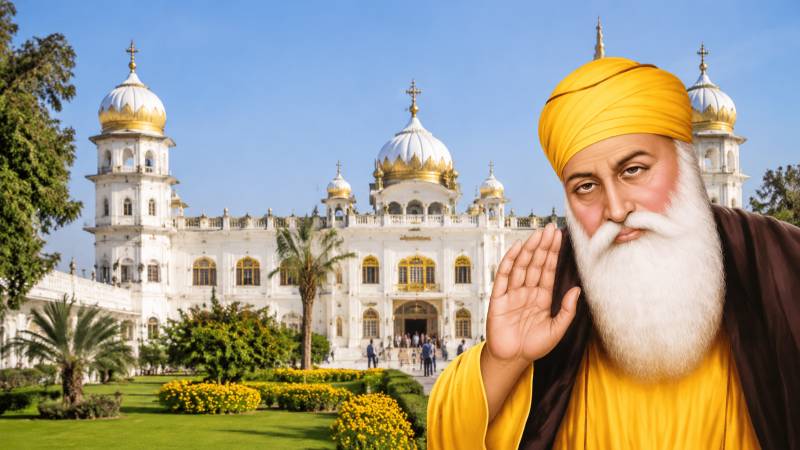
As a practising Muslim, I believe that commitment to one's faith should strengthen, rather than diminish, respect for other religions and human dignity. This belief is particularly meaningful as the Sikh community celebrates the 557th birth anniversary of Guru Nanak Dev Ji on November 24, 2026. Born in 1469 in present-day Nankana Sahib, Pakistan, Guru Nanak founded Sikhism and emphasised devotion to God, honest living, social equality and service to humanity. His teachings continue to inspire reflection beyond religious boundaries.
Respecting his legacy does not require Muslims to compromise their beliefs, just as Sikhs need not abandon theirs to respect Islam. Genuine religious coexistence lies not in erasing theological differences but in recognising one another's dignity and freedom of belief. The question is not whether people belonging to different religions can agree on every matter of faith, but whether they can preserve their convictions while treating one another with fairness and humanity.
The significance of Guru Nanak's birthplace extends beyond religious geography. Nankana Sahib represents an important chapter in the spiritual and cultural history of the subcontinent. The Punjab of Guru Nanak's time was a meeting place of languages, traditions and religious influences. Muslim scholars, Hindu spiritual teachers, Sufi mystics and ordinary villagers participated in a complex social environment where religious distinctions existed alongside everyday interaction.
Guru Nanak developed his teachings within this setting, yet Sikhism cannot be adequately described as a simple combination of Hinduism and Islam. It emerged as a distinct religious tradition with its own scripture, institutions and spiritual identity. Understanding this distinction is essential for meaningful interfaith respect. Admiration should never become an excuse for interpreting another community's beliefs entirely through one's own religious understanding.
As a Pakistani, I find particular significance in the fact that the birthplace of Sikhism's founder lies within our national boundaries. Preserving Nankana Sahib and other Sikh sacred places is an obligation towards history, cultural diversity and the religious rights of communities whose spiritual memories remain connected with this land.
One of the most compelling aspects of Guru Nanak's teachings is the relationship between belief in God and responsibility towards fellow human beings. His message emphasised divine oneness while questioning social divisions that assigned unequal worth to individuals according to birth, occupation or inherited status. His rejection of caste-based superiority was particularly significant in a society where hierarchy influenced everyday relationships.
As a Muslim, I find an important ethical resonance with the Quranic emphasis on justice, compassion and human dignity. The Quran describes human diversity in terms of peoples and tribes created so that human beings may know one another rather than claim superiority through differences of identity.
Nevertheless, similarities between religions should not obscure their theological distinctions. Islam and Sikhism possess different understandings of revelation, spiritual authority and religious practice. Recognising these differences does not prevent appreciation of their shared ethical concerns. Genuine interfaith understanding becomes possible when we abandon the assumption that respect requires complete agreement.
Guru Nanak's teachings are often summarised through three interconnected principles: remembrance of the divine name, earning an honest livelihood and sharing resources with others. Commonly expressed as Naam Japna, Kirat Karni and Vand Chhakna, these principles present spirituality as something reflected in everyday conduct rather than confined to ritual observance.
Their relevance is particularly evident in contemporary societies where economic success is frequently separated from ethical responsibility. Despite material development, inequality, exploitation and the concentration of wealth continue to challenge our collective conscience. Guru Nanak's teachings encourage us to question whether prosperity without social responsibility represents genuine success.
Guru Nanak's emphasis on honesty, humility and service invites reflection upon the relationship between devotion and conduct. A society may celebrate spiritual leaders while neglecting the responsibilities emphasized in their teachings. Religious sincerity should encourage self-examination rather than provide justification for judging others.
From an Islamic perspective, I find a related ethical concern in the obligations of zakat, charity and fair dealing, although their religious foundations and practices differ. Different spiritual traditions can encourage generosity, integrity and concern for vulnerable people without necessarily sharing identical theological foundations.
Perhaps no institution illustrates the practical dimension of Sikh teachings more visibly than langar, the communal kitchen associated with gurdwaras. Meals are offered without discrimination based on religion, caste, wealth or social position. People from different backgrounds sit together, reinforcing the principle that human dignity should not depend upon economic privilege or inherited status.
The significance of langar extends beyond providing food. Hunger is addressed through hospitality, while social distance is challenged through a shared human experience. Pakistan also possesses traditions of communal hospitality and charitable kitchens associated with religious institutions and public welfare. These practices are not identical, but they demonstrate how ethical principles can become organised social action. Societies should measure religious commitment not merely through declarations of faith, but also through the assistance provided to those who are hungry, vulnerable or excluded.
An especially meaningful aspect of Guru Nanak's life is his association with Bhai Mardana, the Muslim musician traditionally remembered as his companion during spiritual journeys. Sikh narratives describe Mardana accompanying Guru Nanak and playing the rabab while the Guru expressed his teachings through devotional poetry. Some historical details of these journeys remain subjects of scholarly discussion. Nevertheless, Mardana's enduring place within Sikh tradition illustrates the importance of companionship across religious boundaries.
Their relationship is remembered through music, friendship and shared spiritual experience rather than merely through differences of religious identity. A Muslim and a Sikh can disagree about religious doctrine while sharing commitments to friendship, hospitality, artistic expression and community welfare. Acknowledging differences respectfully may provide a more durable foundation for mutual understanding than pretending those differences do not exist.
The poetry associated with Guru Nanak also deserves appreciation as part of South Asia's intellectual and literary heritage. His compositions, preserved in the Guru Granth Sahib, explore human existence, devotion, ethical conduct and the limitations of worldly power. In Punjab, poetic expression has long provided a cultural language through which people have explored love, humility, injustice and the relationship between humanity and the divine.
Muslim Sufi poets such as Baba Farid occupy an important place in this history. The Guru Granth Sahib includes verses attributed to Sheikh Farid, demonstrating the literary and spiritual breadth of Sikh scripture. This inclusion should not be interpreted as the disappearance of religious distinctions, but as evidence of engagement with spiritual expression beyond narrow communal boundaries.
The anniversary also invites reflection upon Pakistan's responsibilities towards its religious minorities. Our constitutional and moral obligations require that citizens belonging to different faiths should be able to practise their religion, preserve places of worship and participate in national life with dignity.
Pakistan's Sikh community is relatively small, but its historical significance cannot be measured by population alone. A society's treatment of minorities reveals the practical meaning of citizenship. Protecting religious communities should not be regarded as a favour granted by the majority; it is a matter of rights, equal protection and state responsibility.
The same principle should apply to Hindus, Christians, Sikhs, Ahmadis and other communities, irrespective of theological disagreements surrounding their beliefs. As a Muslim, I regard human dignity and the rejection of religious coercion as serious ethical considerations. However, tolerance becomes meaningful only when reflected in everyday life. Festival greetings and ceremonial statements cannot substitute for access to education, employment, security and legal protection. Minority citizens should not have to demonstrate exceptional loyalty before receiving the rights that belong to them.
Pakistan's historical relationship with Sikhism presents both opportunities and challenges. Gurdwara Janam Asthan at Nankana Sahib and Gurdwara Darbar Sahib at Kartarpur are among the most important sacred locations associated with Guru Nanak. Kartarpur, where he established a community and spent his later years, holds particular significance in Sikh memory.
The opening of the Kartarpur Corridor in November 2019 represented an important initiative facilitating religious pilgrimage across the India-Pakistan border. For many devotees, visiting a sacred place separated by an international boundary carried emotional significance beyond ordinary travel. Yet the corridor also illustrates how religious access can become vulnerable to political developments.
As of early November 2026, pilgrim movement through the corridor remained suspended from the Indian side, according to official information, while Pakistan expressed willingness to facilitate its resumption. Security considerations and bilateral tensions cannot simply be disregarded, but the spiritual needs of ordinary pilgrims should not disappear from diplomatic discussions. Preserving access to sacred places requires sensitivity towards legitimate security concerns as well as the cultural and religious connections that transcend political boundaries.
The relationship between India and Pakistan makes Guru Nanak's legacy particularly relevant. The two countries share centuries of history, language, literature and cultural exchange, but their political relationship has frequently been marked by confrontation and mistrust. Partition in 1947 created independent states while dividing communities, families and religious landscapes developed over generations.
Nevertheless, religious pilgrimage offers a meaningful opportunity for cooperation. Allowing people to visit sacred places does not require agreement on every disputed issue. It requires recognition that ordinary individuals possess cultural and spiritual needs deserving consideration alongside state interests. Cooperation over pilgrimage, heritage conservation and historical research may appear limited compared with major diplomatic negotiations, but such initiatives can preserve human contact during difficult periods.
Educational institutions also have considerable scope to introduce students to the religious and cultural diversity of their country. Pakistan's history is often presented through political developments, constitutional debates and events associated with the creation of the state. These subjects are important, but they cannot fully explain the intellectual inheritance of the land.
Students should also learn about different religious communities, regional languages, spiritual movements and shared cultural traditions. Studying Guru Nanak as a historical and religious figure does not require students to adopt Sikh beliefs; it requires them to understand an influential part of South Asian history accurately. Similarly, minority students should be able to learn about Islamic civilisation without surrendering their own identities.
In an age when social media can amplify prejudice within minutes, responsible interfaith communication deserves particular attention. Digital platforms have made religious discussion more accessible, but misinformation, provocative interpretations and historical distortions can also circulate rapidly. Statements extracted from their context may generate hostility among people unfamiliar with the traditions being discussed.
Respectful dialogue does not require suppressing legitimate theological disagreement or historical criticism. Religious ideas can be studied, questioned and debated, but criticising an argument differs fundamentally from humiliating a community. Scholars, journalists, teachers and religious leaders have a particular responsibility to maintain this distinction.
There is also a broader question about the difference between religious identity and religious conduct. A society may construct magnificent places of worship while failing to protect vulnerable individuals. It may celebrate spiritual leaders while neglecting the responsibilities emphasised in their teachings. This contradiction is not confined to any particular faith.
Guru Nanak's emphasis on honesty, humility and service invites reflection upon the relationship between devotion and conduct. For Muslims, comparable questions arise when considering the ethical obligations associated with prayer, fasting and charity. Religious sincerity should encourage self-examination rather than provide justification for judging others.
On this 557th birth anniversary of Guru Nanak Dev Ji, I extend my heartfelt greetings to Sikh friends, colleagues, students and communities worldwide. Guru Nanak's legacy reminds us of the enduring values of human dignity, equality and service, while his birthplace in Pakistan reflects the richness of our cultural heritage.
Honouring that heritage requires more than ceremonial celebrations; it calls for protecting sacred sites, safeguarding minority rights and promoting understanding through education and human contact. Religious differences will continue to exist, and meaningful coexistence does not require their disappearance. A society becomes truly enriched when people can remain faithful to their beliefs without denying others the same freedom, and remain deeply religious without losing sight of their shared humanity.