

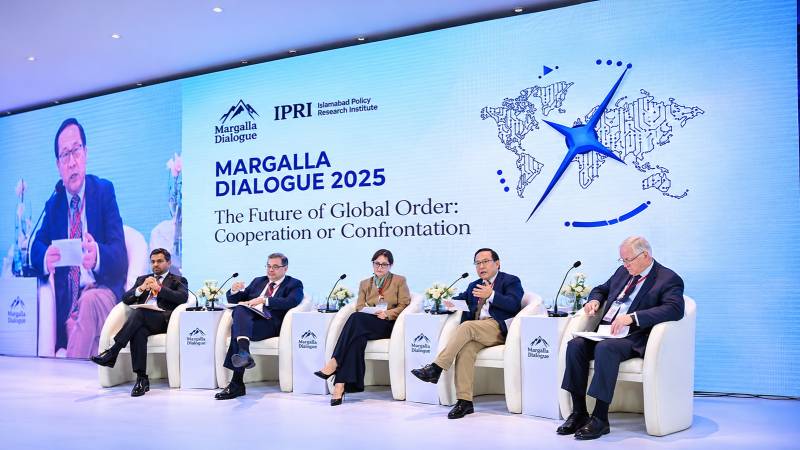
States, like individuals, eventually reach a point where it is no longer enough to act; they must also explain themselves. A country that has spent decades being described by others as a frontline state, a security problem, a client or a crisis can find itself with an unfamiliar opportunity: to tell its own story while the world is briefly paying attention. The seventh Margalla Dialogue, held by the Islamabad Policy Research Institute (IPRI) on 10 and 11 November 2026 under the theme “Global Order in Transition: Navigating Strategic Uncertainty,” should be read in that light. Formally, it was an international conference on geopolitics. In substance, it was something more ambitious: an attempt to turn a year of diplomatic success into a durable national identity. Whether that attempt succeeded depends less on what was said in the hall than on how it was received outside it.
The year provided unusual material. When the United States and Israel went to war with Iran at the end of February, Pakistan found itself in a position few had anticipated. In April, it hosted talks between Washington and Tehran. In August, Islamabad signed the Makkah Joint Defence Agreement with Saudi Arabia and Türkiye. It sits on the UN Security Council. And behind all of this lies May 2025, when the four-day conflict with India produced an outcome that Pakistan’s establishment regards as a vindication of its deterrence.
A country long accustomed to being discussed as a problem was, for a few months, discussed as a solution. The Margalla Dialogue was an opportunity to consolidate that shift to move from “Pakistan helped” to “Pakistan matters.” The organising claim of the conference was that Pakistan is now a middle power. Yet middle-power status is not something a state can simply declare into existence. It is conferred through recognition by other states, markets and the international institutions and media that shape how elites understand the world. The conference itself provided reasons for caution. Russia’s Timofei Bordachev observed that middle powers routinely discover their ambitions are constrained by economic, military and geographical limits. Germany’s Carlo Masala went further, arguing that only Washington and Beijing possess the resources to shape the global order at its highest level. If he is right, Pakistan’s “middle-power moment” may be less a structural transformation than a temporary opening created by crisis.
That is not a reason for pessimism, but it is a reason for precision. Vali Nasr of Johns Hopkins University offered perhaps the most persuasive explanation for Pakistan’s enhanced relevance. Its importance, he argued, flows partly from geography and exposure: the Iran war unsettled Gulf confidence in American security guarantees and drew Pakistan more deeply into West Asian security. But relevance born of proximity to danger is not the same as influence. The first is something that happens to a country; the second is something a country earns and sustains. The distinction is important, and the conference blurred it more often than it clarified it.
The inaugural speech by Deputy Prime Minister and Foreign Minister Ishaq Dar illustrates the problem. It was a carefully balanced address built around strength at home and effective diplomacy abroad. It warned against a world in which might is right, cited Gaza, raised terrorism from Afghan soil, defended Pakistan’s rights under the Indus Waters Treaty and called for a Kashmir settlement under UN resolutions. It also hailed Operation Bunyan-un-Marsoos, described the Makkah pact as defensive, called China the cornerstone of foreign policy while noting engagement with Washington, and presented the April talks as evidence of Pakistan’s commitment to dialogue.
Read closely, however, the speech spoke in several voices at once. There was the mediator bringing adversaries to the table; the deterrent power seeking recognition; the aggrieved neighbour pressing territorial and water claims; the ally of Riyadh and Ankara; and the partner of Beijing that also wants Washington’s goodwill. Each identity is defensible on its own terms. Together, they create a strategic ambiguity that may be useful in diplomacy but is difficult to communicate. The tension is most obvious in Pakistan’s relationship with Iran. Islamabad presents itself as a neutral facilitator between Washington and Tehran, yet it has also entered a mutual defence pact with Saudi Arabia. An Iranian participant at the dialogue suggested Pakistan’s mediating role was well understood in Tehran, indicating that the balancing act is working—for now. But a mediator’s credibility is a perishable asset. It can be spent faster than it is earned.
The dialogue’s most valuable admission came on its second day, when attention turned from Pakistan’s external image to its internal foundations. In the special forum on economic bottlenecks, the recurring message was clear: geopolitical opportunity cannot become lasting influence without a resilient domestic economy. Senator Sherry Rehman argued that Pakistan’s relationship with the Gulf should move beyond fuel imports and labour exports towards investment, energy cooperation and technology partnerships. Daniel Castro, the American technology analyst, cautioned Pakistan against digital protectionism and data-localisation rules. The larger point was unavoidable. A state that depends on remittances, rollovers and external financing will find that its diplomatic prestige is always partly borrowed. Geography can make a country indispensable in a crisis; only economic strength makes it indispensable in peacetime.
These were among the most important arguments of the two days and among the least reported. That brings us to the media, where the real lessons of this year’s dialogue lie. A conversation is only as large as the audience that is willing to hear it. Pakistan’s national coverage followed a familiar pattern. The first wave came from state channels, which led with ministerial statements on sovereignty, peace and the Indus Waters Treaty. This was not inaccurate journalism, but it was hierarchical journalism. It treated the dialogue as a sequence of official statements ranked by seniority rather than an exchange of arguments in which the most important idea might come from the least senior speaker.
The private press was more varied but not necessarily more critical. Dawn reported both the IT minister’s optimism about artificial intelligence and the Chinese scholar Cheng Xizhong’s sharp criticism of Indian policymakers. The latter was the more quotable line, and therefore the one most likely to travel. But quotability is not significance. A combative sentence about India confirms existing narratives and generates reaction. A careful argument about economic resilience does neither. Newsrooms that select for quotability will systematically underreport the self-critical parts of national conversations, often not out of bias but habit.
Geography can make a country indispensable in a crisis; only economic strength makes it indispensable in peacetime. A state that depends on remittances, rollovers and external financing will find that its diplomatic prestige is always partly borrowed.
There is also a structural problem Pakistani journalism rarely acknowledges. Much of the analytical commentary surrounding the Margalla Dialogue has come from people connected to IPRI itself. Scholars are entitled to write about their own institution’s work, but when evaluation is largely left to the organisers, the result can become review rather than criticism. Few asked the questions that would make the dialogue genuinely useful: What changed after previous editions? Which recommendations were implemented? Why does a forum about openness remain invitation-only? And how can the confident language of middle-power diplomacy be reconciled with the economic vulnerability acknowledged by the government’s own ministers?
A national conversation that receives only applause cannot improve. Beyond Pakistan’s borders, the coverage did not so much distort the dialogue as dismantle it. Each regional newsroom selected the fragment that mattered most to its own audience.
In Bangladesh, reports focused on the attendance of the director general of National Security Intelligence. For Dhaka, the story was primarily about a security visit and shifting regional relationships. In India, the Press Trust of India focused on Dar’s assurance that the Makkah pact was not aimed at any country, while framing the surrounding issues in India’s own political vocabulary. Afghanistan International reduced the inaugural address to its remarks about terrorism from Afghan soil. It would be easy to call this hostility, but that would misread what happened. Most of these reports were not false. They were selective, and their selectivity was partly shaped by Pakistan’s own messaging.
A speech that addresses every audience gives every audience a sentence to take away. Dhaka heard a security partner. New Delhi heard a defence pact and a Kashmir claim. Afghan media heard an accusation against the Taliban. The multi-voiced address that worked as diplomacy inside the hall became, in the regional press, a set of separate and sometimes contradictory stories. Strategic ambiguity is a diplomatic asset. As a communications strategy, it is a liability. The global response was perhaps the most telling of all because it was largely silence. Major international wire services and broadcasters that followed the Islamabad Talks closely in April paid little attention to the Margalla Dialogue in November. Even the keynote by the University of Chicago’s John Mearsheimer received limited attention outside Pakistani reporting.
This silence is not simply a judgement on Pakistan. It reflects how international media work. Diplomacy creates news because something happens: delegations arrive, deals are signed, ceasefires hold or collapse. Dialogues create context, and context rarely makes headlines. When Pakistan hosts other people’s negotiations, it becomes part of a global story. When it hosts its own conversation about the world, it is largely talking to itself. This is the central paradox of the seventh Margalla Dialogue. Speaker after speaker argued that Pakistan had become more consequential, yet the forum designed to explain that significance to the world was heard mainly at home and in the immediate neighbourhood and even there in fragments. The gap is not necessarily a failure of the conference. It is a measure of how far Pakistan still has to travel. Recognition follows sustained performance, not single moments, and the world’s attention economy rewards events more readily than ideas.
What, then, should change? For the organisers, a forum seeking global influence must behave like a global institution. Full session videos and transcripts should be published promptly. Accredited foreign and regional correspondents should be invited rather than relying primarily on official press releases. Some sessions should be opened to students and researchers, and critical domestic voices should have a prominent place. A dialogue in which Pakistan visibly argues with itself would be more credible abroad than one in which it only argues with others. For Pakistan’s media, the lesson is to resist stenography and the temptation of the quotable insult. The most important stories from this year’s forum were the disagreements and admissions: doubts about multipolarity, warnings of a regional arms race, caution against digital nationalism and the acknowledgement that influence cannot be borrowed from geography indefinitely.
And for the state, the lesson is that narrative power cannot be manufactured through conferences, however well organised. It rests on credibility, and credibility rests on consistency between what a country says and what it does, on a willingness to invite scrutiny as well as applause, and on an economy strong enough to make its diplomacy believable. Pakistan has long complained that its story is told by others. The Margalla Dialogue shows that it can now tell its own story to itself with growing confidence. The harder task is persuading the rest of the world to listen, and that will require more than a stage. The seventh Margalla Dialogue captured a country that has gained real weight in a dangerous year and is still deciding what that weight means. If this year’s diplomatic achievements are to become a lasting identity rather than a passing moment, Pakistan will need institutions and media that value honest argument over comforting narrative. A conversation, after all, is only as large as the audience willing to hear it.