

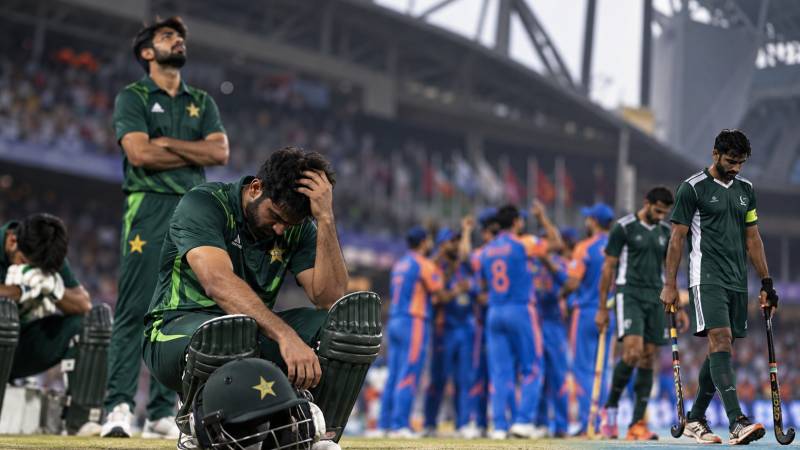
Pakistan’s dismal showing at the 20th Asian Games in Aichi-Nagoya is not an athletic failure; it is a direct indictment of the federal government. Decades of chronic underfunding, direct political interference, and bureaucratic incompetence across state sports bodies have systematically gutted the nation’s athletic pipeline. Rather than fielding battle-hardened, high-performance contingents backed by modern sports science, Pakistan arrived in Japan fundamentally handicapped by the state's ad-hoc planning. Athletes were thrown into continental competition without adequate preparation, leaving them tactically vulnerable, physically unconditioned, and predictably prone to mental collapse when the stakes were highest.
Nowhere was this administrative failure more visible than on the cricket pitch during the men's clash against arch-rivals India at Nisshin. The encounter was effectively lost within the opening half-hour due to baffling squad directives and tactical selections that reeked of sheer state-managed incompetence. Instead of trusting seasoned, frontline performers to establish control and absorb the opening tension, the management rolled out raw, inexperienced bowlers to start the proceedings. It proved to be an absolute disaster.
Unprepared for the blinding glare of an Asian Games rivalry, these young bowlers cracked immediately under the pressure of the occasion. Spraying deliveries indiscriminately on both sides of the wicket without set line-and-length plans, they conceded far too many runs at the very start of the match. India’s top order seized on the wayward bowling, plundering easy boundaries and racking up a mountainous total inside the first powerplay. By the time the state-assembled coaching staff scrambled to introduce damage control, the game had already slipped out of reach. The subsequent batting collapse—characterized by panicked, frantic swipes against spin and an inability to rotate strike—was the natural byproduct of a government sports board that treats match simulations and psychological preparation as unnecessary luxuries.
This identical pattern of state-engineered collapse played out on the hockey turf. Once the powerhouse of international hockey, Pakistan’s national team was crippled long before the opening whistle by endless budgetary standoffs between the Ministry of Inter-Provincial Coordination and the Pakistan Sports Board. Deprived of foreign exposure tours, proper equipment, video analysts, and mental conditioning coaches, the squad looked tactically obsolete against structured opponents.
As long as the state views national sports through the prism of political patronage rather than merit, Pakistan will remain trapped in this degrading cycle: underprepared for battle, sabotaged by amateurish directives, and condemned to crumble under the world’s watchful gaze.
In key matches, leading late into the third and fourth quarters, Pakistan’s players repeatedly froze. Lacking the drilled conditioning necessary to manage the clock, absorb a high press, and defend without committing fouls, the team panicked under sustained pressure. They conceded cheap penalty corners inside the 23-meter line and surrendered winning positions in the dying minutes of critical games. Elite sporting nations spend full Olympic cycles drilling high-leverage defensive scenarios; Pakistan’s players were abandoned by their government to improvise on the fly.
In individual arenas from squash to combat sports—athletes were rushed to Japan off the back of rushed, underfunded training camps convened mere weeks before departure. Stripped of sports nutritionists or psychologists, solitary competitors fought bravely until matches reached the wire. When points lengthened and heart rates spiked, psychological exhaustion inevitably took over. These athletes did not lose due to a lack of patriotism; they lost because the state failed to provide them with the mental resilience that comes solely from scientific conditioning.
Yet, as devastating as these collapses are to millions of sports fans across the country, what transpires off the field is far more infuriating. The federal government and its handpicked bureaucrats remain entirely unfazed by the relentless humiliation Pakistan suffers on the international stage. Defeats that draw ridicule from across the globe do not cause a ripple of concern inside the corridors of power in Islamabad.
In countries with functioning sports ministries, catastrophic showings trigger immediate parliamentary inquiries, sweeping structural dismissals, and an overhaul of the athletic roadmap. In Pakistan, the government’s response is complete, shameless apathy. Officials treat the Asian Games not as a matter of national prestige, but as an all-expenses-paid junket for non-performing bureaucrats and their retinues. No investigations are launched, no accountability is enforced, and not a single minister offers an apology for wasting public funds. As long as the state views national sports through the prism of political patronage rather than merit, Pakistan will remain trapped in this degrading cycle: underprepared for battle, sabotaged by amateurish directives, and condemned to crumble under the world’s watchful gaze.