

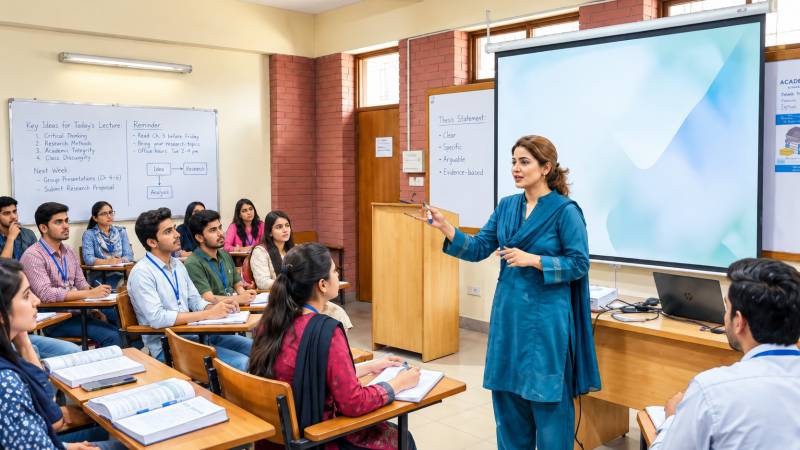
Every year on 5 October, World Teachers’ Day gives societies an opportunity to celebrate those who perform one of civilization’s most consequential tasks: preparing one generation for the world it will inherit from another. But the observance in 2026 carries particular significance. This year marks sixty years since the adoption of the 1966 ILO/UNESCO Recommendation concerning the Status of Teachers, the landmark international framework, that recognized teaching not simply as employment but as a profession requiring proper preparation, dignity, professional freedom, fair working conditions and continuing development. Appropriately, the theme for World Teachers’ Day 2026 is “Standing with teachers: 60 years of protecting the profession, advancing its status and shaping our futures.” It arrives at a moment when teachers everywhere are confronting new pressures produced by artificial intelligence, digital transformation, climate change, migration, social inequality and rapidly changing expectations of education. UNESCO itself notes that these changes affect the symbolic, professional and material status of teachers — whether society values them, whether they are trusted as professionals, and whether their salaries and working environments allow them to perform their responsibilities effectively.
For Pakistan, however, World Teachers’ Day cannot remain merely an occasion for ceremonial speeches, bouquets, social-media tributes and photographs with distinguished educators. The country must use the day to confront a much more difficult question: what status have we actually given the teacher? We routinely describe teaching as a noble profession, yet nobility in rhetoric is not always matched by institutional respect. A teacher may be praised from the podium while simultaneously being burdened by overcrowded classrooms, inadequate laboratories, obsolete teaching materials, administrative duties unrelated to education, insecure appointments and limited opportunities for professional development. At the school level, many teachers serve communities where basic infrastructure remains inadequate. At the university level, faculty members face another set of pressures: uncertain research funding, bureaucratic controls, excessive documentation, promotion anxieties and shrinking institutional autonomy. The contradiction is obvious. We expect teachers to create scientists, engineers, physicians, entrepreneurs and informed citizens, but frequently hesitate to provide the teachers themselves with the intellectual and material environment necessary for that work. Respect cannot survive indefinitely as a slogan. It eventually has to appear in budgets, institutions and behaviour.
Pakistan’s education challenge makes the teacher question particularly urgent. UNICEF currently estimates that 25.1 million Pakistani children between the ages of five and sixteen are out of school, representing about 35 per cent of the national population in this age group. Sindh alone accounts for approximately 7.4 million out-of-school children, around 44 per cent of its school-age population, while Balochistan faces the gravest proportional exclusion, with nearly 69 per cent of children aged five to sixteen outside school. UNESCO’s 2026 assessment similarly places the figure at roughly 25.15 million and stresses that the crisis is not uniform: exclusion varies substantially according to geography, poverty, gender and access. These figures should transform the way Pakistan discusses teachers. The teacher is not simply one employee within a large government apparatus. Teachers stand at the centre of perhaps the largest developmental challenge facing the country. Bringing a child into school is important, but keeping that child there, making education meaningful and ensuring that literacy becomes understanding depend ultimately upon what happens between teacher and student.
Pakistan has often attempted to solve educational problems through visible interventions: new buildings, laptops, tablets, smart boards, curriculum revisions, testing systems and digital platforms. Many of these measures have value. Technology can widen access and improve pedagogy. But no education system has yet discovered a technological substitute for a capable teacher. A smart board in the hands of an unsupported teacher remains merely an expensive board. A sophisticated curriculum without a teacher trained to interpret it remains a document. Artificial intelligence may generate explanations, exercises and assessments within seconds, but it cannot fully perform the human function of recognizing when a frightened child has lost confidence, when an apparently weak student has unusual potential, when curiosity should be encouraged rather than disciplined, or when a classroom requires empathy rather than another examination. Education is partly about information, but teaching is about interpretation, motivation, judgement and human development. The more technology enters the classroom, the more important it becomes to define what only the teacher can provide.
This distinction is particularly important in the age of artificial intelligence. Teachers understandably worry that technology may diminish their authority or even make portions of traditional teaching redundant. The more constructive approach is to recognize that AI will change teaching without eliminating its essential purpose. Routine tasks such as preparing worksheets, translating material, generating examples, organizing lesson plans and providing preliminary feedback can increasingly be assisted by machines. This should release teachers for the activities that matter most: mentoring, discussion, critical reasoning, experimentation, creativity and personal guidance. But that transition will not happen automatically. Teachers must themselves become digitally literate. They require training not only in how to use AI systems but also in recognizing hallucinated information, algorithmic bias, plagiarism, privacy risks and overdependence on automated answers. A country that introduces AI tools to students without preparing teachers risks creating technological confusion rather than educational transformation. Pakistan therefore needs a national programme of continuous teacher development in digital and AI literacy, adapted separately for primary schools, secondary schools, colleges and universities.
Teacher accountability is necessary, but accountability without institutional responsibility becomes scapegoating. Teachers cannot be held solely responsible for learning outcomes when poverty, inadequate facilities and unequal opportunities shape what happens inside the classroom.
Money inevitably enters this discussion. Pakistan’s education expenditure remains extremely constrained. The Pakistan Economic Survey 2025–26 reports education expenditure of approximately Rs962 billion in FY2025, equivalent to only 0.8 per cent of GDP. It also records provincial development allocations for school education and a revised Higher Education Commission development allocation of Rs34.9 billion for 147 public-sector university and institutional projects. UNICEF notes that Pakistan’s expenditure level remains well below the commonly cited 4–6 per cent of GDP benchmark associated with international education commitments. No education system can sustainably raise teacher quality while simultaneously starving schools, colleges and universities of resources. Yet the answer is not simply to increase expenditure without reform. Money must reach classrooms, laboratories, libraries, teacher development and disadvantaged districts.
A child may attend a private school with air-conditioned classrooms, science laboratories, language teachers, counselling services and digital resources, while another child a few kilometers away attends a government school struggling with basic facilities. Teachers in the latter environment are often expected to produce comparable outcomes under completely incomparable circumstances. Pakistan therefore has not one education system but several overlapping systems divided by income, geography and institutional privilege. The teacher frequently becomes the individual upon whom society places responsibility for inequalities created far beyond the classroom. It is unreasonable to hold a teacher solely responsible for learning outcomes when children arrive hungry, schools lack resources, absenteeism is driven by poverty, and families may need children to work. Teacher accountability is necessary, but accountability without institutional responsibility becomes scapegoating.
At the same time, teachers themselves must accept that professional status brings professional obligations. Standing with teachers should never mean defending absenteeism, poor preparation, resistance to assessment or disregard for students. A respected profession must also be an accountable profession. Doctors, engineers, pilots and researchers are expected to update their knowledge because their disciplines evolve; teachers should be no different. A science teacher cannot continue teaching concepts exactly as they were taught thirty years earlier while science has moved forward. A university professor cannot insist upon academic freedom while neglecting lectures, supervision or research ethics. Respect must operate in both directions. Institutions must respect teachers, and teachers must respect the intellectual rights of students. Protecting the profession should therefore mean protecting good teaching, professional autonomy and due process while creating credible mechanisms for addressing persistent non-performance.
Universities deserve special attention because teaching at the higher-education level occupies a distinctive position. UNESCO’s 1997 Recommendation concerning the Status of Higher-Education Teaching Personnel expanded the principles applied to teachers by emphasizing academic freedom, institutional autonomy, professional responsibilities and appropriate employment conditions. Pakistani universities frequently discuss international rankings, research publications and innovation, but these ambitions remain inseparable from the quality of university teachers. Universities cannot become globally competitive through buildings, advertisements or rankings strategies alone. They become stronger when competent academics are recruited transparently, young faculty are mentored, research grants are accessible, laboratories function, promotion systems reward genuine scholarship and faculty members are able to question established ideas without fearing institutional retaliation. The university teacher must be able to tell a student, “I do not know — let us investigate,” because those six words often represent the beginning of research.
Pakistan also needs to rethink the relationship between teachers and public policy. Educational policies are too often designed above the classroom and then delivered downward for implementation. Yet teachers are among the people best placed to explain why reforms succeed or fail. They know which textbooks confuse students, which assessments encourage memorization, which administrative requirements consume teaching time and which technologies actually help learning. UNESCO’s 2026 theme explicitly draws attention to teachers’ professional status, including their autonomy and their voice in policy-making. Pakistan should institutionalize teacher participation in curriculum review, assessment reform, digital education policy and professional standards rather than consulting teachers only after major decisions have already been made.
Climate change adds another dimension. Pakistani teachers now educate children who will live through increasing heat, water stress, floods and environmental disruption. The catastrophic floods of recent years demonstrated that schools are not isolated from climate vulnerability; they may close, become damaged, serve as emergency shelters or lose students displaced from their communities. Teachers therefore need preparation in climate literacy, disaster awareness and educational continuity during emergencies. The modern Pakistani teacher must increasingly be not only a subject specialist but also a mediator of scientific literacy, health information, digital knowledge, civic responsibility and environmental understanding. The role has expanded while professional support has often failed to keep pace.
World Teachers’ Day 2026 therefore offers Pakistan an opportunity to reconsider a simple but fundamental proposition: there can be no educational reform without the teacher. We may redesign curricula, introduce artificial intelligence, construct schools, distribute devices, establish universities and announce education emergencies, but every reform eventually arrives at the same destination — the classroom. There, one person must convert policy into learning. If that person is knowledgeable, motivated, respected and supported, even modest facilities can sometimes produce remarkable outcomes. If that person is demoralized, poorly prepared or institutionally neglected, expensive reforms may achieve surprisingly little.
Sixty years after the international community adopted the Recommendation concerning the Status of Teachers, the message of this year’s theme is therefore especially relevant to Pakistan. Standing with teachers should not mean standing beside them only on 5 October. It should mean protecting the dignity of the profession, improving recruitment, strengthening teacher education, ensuring continuing professional development, providing workable classrooms and laboratories, allowing professional autonomy, demanding accountability and giving teachers a meaningful voice in educational reform. Above all, it requires recognizing that the future of Pakistan is being shaped every morning in thousands of classrooms, from small village schools to major universities. A nation that genuinely values its future must value the people entrusted with preparing it. Pakistan cannot raise the status of education without raising the status of the teacher, and it cannot build the Pakistan of tomorrow while neglecting the teachers of today.