

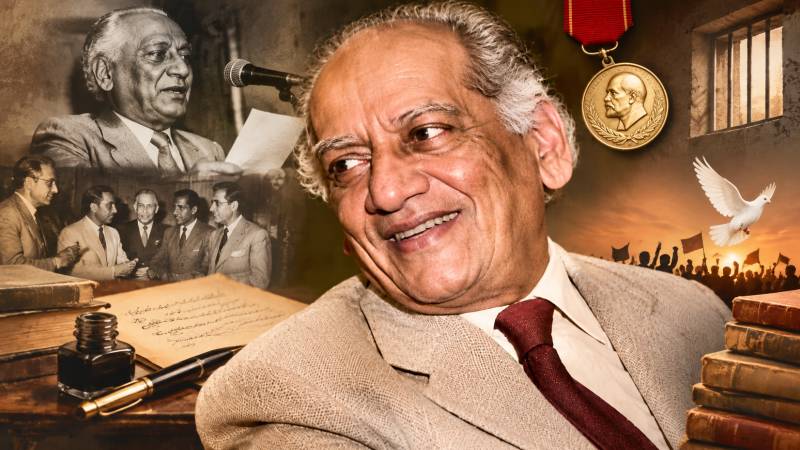
Faiz Ahmad Faiz, the great poet, human rights activist, trade unionist, journalist, thinker and revolutionary, belonged to a twentieth-century pantheon of literary figures that included the likes of Pablo Neruda, Nazim Hikmet and Mahmoud Darwish. All of them were actively associated with the Afro-Asian Writers' Association. Faiz also served as editor of its prestigious magazine, Lotus. Very few people know that Faiz, Nazim Hikmet, Mahmoud Darwish and Pablo Neruda were ideologically close, and that their works bear remarkable similarities. Their message was universal: the pursuit of peace and justice for humanity at large.
Pablo Neruda (1904–1973) and Faiz Ahmad Faiz (1910–1984), contemporary poets, friends and outstanding humanists, left a lasting impression on world literature. Their works received global recognition. Neruda was awarded the Nobel Prize in Literature in 1971, while Faiz received the Lenin Peace Prize in 1962. Both Neruda and Faiz, like many others, notably Nazim Hikmet and Mahmoud Darwish, were essentially humanists, anti-colonialists and anti-imperialists. Their struggles and literary works were deeply intertwined and inseparable. Their writing complemented their political struggles, just as their struggles informed their literary contributions.
Faiz Ahmad Faiz was born in Sialkot, in Punjab, which was then part of British India. He belonged to a well-to-do landowning family. His father was a prominent lawyer with a keen interest in literature. His circle of friends included several distinguished literary figures, among them Muhammad Iqbal (1873–1938), the national poet of Pakistan. Faiz received his early education at missionary schools in Sialkot, where he studied in English. He also learned Urdu, Persian and Arabic. He subsequently studied English and Arabic literature at Government College, Lahore, earning an MA in English in 1932. He also pursued studies in Arabic at Oriental College, Lahore. Beyond his formal education, Faiz actively participated in literary circles, attending gatherings held at the homes of established writers. After graduating, he worked as a teacher in Amritsar and Lahore from the mid-1930s onwards.
In the 1930s, Faiz joined the renowned left-wing Progressive Writers' Movement, led by Sajjad Zaheer (1905–1973). During the Second World War, Faiz served in the Indian Army in Delhi and was promoted to the rank of lieutenant colonel in 1944. Following the Partition of the subcontinent in 1947, Faiz resigned from the army and moved to Pakistan with his family. He had married Alys Faiz in 1941. Alys, who died in 2003, later published her memoir, Over My Shoulder (1993).
In Pakistan, Faiz became the editor of the English-language daily Pakistan Times. He also served as managing editor of the Urdu daily Imroze and remained actively involved in organising trade unions. In 1951, Faiz and several army officers were implicated in the so-called Rawalpindi Conspiracy Case and arrested under the Safety Act. Government authorities alleged that Faiz and the others were involved in plotting a coup d'état. He spent four years in prison, facing a death sentence, before being released in 1955. Following his release, Faiz became secretary of the National Council of the Arts. In 1962, he was awarded the Lenin Peace Prize by the Soviet Union.
Following General Zia-ul-Haq's military takeover on 5 July 1977, Faiz once again found himself in difficulty and was forced into exile. He spent the period between 1979 and 1982 in war-torn Lebanon before returning to Pakistan. He died in Lahore on 20 November 1984. Faiz's early poetry collections, Naqsh-e Faryadi (1943), Dast-e Saba (1952) and Zindan Nama (1956), reflect his experiences of imprisonment. In his poetry, Faiz describes life behind prison walls and the experience of confinement, finding consolation in the thought that "though tyrants may command that lamps be smashed / in rooms where lovers are destined to meet / they cannot snuff out the moon..."
A revolutionary who never indulged in slogan-mongering, Faiz combined classical authenticity with modern sensibility to build a lasting tradition of resistance in literature.
Faiz was a prolific writer whose contributions to poetry and prose remain immense. In Culture and Identity: Selected English Writings of Faiz, Sheema Majeed and Mohammad Reza Kazimi have brought together a valuable selection of his writings. Faiz's poetry is musical, lyrical and inspiring. It is rooted in the desire to make his homeland, and the world at large, a better place for the downtrodden and the "wretched of the earth", a phrase famously coined by Frantz Fanon.
What makes Faiz remarkable is that, despite the overwhelming influence of revolutionary ideas on his work, he never allowed ideological convictions to burden his poetry with crude rhetoric. He was a master of literary art and craftsmanship, a quality often lacking in many revolutionary poets of his time. Faiz's legacy is universal and enduring. For nearly six decades, he gave inimitable expression to the suffering of his people, the agony of dispossession and the experience of exile.
Faiz participated in the prolonged struggle for freedom, both during the colonial period and in the post-independence era. His poetry embodies a message of hope and a commitment to creating a truly democratic polity in which exploitative forces have no place. He dreamed of a world in which human beings could live in peace and tranquillity. He was truly a messenger of peace, equality and justice, and his commitment to these ideals remained unwavering. His poetry reflects the aspirations of the masses.
From a literary perspective, Faiz was a poet par excellence and a revolutionary who never indulged in empty sloganeering. His work combines classical authenticity with modern sensibility. Even his critics regard him as a master of poetic expression and an influential architect of a new tradition of resistance in literature.
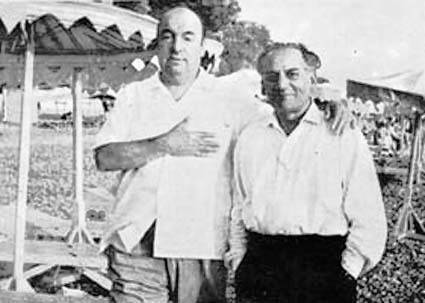
Pablo Neruda and Faiz Ahmad Faiz: A rare photograph of two great literary luminaries.
In the post-independence period and throughout the Cold War, Faiz continued to struggle against an oligarchy of the rich and powerful. This ruling elite, nurtured by the colonial masters, had captured political power while denying ordinary people their rightful place in society. The same situation, in many ways, persists even today. Faiz used poetry as a means of resistance against the colonial and post-colonial legacies of control, exploitation and the denial of basic rights to the masses.
Faiz was an active participant in the broader struggle for social and political change, rather than an idealist poet who remained on the sidelines, merely criticising others. This distinguished him from many of his contemporaries, who believed in "art for art's sake" and sided with the rulers of the day, either through their silence or their inaction. This was also why the eminent thinker of our time, Professor Edward W. Said, admired Faiz for his courage and resilience.