

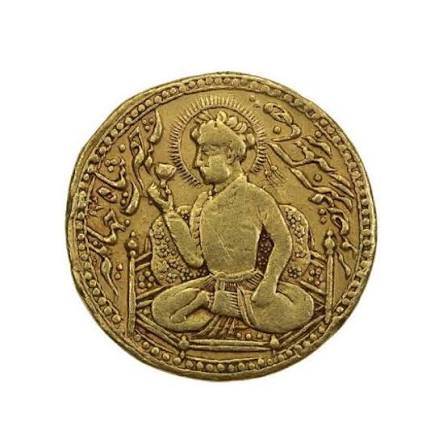
In 1611, the ruler of the wealthiest empire on earth minted a gold coin that shocked the Islamic world. The coin had a portrait in profile: the Mughal Emperor Jahangir, sitting cross-legged, holding a wine goblet to his face.
For a Muslim sovereign ruling over a vast, diverse population in the South Asian subcontinent, publicly flaunting the consumption of alcohol was an audacious move. But Jahangir, or the "Conqueror of the World," was not a man who hid his vices. In his wildly candid memoirs, the Jahangirnama, he documented his daily intake of alcohol and opium like a pharmacist would, noting exactly how many cups of double-distilled spirits he required just to face the day!
His dependence on alcohol drove him to commission some of the most spectacular objects ever created by human hands. If you are going to drink yourself into oblivion while ruling the world, you do not do it from a wooden mug. You do it from vessels that project absolute power. For Jahangir, the wine cup became the primary canvas for Mughal lapidary arts. Any of his cups was a handheld masterpiece where geopolitics, unimaginable wealth, and human frailty collided.
The Mughals were descendants of the Timurids, a Perso-Turkic dynasty from the steppes of Central Asia. In that nomadic cultural tradition, the wine cup was far more than a drinking vessel; it was a political tool. A sovereign sitting on a throne of state with a goblet in hand was the visual shorthand for victory and dominion. When Jahangir hosted a courtly gathering, the distribution of wine to his favourite nobles was a carefully choreographed performance of hierarchy. The cup acted as a liquid sceptre.
But Jahangir’s daily concoction required a serious vessel. He wasn't just drinking fermented grape juice. His preferred drink was a cocktail of potent, distilled spirits heavily laced with opium. He drank to numb the crushing pressures of imperial governance, to soothe the sting of his own sons' constant rebellions, and to chase a fleeting sense of spiritual ecstasy.
For this, he turned to a material that came to define his reign: nephrite jade.
Before one of these cups ever touched the emperor’s lips, its physical journey began thousands of miles away. True jade was sourced from the freezing riverbeds of Khotan and Kashgar, located in the shadow of the Kunlun Mountains in what is now China's Xinjiang province. Boulders of the raw stone were hauled across the treacherous routes of the Silk Road, until they reached northern India, carried on the backs of pack animals.
Jahangir preferred jade over almost everything else, at times valuing the smooth, cold stone higher than gold or diamonds. Highly polished jade has a waxy surface that warms to the touch and feels incredibly heavy in the hand. Beyond its physical beauty, which ranged in colour from a translucent, milky white to a brooding spinach green, jade was believed to hold immense practical power.
It was widely believed that a jade cup would detect poison: either by cracking down the middle, changing colour, or breaking out in a sudden cold sweat
The Mughal court was an arena of astonishing artistic beauty, but it was also a snake pit of paranoia. Fathers routinely blinded ambitious sons; brothers waged scorched-earth wars of succession against one another. The threat of a poisoned drink was a daily occupational hazard of ruling the empire. According to ancient Turkic and Persian lore, jade was the ultimate defence mechanism. It was widely believed that a jade cup would detect poison: either by cracking down the middle, changing colour, or breaking out in a sudden cold sweat. Jahangir’s beautiful cups were, in a very real sense, his armour.
Transforming a raw boulder from the Silk Road into an imperial wine cup required a level of craftsmanship that borders on the incomprehensible today. Jade cannot be carved with a metal knife. The interlocking molecular structure of nephrite makes it tougher than steel. It has to be ground. The imperial craftsmen in Jahangir’s royal workshops had to use abrasive pastes made of quartz sand or crushed garnets, slowly and agonizingly grinding away the stone using bow drills and spinning wooden wheels.
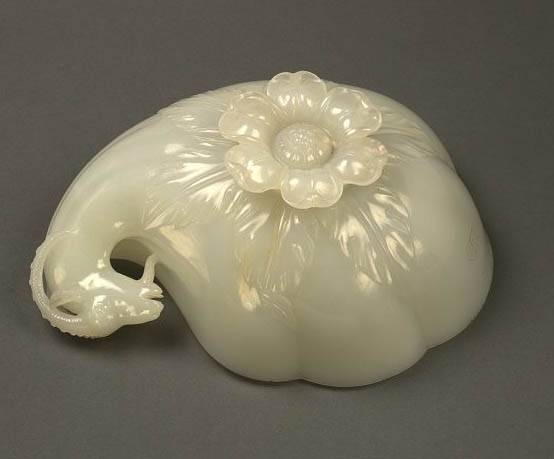
It was a process of friction, not cutting. A single slip of the drill could ruin months of labour. A single cup could take a team of artisans a year to hollow out. Yet, out of this intensely abrasive process, master jewellers like Sa’ida-ye Gilani—an Iranian craftsman who caught Jahangir's eye and was promoted to head the imperial workshops—produced objects that looked as though they had been effortlessly shaped from soft wax. The walls of some cups were ground down so thin that they became translucent, allowing the ambient light of the court to glow through the dark stone.
The design of these vessels was a direct collision of global cultures, reflecting the cosmopolitan reality of Jahangir's court in Agra and Lahore. The basic shapes often imitated the cast-brass and metalware vessels of their Central Asian ancestors—gourd shapes with globular bodies. Layered over these traditional forms was a distinctively Indian love for the natural world. The bases of the cups were frequently fashioned to look like blooming lotus flowers, while the handles were carved into the incredibly lifelike heads of rams, ibexes, or antelopes.
The fusion extended beyond Asia. Jahangir was a man of insatiable curiosity. His court welcomed European Jesuits, English merchants, and French jewellers. Elements of European Renaissance design occasionally crept into the workshops, mixing with Hindu floral creepers and Islamic geometry.
We know exactly what these drinking sessions looked like because foreign observers wrote them down. In 1615, King James I sent an English diplomat named Sir Thomas Roe to secure trading rights in India. Roe spent years tracking the traveling Mughal court. He hated the dust, the heat, and the endless waiting, but he left an incredibly detailed record of the emperor's drinking habits.
Roe’s diaries depict a monarch dripping in diamonds and pearls, surrounded by wealthy courtiers, slowly drinking himself into a stupor as the night wore on. Roe described Jahangir drinking a heavily spiced, distilled spirit that the Englishman claimed would make a normal man's throat bleed. He watched the emperor become generous, then maudlin, weeping over the state of the world, before finally passing out. At that point, the courtiers would snuff the candles and silently slip away in the dark.
But Roe also noted the sophistication of the environment. This was not a barbaric free-for-all; it was a highly refined ritual, wrapped in poetry.
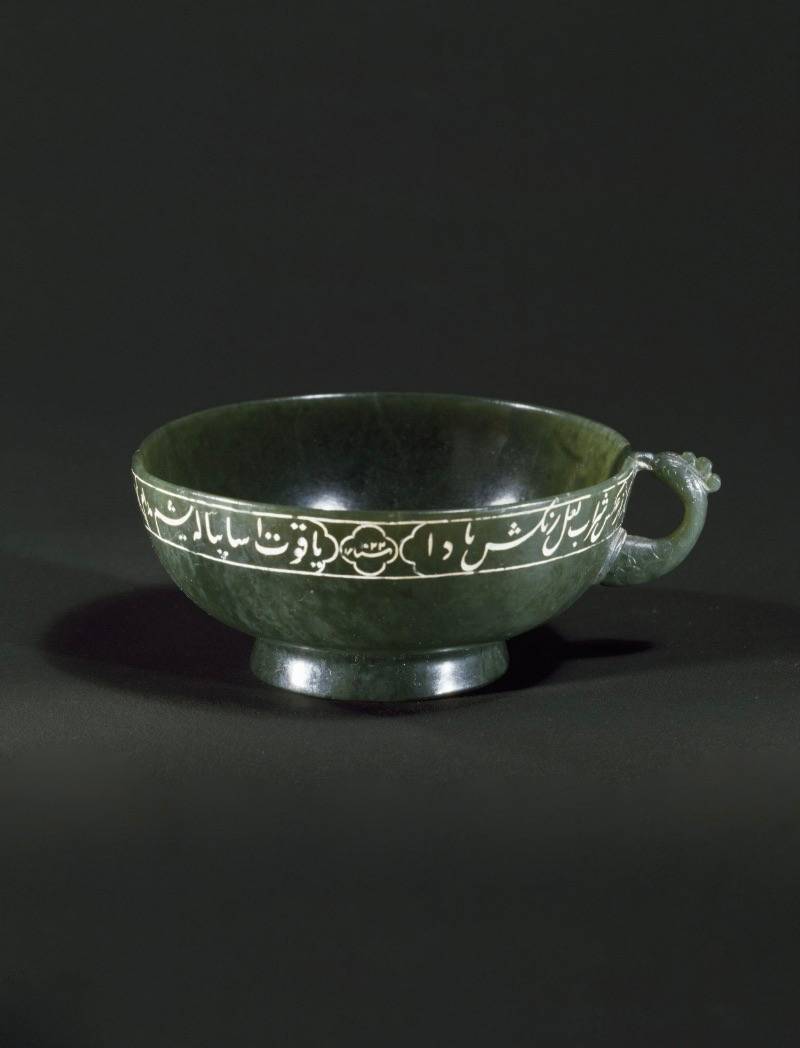
The cups themselves were not silent. Around the lip or the neck of the vessel, master calligraphers engraved verses in elegant Persian script. Sometimes these were lines composed by the emperor himself, who was an undeniable literary talent. More often, they were lines from the great Sufi poets like Hafiz.
One famous verse engraved on his surviving cups reads: "Cup-bearer, brighten our goblet with the light of wine! Sing, minstrel, for the world is working as we desire."
This poetry added a complicated, mystical layer to Jahangir’s addiction. In Sufi philosophy, wine is a powerful metaphor for divine love, and inebriation is a symbol of ecstatic union with God. The tavern is the mosque; the cup-bearer is the divine guide. Jahangir operated in the grey area where this spiritual metaphor and his physical reality blurred. By engraving Sufi poetry onto his jade cups, he wrapped his very real, very physical addiction in the respectable cloak of mysticism.
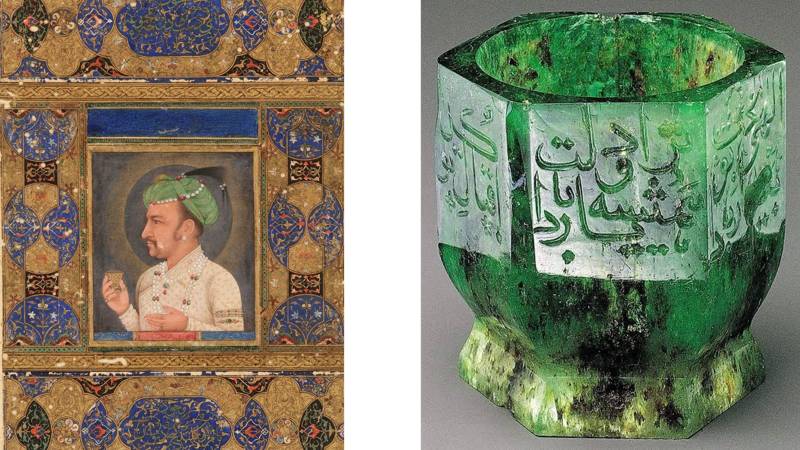
Several of these masterworks survive as physical witnesses to his reign. There is a dark green nephrite cup now held in the British Museum, dated around 1618. Its base is carved in the shape of a blooming flower, a quiet nod to the emperor's obsession with botany. Another famous piece, crafted from quartz and chromium muscovite, resides in the RISD Museum in Rhode Island. But perhaps the most evocative is a 1613 white jade cup in the Victoria & Albert Museum in London, bearing Jahangir’s name and verses explicitly alluding to his beloved wine.
Jahangir’s health deteriorated rapidly. His hands, which once steadily held the heavy jade goblets, began to tremble so violently that he could no longer drink without spilling the dark liquid down the front of his silk robes. He was eventually forced to have his servants hold the cups to his lips for him. As his physical body failed, the daily governance of the empire slipped from his shaking fingers. It transferred into the highly capable hands of his formidable wife, Empress Nur Jahan, who began to issue orders and even mint coins in her own name, an unprecedented act for a Mughal empress.
The very objects he commissioned to detect poison were filled with the poisons he willingly swallowed every day. He died in 1627 while traveling from the cool mountains of Kashmir back to Lahore, his body completely shattered by his indulgences. His son, Shah Jahan, would take the throne and commission his own extraordinary jade vessels, but he was a more orthodox, sober ruler, and his cups were meant for water.
Jahangir’s wine cups were eventually scattered, heavily looted during the violent plundering of South Asia by the British East India Company in the 18th and 19th centuries. They were shipped across oceans, reduced to spoils of war and colonial curiosities for Western collectors.
They represent a man who possessed all the wealth in the world but could not buy peace of mind.