

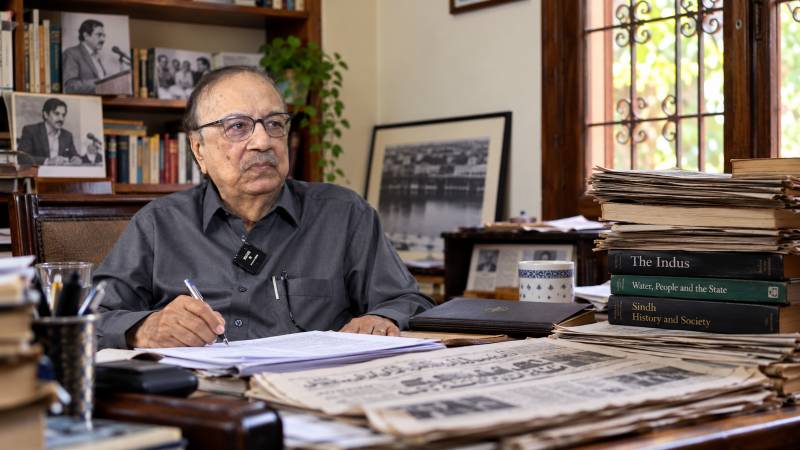
The circumstances of respected veteran journalist Ghulam Nabi Mughal Sahib, now in his eighties in Hyderabad, have exposed a deepening structural crisis in Pakistani media. A former editor and bureau chief linked to The Frontier Post, a long-standing columnist for Daily Jang, and a principled advocate for Sindh’s lower-riparian rights against the Kalabagh Dam and upstream diversions, Mughal Sahib was recently forced to appeal to the Sindh government for medical and financial help. Afflicted by chronic prostate disease, severe hernia and heart complications, he could not afford treatment after more than five decades of dedicated public-interest work. Recent incidents, including a robbery (in 2021) at his residence that prompted the Chief Minister to inquire about his health and direct assistance, and an earlier assault condemned by the Pakistan Federal Union of Journalists, have only underscored the vulnerability that now surrounds him.
His situation is not a personal failing. It is the predictable result of a media industry that has separated professional labour from institutional security. While proprietors have converted cross-media holdings into political leverage and commercial advantage, journalists of Mughal Sahib’s integrity; those who have refused to trade principle for private gain, reach old age without pensions, commutation, gratuity or reliable medical cover. The quiet dignity with which he has continued writing on Sindh’s history, federal inequities and the Indus makes the absence of any automatic safety net all the more stark.
Born in March 1944, Mughal Sahib entered journalism during eras of authoritarian rule. His family business of goldsmith would have given him riches, but he preferred committed journalism as his career. He anchored his career in provincial equity, constitutional federalism and the ecology of the Indus, rather than seeking patronage. Through his columns he challenged executive overreach with evidence and restraint. In the early 1990s, under Sindh Chief Minister Jam Sadiq Ali, he faced pressure and threats for reporting state abuses, yet continued with dignity. He has also chronicled the history of press resistance from the 1970s and 1980s onward, preserving a record that younger journalists now rarely encounter in commercial newsrooms.
His most lasting contribution concerns water. Treating the Indus as the biological and economic foundation of Sindh, he argued that projects such as Kalabagh and the Greater Thal Canal violated historical riparian understandings, including the spirit of the 1945 Sindh-Punjab Draft Agreement, and bypassed the 1991 Water Apportionment Accord. He documented how reduced flows below Kotri Barrage accelerated seawater intrusion across Thatta, Badin and Sujawal, destroying farmland, mangroves and coastal fishing livelihoods. By linking hydrology, environmental evidence and constitutional rights, he helped inform regional resistance to mega-projects that favoured upstream interests. Because this advocacy challenged powerful centres without generating patronage, it left him unprotected against later medical costs.
The wider cause lies in the transformation of media ownership. From independence through the late twentieth century, newspapers were largely mission-driven, led by editors who treated journalism as a public trust. That model eroded after the PEMRA Ordinance of 2002 opened private 24-hour television. Industrialists with holdings in textiles, real estate, banking and sugar entered the sector. In the resulting “Seth” culture, channels and newspapers often serve as strategic corporate assets to influence regulation, secure advertising and shield core businesses. Resources flow to high-profile talk-show hosts, while field reporters, regional correspondents and long-form writers face wage freezes, salary delays and short-term contracts. Unionisation has weakened. Veterans who, like Mughal Sahib, worked under earlier standards of public service become liabilities without terminal benefits.
Statutory protections have failed to prevent this. The Newspaper Employees (Conditions of Service) Act of 1973 established Wage Boards, required permanent appointments for core editorial work, and mandated provident funds, gratuity and medical cover, with an Implementation Tribunal to enforce compliance. Media houses challenged awards in court and replaced permanent posts with third-party contracts, stripping rights from most journalists. Delays exhausted aging claimants. Electronic media was left outside this framework under the PEMRA Ordinance, governed only by general commercial laws with no specialised pensions or medical guarantees. Regulation focused on licensing rather than labour standards.
Pakistan has relied on discretionary executive relief rather than rights-based insurance. Journalists in crisis must make public appeals, turning entitlement into patronage. Several Indian states have codified monthly pensions for accredited veterans alongside cashless health coverage. European models use tripartite contributory funds linked to professional status. Pakistan’s 2021 federal and Sindh protection laws prioritise physical safety against violence and harassment; necessary given the country’s press-freedom ranking, yet treat economic precarity as secondary. Commissions have faced delays in funding and rules. Existing welfare remains discretionary; there is no automatic pension or medical right based on verified years of service. When journalists of Mughal Sahib’s stature depend on the goodwill of those they scrutinise, autonomy is compromised.
Reform requires an enforceable architecture: a Unified Media Employment Code covering print, broadcast and digital journalists and restricting exploitative contracts; an earmarked cess on advertising to fund an independent tripartite trust; a statutory pension and commutation scheme for accredited practitioners aged sixty and above with minimum verified service, including survivor benefits; and media health cards guaranteeing cashless cover for major age-related care. These steps would end public appeals and restore dignity.
Mughal Sahib’s case is an indictment of institutional priorities. A journalist who, with humility and rigour, defended provincial water rights, documented ecological damage and resisted authoritarian pressure now faces severe illness without support. When conglomerates profit while treating the labour that builds their credibility as disposable, public-interest journalism erodes. Younger reporters watching a lifetime of principle end in abandonment have little incentive for critical work. Providing pensions, commutation and medical cover is not benevolence but a democratic obligation. A society that fails to honour its public-interest writers in old age weakens the accountability on which its institutions depend. Mughal Sahib’s lifelong service deserves structural dignity, not merely sympathy.