

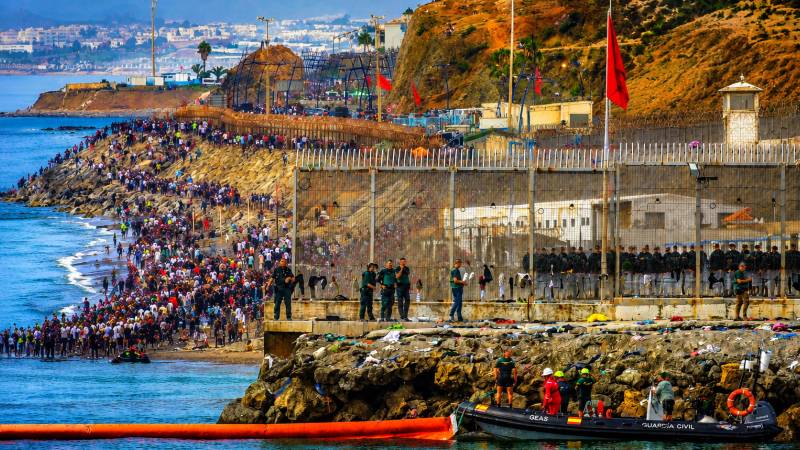
The extraordinary migration crisis that overwhelmed Ceuta in late July 2026 should not be viewed merely as another episode of irregular migration at Europe’s southern frontier. It was simultaneously a humanitarian tragedy, a border-security emergency, a test of European solidarity and, inevitably, a geopolitical event. Most importantly, it raises an uncomfortable question: is Spain becoming increasingly vulnerable because it has chosen to pursue an independent foreign policy, particularly over Gaza, Israel and the wider Middle East?
The scale of the Ceuta crisis was remarkable. Spanish authorities ultimately put the number of people who entered the territory during the influx at around 70,000, although Moroccan authorities offered a substantially lower estimate. Most subsequently returned to Morocco, but thousands remained, including a large number of unaccompanied minors. Ceuta’s reception facilities were overwhelmed, and its local leadership later estimated that around 100 people had died during the border rush. For a city with a population of only around 85,000, the sudden arrival of tens of thousands of people was not an ordinary migration challenge. It was an institutional shock. Yet numbers alone do not explain what happened.
The sudden movement of such a large number of people towards Ceuta can be explained, at least in part, by a combination of economic frustration, social desperation and rapidly circulating misinformation. Among Moroccan youth, unemployment and underemployment have created a deep sense of stagnation, particularly among those who see few realistic opportunities for upward mobility at home. For many, Europe represents more than higher wages; it symbolizes escape from uncertainty, limited prospects and a future that appears increasingly closed.
Social media appears to have amplified misleading interpretations of a Spanish Supreme Court ruling concerning migrants intercepted at sea while attempting to reach Ceuta and Melilla. The ruling placed limits on immediate returns in certain legal circumstances, but it did not create a general right to remain in Spain. Online discussion, however, often stripped away these legal distinctions and reduced the message to something far simpler: if one could reach Spanish territory, there might be a realistic chance of staying. For young people already inclined to migrate, that perception could transform frustration into immediate action.
It is therefore entirely plausible that economic pressure, digital misinformation, peer influence and the apparent availability of an opportunity combined to produce a sudden mass movement without any centrally organized plan. Yet this explanation should not end the discussion. Ceuta has previously been affected by periods in which migration flows coincided with serious political tensions between Spain and Morocco, most notably in 2021. That precedent makes it difficult to treat the 2026 episode as purely spontaneous. The challenge is to distinguish between well-established social causes and the wider political context, which may have influenced how effectively the movement was contained.
Spain faced a similar crisis in May 2021, when around 10,000 people crossed from Morocco into Ceuta amid a diplomatic dispute over Spain’s decision to provide medical treatment to Brahim Ghali, leader of the Polisario Front, which seeks independence for Western Sahara. As tensions rose, Moroccan border enforcement appeared to weaken sharply, prompting Spain’s defence minister to describe the episode as “blackmail.” The incident demonstrated how migration flows could become a form of geopolitical leverage, with reduced border enforcement alone capable of placing enormous pressure on a neighboring country.
That precedent inevitably influences interpretations of the 2026 crisis, although Morocco denies deliberately engineering the latest influx and important differences exist between the two episodes. Recent developments—including Prime Minister Pedro Sánchez’s visit to Algeria, Morocco’s regional rival, and Spanish parliamentary moves concerning nationality rights for descendants of Sahrawis provide more immediate sources of tension between Madrid and Rabat. While these factors may offer a more direct explanation than Spain’s position on Gaza, the 2021 experience makes it reasonable to examine whether wider political considerations again affected border enforcement.
Under Pedro Sánchez, Spain has emerged as one of Europe’s strongest critics of Israel’s conduct in Gaza, moving beyond diplomatic criticism to concrete policy measures. Madrid has restricted military cooperation with Israel, pursued a broader arms embargo, opposed military-related shipments using Spanish infrastructure, and taken measures against products originating from illegal Israeli settlements. These actions have contributed to a serious deterioration in Spanish-Israeli relations and reflect a deeper disagreement over Gaza, international humanitarian law and Europe’s responsibilities in the conflict.
Spain has also extended this position to the defence of international judicial institutions. In May 2026, Sánchez urged the European Commission to consider using the EU’s Blocking Statute against US sanctions targeting the International Criminal Court in connection with its actions concerning Israel. Madrid’s argument was essentially that European institutions should not permit external political pressure to undermine an international court.
Spain’s position, therefore, extends beyond support for the Palestinian cause. It raises a broader question about the credibility of international law: powerful states cannot reasonably defend international courts when they investigate adversaries while attempting to weaken those same institutions when scrutiny turns towards their allies. Spain’s position deserves attention because it highlights a basic principle of international relations: alliance membership does not eliminate national sovereignty. Spain is a NATO member, a close partner of the United States and part of Europe’s security architecture, but democratic alliances should rest on consultation and shared interests rather than automatic conformity. If every member were expected to endorse every major American military decision, the distinction between alliance and hierarchy would become increasingly blurred.
The sudden movement of such a large number of people towards Ceuta can be explained, at least in part, by a combination of economic frustration, social desperation and rapidly circulating misinformation.
Madrid made this point particularly clear in 2026 by opposing the US-Israeli military campaign against Iran, arguing that NATO membership did not oblige Spain to support actions it considered inconsistent with international law. The disagreement contributed to a deeper diplomatic rupture with Israel, including the permanent withdrawal of the Spanish ambassador.
Spain’s interpretation can certainly be challenged, whether on legal, strategic or security grounds. But disagreement with Madrid does not negate its right to exercise independent judgement. That ability to differ from allies, while remaining within the alliance, is itself an essential expression of sovereignty. One possible interpretation is that the Ceuta crisis unfolded within a geopolitical environment unusually unfavourable to Spain. Morocco’s ties with both Washington and Tel Aviv have deepened, while Madrid has taken increasingly independent positions on Gaza, Israel and international law. That coincidence naturally invites speculation about whether Spain’s diplomatic choices made it more vulnerable to indirect pressure. There is, however, no public evidence proving that the United States or Israel encouraged Morocco to ease border controls, and Spain itself has not made such an accusation. The possibility therefore remains in the realm of inference rather than fact. Yet because states often exercise influence through signals, strategic silence, selective cooperation or converging interests rather than explicit instructions, the question cannot be closed entirely. Whether Ceuta was simply the product of migration pressures and Spanish-Moroccan tensions, or whether a wider geopolitical calculation also played some role, remains unresolved.
Supporting Spain’s position on Palestine does not require accepting uncontrolled migration into Spanish territory, just as sympathy for migrants does not require denying Spain the right to protect its borders. These principles are not contradictory. Many of those attempting to enter Ceuta are young people driven by unemployment, poverty, insecurity and the hope of a better future, while others may have legitimate claims to international protection. Unaccompanied minors in particular are entitled to additional safeguards under Spanish and international law. Spain therefore has clear humanitarian and legal responsibilities towards people who reach its jurisdiction. But those responsibilities do not eliminate the equally legitimate duty of the Spanish state to protect public order, maintain control of its frontier and safeguard the interests of its own citizens.
The scale of the 2026 influx made this balance especially difficult. A city of roughly 85,000 people cannot absorb tens of thousands of irregular arrivals within a matter of days without severe pressure on housing, policing, healthcare, social services and local administration. Spain’s response reflected this tension: many adult migrants were returned, while unaccompanied minors were processed separately under stricter legal protections, with overcrowding eventually requiring transfers to mainland Spain. This was neither a simple open-border approach nor an indiscriminate closure. Rather, it represented an imperfect attempt to reconcile sovereignty with humanitarian obligation. Border enforcement should therefore not automatically be equated with xenophobia. A democratic state can insist on controlling its territory while still treating migrants with dignity, protecting vulnerable people and respecting the rule of law.
If migration is deliberately used as a tool of political pressure, the issue becomes not only strategic but deeply moral: migrants, refugees and desperate young people cannot be treated as bargaining instruments between states. Europe’s increasing reliance on neighbouring countries to control migration may offer short-term operational benefits, but it also creates a serious dependency. The Ceuta crisis exposed this vulnerability clearly: if the security of Europe’s external borders ultimately depends on the cooperation or political mood of non-EU governments, then European strategic autonomy remains incomplete. Ceuta should therefore be seen not simply as a Spanish border problem, but as a broader warning that Europe must strengthen its own capacity to manage migration without allowing vulnerable human beings to become instruments of geopolitical pressure.
Spain’s stance on Palestine is significant because it has shown a degree of consistency between principle and policy that is increasingly uncommon in international affairs. Governments often speak in favour of human rights, international law and civilian protection when doing so carries little political or economic cost. The more difficult test comes when those principles strain alliances, provoke diplomatic retaliation or create strategic discomfort. Spain has nevertheless continued to defend the view that Palestinian civilian lives cannot be treated as less valuable than Israeli lives, that allegations of serious violations of international humanitarian law must be investigated, and that institutions such as the International Criminal Court must be allowed to function without selective political interference. This position has already carried consequences: relations with Israel have deteriorated, Madrid’s defence of the ICC has brought it into tension with Washington, and Spain has at times found itself apart from the positions of other major European governments. The importance of Spain’s approach lies precisely in these distinctions.
Maintaining an alliance with the United States does not oblige Spain to support every American military intervention, and NATO membership should not amount to the surrender of independent foreign-policy judgement. Madrid has insisted that alliances must coexist with legal accountability, national sovereignty and moral consistency. Whether one agrees with every Spanish decision or not, the underlying principle is defensible: international law cannot retain credibility if its application depends on the identity or strategic importance of the state involved. In that sense, Spain’s position on Palestine is not simply a regional policy choice; it is also a test of whether European governments are prepared to uphold the principles they frequently invoke when doing so becomes politically costly.
The deeper test arising from Ceuta may ultimately be a European one: whether the European Union truly possesses the strategic autonomy it so often invokes. That concept has little meaning if member states cannot disagree with Washington on major international questions without risking political isolation, or if the Union’s external borders remain vulnerable whenever relations with neighbouring countries deteriorate. Europe therefore has a dual responsibility towards Spain: to recognize Ceuta as a European frontier rather than merely a Spanish problem, ensuring that cooperation with Morocco does not become strategic dependence, and to defend the right of member states to pursue legitimate foreign-policy differences, including disagreements with the United States and Israel. Spain, for its part, must exercise that independence carefully, maintaining workable relations with Morocco, avoiding unnecessary provocation and clearly distinguishing criticism of Israeli government policy from hostility towards Israel or Jewish people. Strategic autonomy requires restraint as well as courage, but Madrid should not be expected to surrender its independent judgement simply because exercising it carries diplomatic costs.
The Ceuta crisis cannot, on the evidence presently available, be described conclusively as retaliation for Spain’s position on Gaza. Economic desperation, social-media misinformation, legal confusion, migration pressures and tensions between Madrid and Rabat all provide plausible explanations. Yet the broader geopolitical question cannot be closed so easily. Spain has become unusually willing among major European states to challenge Washington and Tel Aviv when it believes their policies conflict with international law, while Morocco’s strategic relationships with both countries have deepened. None of this proves coordination behind Ceuta, but the convergence of interests, the timing of the crisis and the precedent of migration pressure in Spanish-Moroccan relations leave legitimate questions unanswered. The possibility of indirect geopolitical pressure therefore remains just that a possibility, neither established nor entirely dismissible.
What is clearer is that Spain should not be penalized for exercising independent judgement. Madrid has accepted diplomatic costs for its positions on Gaza, the International Criminal Court and military intervention, while remaining firmly European, Western and democratic. A mature alliance should permit precisely such disagreement. Spain has the right to defend Ceuta, protect migrants according to law, criticize Israeli government policy, support international judicial institutions and disagree with Washington without ceasing to be an American ally. Principles have little meaning if they survive only when they are politically convenient.
Ceuta therefore leaves Europe with a question larger than the origins of this particular crisis. Whether economic desperation alone produced the influx, whether Moroccan calculations contributed to it, or whether wider geopolitical interests operated somewhere in the background remains unresolved. What should not remain uncertain is Europe’s response: it must reduce its vulnerability to the political manipulation of migration and defend the sovereign right of its members to pursue independent foreign policies. Otherwise, what is ultimately weakened will be not merely Spain, but Europe’s own claims to strategic autonomy and a rules-based international order.