

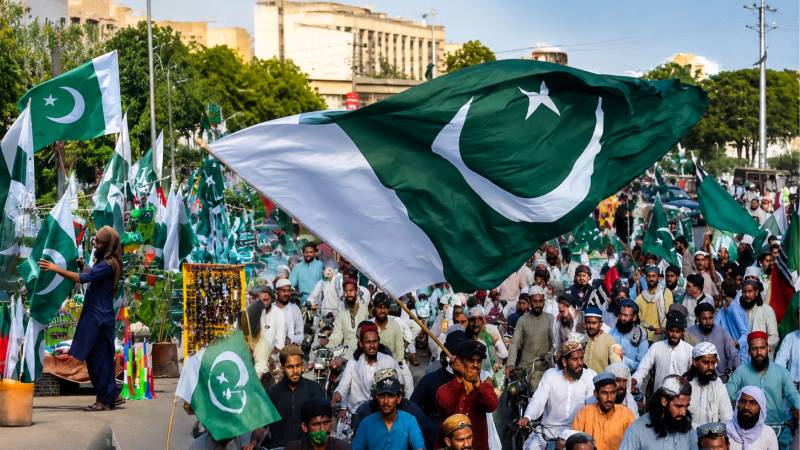
Every year, on 14 August, we celebrate independence with flags, national anthems, ceremonies and speeches. We remember the struggle that brought a new country into existence and honour those who sacrificed for it. For a day, the language of independence surrounds us everywhere. But perhaps Independence Day should also make us pause and ask a more difficult question: Are we truly independent?
The question is not whether Pakistan is a sovereign state. It unquestionably is. Independence gave us a territory, a Constitution, institutions and the authority to determine our own affairs. But sovereignty at the level of the State is only one dimension of independence. There is another, more difficult dimension: whether our institutions and citizens are able to exercise that sovereignty according to law, conscience and principle.
A country may be politically independent while some of its institutions struggle to act independently. A citizen may possess constitutional rights while lacking the practical confidence to exercise them. A lawyer may have professional freedom while finding it difficult to speak against powerful interests. A journalist may technically enjoy freedom of expression while confronting pressures that make that freedom increasingly difficult to exercise. Independence, therefore, cannot be measured merely by the absence of foreign control. It must also be measured by the strength of institutions and the courage of individuals within them.
The judiciary provides perhaps the clearest example. Judicial independence does not mean that judges are free from accountability or criticism. It means that a judge must be able to decide a case according to law and conscience, without fear, favour or improper influence. The authority of a court ultimately depends not only upon the words written in a Constitution but upon public confidence that those words are being applied independently.
The same principle applies to the legal profession. An advocate's independence is not a privilege reserved for difficult cases; it is the foundation of meaningful advocacy. A lawyer must be able to represent a client fearlessly within the boundaries of law and professional ethics, even when the case is unpopular or the opposing side is powerful. If advocacy becomes dependent upon convenience, influence or fear, the justice system loses one of its essential safeguards. But independence cannot be demanded from institutions while being ignored by society itself.
Sovereignty at the level of the State is only one dimension of independence. There is another, more difficult dimension: whether our institutions and citizens are able to exercise that sovereignty according to law, conscience and principle.
Citizens also have a responsibility to think independently. A society in which people merely repeat the opinions of political leaders, social groups, influential personalities or social media networks may possess freedom but still lack intellectual independence. Democracy requires more than the right to vote. It requires citizens capable of questioning, disagreeing and changing their minds when facts demand it. This is perhaps one of the least discussed forms of independence: the independence of the mind.
A free citizen should be able to disagree without becoming an enemy. A lawyer should be able to argue without becoming a rival. A journalist should be able to question without becoming a traitor. A judge should be able to decide without becoming answerable to anything other than the Constitution and the law. These are not threats to national unity. They are among the conditions that make a free society meaningful.
Independence also requires institutions that are stronger than individuals. When systems depend excessively upon personalities, institutions become vulnerable. A strong democracy cannot rely upon the character of one person; it must rely upon rules that continue to function regardless of who occupies an office.
This is why the rule of law is inseparable from independence. Laws must apply not merely to the ordinary citizen but to those who possess power. Constitutional guarantees become meaningful when they are capable of protecting the weak against the strong, not merely when they are celebrated in speeches. There is, however, another uncomfortable truth. Independence is never permanently achieved. It is not an achievement that can be placed in a museum and admired once a year. Every generation must protect it again.
Institutions can become dependent. Rights can become fragile. Professional courage can weaken. Public debate can become intolerant. The space for disagreement can shrink. And when these things happen gradually, society may continue celebrating independence while quietly losing some of the freedoms that give independence its meaning. Perhaps that is why Independence Day should be more than a celebration. It should also be an annual examination of ourselves.
Judicial independence does not mean that judges are free from accountability or criticism. It means that a judge must be able to decide a case according to law and conscience, without fear, favour or improper influence.
Are our institutions strong enough to withstand pressure? Can a citizen seek justice without fear? Can a lawyer defend an unpopular person without being condemned for doing so? Can a journalist question authority without being treated as an enemy?Can a judge decide according to law without considering who may be pleased or displeased by the decision? Can an ordinary citizen disagree with the majority and still feel that he or she belongs to the nation? These questions do not diminish our independence. They honour it.
Pakistan's founders did not struggle merely to replace one authority with another. The deeper promise of independence was the creation of a society in which people could live with dignity, participate in public life and be governed by institutions established through law. After decades of independence, the responsibility has therefore moved from one generation to another. The question is no longer simply what our predecessors achieved for us. It is what we are prepared to preserve for those who will come after us.
We may proudly say that Pakistan is an independent country. But the more meaningful achievement would be to build a country in which its institutions are independent, its professionals are courageous, its citizens are intellectually free and its laws protect every person without distinction. Perhaps then, on 14 August, we will not merely celebrate the independence we inherited. We will celebrate the independence we have learned to protect. The truest test of independence is not whether a nation can govern itself, but whether its people and institutions have the freedom and courage to do what is right.