

“Small nations have always struggled against more powerful ones for their freedom. The whole history of humankind is a struggle of the oppressed against exploitation and domination. The contemporary history of Pakistan is nothing but an example of such a struggle. The struggle before Independence was against an alien racial domination; today it is for preserving independence. The wheel of change has come full circle, bringing us face to face with the same ancient menace. We are no more a subject people; we have the attributes of an independent nation and the will to remain free; though peace is our ideal, the defence of our rights continues to be the supreme objective of the people of Pakistan” Zulfikar Ali Bhutto in The Myth of Independence
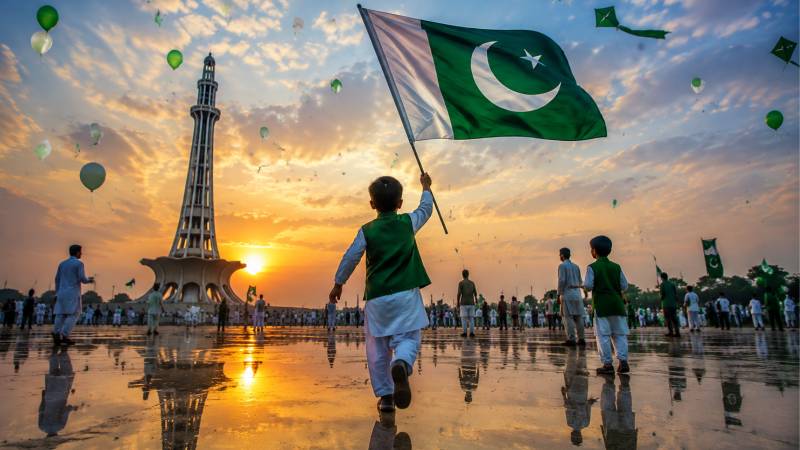
On August 14, 2026, the nation celebrates 79th Independence Day with the hope that the present hybrid-plus government might bring the much-needed reforms in all spheres of governance and fix chronic maladies; political, economic and social, so that Pakistan can be transformed into a true democratic polity, an egalitarian state, independent and sovereign in real sense of the word.
It is an undeniable fact that after 79 years of independence, the ruling elites of Pakistan; militro-judicial-civil complex, businessmen-turned politicians and absentee landowners have pushed the country into a perpetual turmoil. Despite becoming a nuclear state, we are ensnared in a deadly debt trap where majority of the population lacks even basic amenities of life. Wealth and power are concentrated in a few hands and overwhelming burden of taxes, shifted on the less-privileged. The elitist economy favours the rich and mighty with every passing day the rich-poor divide is widening. This paradox depicts what Zulfikar Ali Bhutto highlighted in his masterpiece, Myth of Independence.
The existing oppressive economic system of Pakistan protects and promotes interests of the exploitative classes in utter violation of Article 3 of the Constitution of Islamic Republic of Pakistan [“the Constitution”]. Since its inception, Pakistan nurtured an exploitative system, which has been gaining strength with each passing day. Presently, all forms of exploitation and repression are so deeply rooted that they are even taking away the guaranteed “right to life” from the citizens, what to talk of fulfilling the promise mentioned in Article 3 of the Constitution which says:
“The State shall ensure the elimination of all forms of exploitation and the gradual fulfilment of the fundamental principle, from each according to his ability, to each according to his work”.
It was Zulfikar Ali Bhutto, who for the first time, thought of including the above in Constitution, to fulfill the promise of what he called “Islamic socialism” principle. In reality, he, at the behest of progressive elements in his then Pakistan Peoples Party [Maleeha Lodhi 1980], borrowed it from Marxist ideology. It was considered the lower stage of communism with Marx’s contention, “from each according to his ability, to each according to his needs”.
Karl Marx had specific conditions in mind for such a creed to work in a society where technology, robots with artificial intelligence (AI) and social organisation would substantially eliminate the need for physical labour as we are witnessing under the Fourth Industrial Revolution in the production of goods and services, where “labour becomes not only a means of life but life’s prime want”.
Marx explained that in such a society, each person would be motivated to work for the good of society, despite the absence of a social mechanism compelling them to work, because work would become a pleasurable and creative activity. Marx intended the initial part of his slogan, “from each according to his ability” to suggest not merely that each person should work as hard as he/she can, but that each person should best develop his/her particular talents.
It is an undeniable fact that after 79 years of independence, the ruling elites of Pakistan; military-judicial-civil complex, businessmen-turned politicians and absentee landowners have pushed the country into a perpetual turmoil.
After reading Article 3 of the Constitution, many students ask me: “Can constitutional command of gradual elimination of all forms of exploitation be enforced through the Supreme Court using Article 184(3) of the Constitution”? They ask why the erstwhile apex court of the country, once taking wholesale “so motu” actions, miserably failed to enforce the fundamental rights like free and compulsory education under Article 25A and fulfilment of the principle laid down in Article 3 of the Constitution?
Unfortunately, as a nation we have collectively failed to abide by the supreme law of the land. Theoretically, all admit that the Constitution is supreme, and each organ of the state must perform its duties and functions in accordance with the constitutional scheme, but practically an unelected institution, after finally muzzling the Supreme Court of Pakistan, now exclusively dictates its commands to what all admit “hybrid-plus” civilian governments (so-called) installed changing the real mandate of people.
The legitimacy of elected (sic) governments in Pakistan no more stems from the will of majority of citizens using their power of vote! Resultantly, the nation, especially the youth, is disillusioned as even after 79 years of country’s existence, the political will to implement Article 3 and other fundamental rights guaranteed in Chapter 1 of the Constitution is totally non-existent. It has practically made social contract between State [as defined in Article 7 of the Constitution for the purpose of fundamental rights (Articles 8 to 28) and principles of policy (Articles 29 to 40)] and citizens meaningless!
The prevalent system of Pakistan, in utter and naked violation of constitutional commands, protects the interests of the privileged classes, and the judiciary is no exception. The laws that our judiciary interprets and protects with zeal, in fact, ensure “sanctity of private property” and “exploitation of the have-nots”. The judiciary is not a revolutionary organ; it is a product of the existing socio-economic system. It is naive to expect from judiciary any avant-garde. For getting socio-economic justice, the people will have to wage relentless struggle and exert moral pressure on elected representatives.
The restoration of democracy (sic) after existing of General Pervez Musharraf from presidency, the completion of two consecutive tenures by civil governments, Pakistan Peoples Party [2008-2013] and Pakistan Muslim League (Nawaz) [2013 to 2018] with smooth transfer of power, gave the historically powerful institution a jolt. The mighty general decided to strike back with a third force beginning of hybrid regimes!
Imran Khan, head of Tehreek-i-Insaf (PTI), ousted and jailed Prime Minister of Pakistan, in victory speech of July 26, 2018, vowed to make Pakistan a welfare state. He, however, did not mention implementation of Article 3 of the Constitution as a starting point for abolition of the existing oppressive, unjust and anti-development economic system. The track record of PTI in Khyber Pakhtunkhwa (2013-18), before assuming power in centre, was also disappointing—it showed no will whatsoever for taxation of the privileged classes for the benefit of the poor and establishing a just and egalitarian society.
The oppressive tax system under the successive governments in Pakistan since its inception, both military and elected (sic) civilian governments, has been blatantly violating Article 3 of the Constitution. The vast majority of citizens till today is forcefully subjected to exorbitant indirect taxes even on essential commodities of everyday use, while the mighty sections of society; the big absentee landowners, industrialists, judges, generals and bureaucrats kept on enjoying luxuries of life, amassing wealth and enjoying unprecedented tax exemptions, waivers and amnesties. The rich absentee landowners have either been avoiding or paying negligible agricultural income tax only 0.06% of GDP.
After 79 years of independence income/wealth inequalities are widening, resources are being transferred from the poor to the rich through manipulative taxes and inflation that is taxation without legislation. The exploitative classes, even mafias, fund politicians. The anti-people alliance of the greedy businessmen, tax officials and politicians deprive the state of revenue worth billions. The mighty sections of society are engaged in tax evasion and money laundering. The PTI purportedly won the 2018 election on anti-corruption campaign but during it rule of three years and eight months [August 2018 to April 2022] did not bother to dismantle the anti-people, elitist structures and provide equitable distribution of wealth/resources as envisaged in Article 3 of the Constitution.
The successor governments, first under the banner of Pakistan Democratic Movement (PDM), assuming power in April 2022, and the incumbent arrangement, hybrid-plus, installed by reversing the election results of February 8, 2024 elections, also showed no inclination whatsoever to implement Article 3 of the Constitution.
The huge fiscal deficit, ever-increasing and unsustainable debt servicing coupled with monstrous debt burden are not isolated phenomena. These are results of failure in undertaking fundamental structural reforms, enforcing fiscal discipline, cracking down on parallel economy, increasing tax collection, abolishing perks and benefits of the ruling elites, eliminating wasteful expenses, dismantling rent-seeking structures, ensuring rule of law, and stopping reckless borrowing and ruthless spending.
Resource mobilisation should have been the top priority of the civilian governments (sic) since 2008, after restoration of so-called democracy, by improving infrastructure, social services, growth of small and medium sized firms in the industrial sector and efficient/productive farming for an employment intensive and equitable economic growth process. But they did none of these.
The present government, claiming to have full support of army, in the remaining period must at least pass laws to end economic apartheid, large corporations with equity stakes for the poor be established through public-private partnerships. This would set the stage for a structural change that could help achieve economic growth for the people and by the people which is presently confined to the elites only.
The most disturbing and painful reality of Pakistan is unabated/shameless indulgence of ruling elites in wasteful expenditures. Look at their lifestyle when most of the population is undernourished and suffering extreme hardships due to wrong policies of successive governments. For becoming an economically self-reliant nation, the rulers will have to take the first step by starting to live at a modest level.
True independence requires self-reliance for which fundamental structural reforms are inevitable. There is no dearth of ideas and good people for such reforms. We only lack political will to abolish elitist structures that are the main impediments for ensuring equal opportunities for all citizens and extending to common people benefits of public spending and economic growth.