

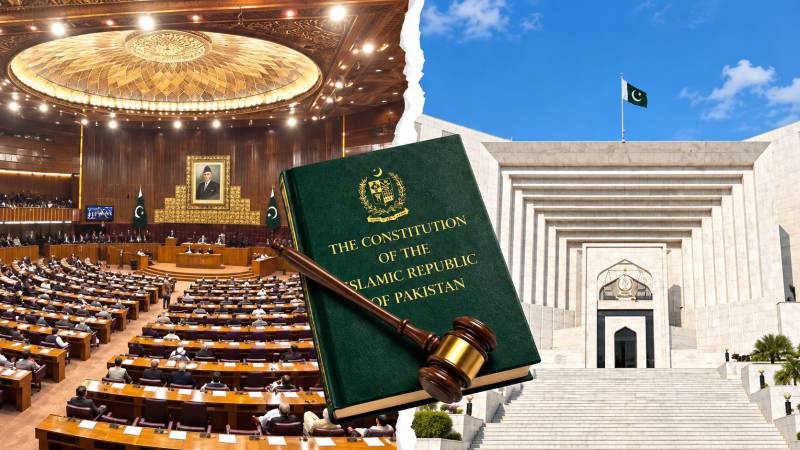
What is the state for? What does it owe its citizens, and what rights can citizens claim against it? These questions have occupied political philosophers from Aristotle to modern theorists of constitutional democracy. In the modern state, they are embodied in constitutions, the fundamental political contracts that define the limits of state power, protect citizens, and establish the obligations of government. Pakistan’s Constitution of 1973 gives a clear answer. Its Preamble commits the state to democracy, freedom, equality, tolerance, and social justice. It guarantees fundamental rights, protects minorities, provides for federalism, and recognizes the independence of the judiciary. Part II, Chapter 1 places enforceable constitutional limits on state power through Fundamental Rights (Articles 8–28), while Chapter 2 sets broader objectives for social and economic well-being through the Principles of Policy (Articles 29–40).
The Preamble further declares that the constitutional order is established “so that the people of Pakistan may prosper and attain their rightful and honoured place amongst the nations of the world.” This is not merely an aspirational statement; it establishes the larger purpose against which the performance of the state can be judged. Yet, more than five decades after its adoption, the country faces a fundamental contradiction: the constitutional promise is considerably more advanced than the reality experienced by its citizens. That contradiction raises the central question of this article: not whether the country has a constitution that promises rights and welfare, but why a state founded on such commitments has struggled to translate them into everyday reality. The problem, therefore, is not principally a shortage of constitutional text, but a persistent failure of constitutional practice.
A constitution cannot, by words alone, educate a child, protect a woman, provide healthcare, or deliver justice. It can, however, establish the rights, institutions, responsibilities, and policy commitments through which such outcomes become possible. Article 38 calls for the promotion of social and economic well-being and the provision of basic necessities—food, clothing, housing, education, and medical relief for those unable to earn a livelihood due to infirmity, sickness, or unemployment. Read alongside the Fundamental Rights and the Preamble, these provisions reveal a constitutional vision in which the state is expected not merely to exercise authority, but to create conditions in which citizens can live with dignity, security, and opportunity.
The problem is not principally a shortage of constitutional text, but a persistent failure of constitutional practice.
The distance between that constitutional vision and the conditions experienced by many Pakistanis is visible in the country’s human-development indicators. UNDP assessments place Pakistan near the bottom of the global human-development table, while the World Bank has repeatedly identified severe human-capital deficits, including millions of out-of-school children and widespread child stunting. Gender inequality remains pronounced, with Pakistan continuing to perform poorly in global gender-gap assessments. The same gap becomes evident when governance and security are examined. Pakistan faces serious internal-security challenges, poor corruption-perception scores, and persistent weaknesses in civic space and democratic performance. While international rankings must be treated with caution, their significance lies less in any individual score than in the consistency of the broader pattern. When different indicators repeatedly point towards deficiencies in human development, governance, security, and civic freedoms, they raise a fundamental question about the state’s capacity to translate constitutional aspirations into public policy and institutional performance.
That question inevitably leads to Parliament, because the Constitution does not implement itself. At the centre of this deficit lies an institutional question: how effectively has Parliament performed its responsibility to protect rights and uphold the constitutional order? As a primary vehicle for democratic control, Parliament has enacted important legislation, but its performance in scrutinising executive power, ensuring implementation of laws, and responding effectively to violations of citizens’ rights remains uneven. The problem becomes particularly visible in the gap between legislation and implementation. Pakistan possesses an extensive body of laws dealing with fundamental rights, governance, accountability, and public welfare, yet parliamentary oversight often weakens once legislation leaves the floor of the House. Standing committees are empowered to examine legislation and question officials, but their recommendations do not consistently translate into sustained executive action. Parliamentary questions, notices, and debates can expose failures, but the mechanisms for ensuring follow-up and corrective action remain limited.
The weakness of implementation is compounded by Parliament’s difficulty in consistently acting as an effective check on executive power. Party politics, executive dominance, parliamentary disruptions, and the passage of legislation with inadequate debate have often reduced parliamentary scrutiny to political contestation rather than sustained constitutional oversight. Pakistan’s history of repeated military interventions has also disrupted the continuity and authority of representative institutions. But historical disruption does not remove Parliament’s present constitutional responsibility: it must ultimately be judged by how effectively it holds the executive answerable and protects the constitutional rights of citizens. A legislature that becomes little more than a forum for political confrontation or debates rights without adequately ensuring their implementation leaves an important part of the constitutional promise unfulfilled.
The consequences of this institutional gap are ultimately felt beyond Parliament, in the everyday relationship between the citizen and the state. Pakistan’s most enduring governance paradox is that the state can be extraordinarily powerful in regulating, limiting freedoms, and taxing, yet remarkably weak in providing security, functioning schools, health facilities, clean water, and timely justice. The citizen therefore encounters two very different faces of the state: an intrusive state when it exercises power, but an absent state when it is expected to deliver services and protection. At the heart of this relationship between the citizen and the state lies the question of how citizenship itself is understood. Pakistan needs a conceptual shift: the citizen must stop being treated as a supplicant. In a patronage system, citizens depend on connections, influence, or bribes to obtain basic entitlements. In a constitutional system, public institutions are expected to deliver rights and services according to law, equal protection, and transparent procedures.
Article 25’s guarantee of equality before the law cannot mean a narrow conception of formal equality that ignores structural barriers and allows profound substantive inequality to persist. The same principle applies to religious, ethnic, and regional minorities. Citizenship cannot be graded, and a federation is strengthened when every citizen and every constituent unit has confidence that the constitutional order belongs equally to them. The Constitution has defined the destination: a society based on democracy, freedom, equality, tolerance, and social justice. The challenge is therefore no longer to add more constitutional promises, but to honour the ones already made. The defining question for Pakistan’s political leadership is simple: when will the promise of the Constitution finally become the lived experience of the citizen?