

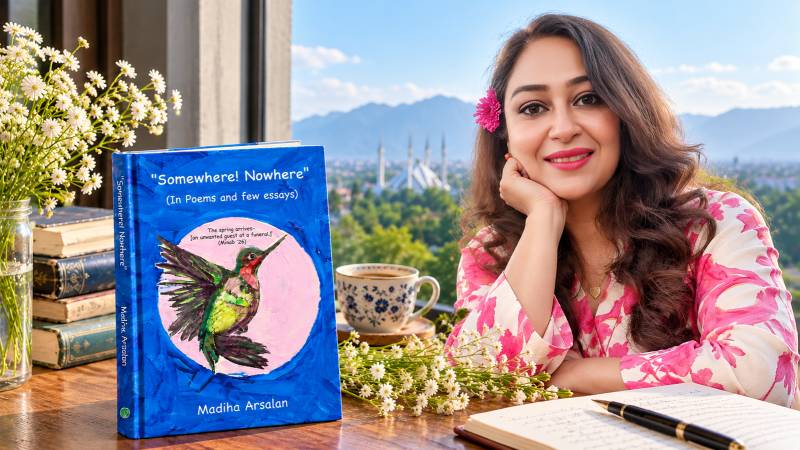
Dedicating her second book of poetry “To those who choose love amidst the chaos and the wars”, Madiha Arsalan’s Somewhere, Nowhere invites readers into a world where love and loss, tenderness and turmoil, personal memories and political realities coexist in an intricate tapestry of human experience. Describing herself as “a wordsmith” who is “presuming” to “decipher the world”, Madiha approaches poetry as an act of attentive witnessing: an attempt to make sense of a world that is at once beautiful and brutal, intimate and incomprehensible. Her poetic sensibility lies in her remarkable capacity to move between the deeply personal and the profoundly political, tracing connections between the fragile landscapes of the heart and the disquieting complexities of our modern world. From the philosophical depth of Shah Latif Bhitai to the mystical musings of Rumi, and onward to the harrowing realities of Gaza, her writing bears witness to human suffering while holding fast to the enduring redemptive power of love, compassion, and renewal.
The title Somewhere, Nowhere evokes the tensions between belonging and estrangement, presence and absence, and the desire to find a place in a world that often resists our attempts to understand it. The collection unfolds across three sections: “Somewhere”, “Marisahs”, and “Nowhere”. Bringing together poetry, reflective essays, and photographs, it explores the multiple ways in which we inhabit the world: through memory and longing, our relationships with others, our encounters with nature, and our responses to injustice and suffering. Each section offers a distinct perspective on the human condition, yet all are connected by the poet’s restless questioning and her desire to unlock the deeper realities of existence.
The poet’s sensitivity to injustice is matched by her intimate understanding of grief, loneliness, and emotional vulnerability. In “I am not giving up: Your eyes! Clouded. Clouded with cataract”, the image of clouded vision suggests how suffering and the passage of time can obscure our understanding of ourselves and the world. Elsewhere, the poet’s “wounds are farther than skin deep”, while the “bruised spirit” and the image of “Soles of my feet bleed” evoke the exhaustion of a self, struggling to endure. The anguish of existence finds stark expression in “The sorrow is so alive that it doesn't let one live, neither let's you die”. Yet Madiha refuses to allow sorrow the final word. Her evocative assertion, “Life is a turmoil, Dance it away in a twirl”, transforms dance into a metaphor for resilience: an imaginative response to life’s turbulence that neither denies pain nor allows it to extinguish the spirit. Even when she “falls on the thorns of life”, the possibility of rising remains. This tension between vulnerability and endurance lends her poetry much of its emotional force.
Nature provides Madiha with another language through which to explore the rhythms of existence. Whether addressing a “mitr” and inviting him to notice the “cool morning breeze” and “birds chirping”, or evoking the “delicate dance”, “the gentle flickering”, and “shimmering symphony of light” of the “fireflies”, she draws attention to the beauty of fleeting moments that often escape our hurried attention. The “withering winter”, “March with its crisp, cold winds”, and the poem on “Dandelions” reveal a poet attentive to the changing seasons and the quiet resilience of the natural world. Nature in her writing is not merely ornamental; it becomes a source of contemplation, companionship, and renewal, offering a counterpoint to the hurried, technologically mediated existence of the contemporary world. Her delight in the sounds and movements of the natural world is captured in the following passage:
The nature loves the chirp of happy sparrows, the blue Jays, robins,
cuckoos and indigenous birds. The hooting owls at night. Trills,
lisps, zits, buzzing, rattling, the sounds of life. The swish swashing
of the leaves as the ghost wind pass through the tall and proud
Deodar (Himalaya Cedar), hugging and kissing every inch of its
being.
The passage brings nature alive through its rich soundscape and tactile imagery. Birds, wind, and the stately deodar become participants in an animated world of movement and intimacy. Madiha articulates her joys, sorrows, desires, and disappointments through recurring images of flowers and gardens, clouds and sky, moons and suns, pines and dandelions, stars and night.
Her poetic sensibility lies in her remarkable capacity to move between the deeply personal and the profoundly political, tracing connections between the fragile landscapes of the heart and the disquieting complexities of our modern world.
Madiha’s language possesses a deceptive simplicity, its unadorned surface concealing layers of thought and feeling that gradually unfold upon reflection. Through metaphors and evocative imagery, she gives voice to emotions that resist direct expression, finding in the familiar and the seemingly ordinary a quiet profundity. What might otherwise pass unnoticed in the rhythms of everyday life becomes, in her poetry, an invitation to pause, to look anew, and to ponder the deeper meanings concealed within the commonplace. Her metaphors do not merely describe an emotion; they illuminate its subtleties, allowing the personal to resonate with the universal. This lyrical sensibility finds expression in both her longer poems and her briefest compositions, where a few carefully chosen words can open up expansive realms of thought.
Her engagement with the Japanese poetic form of haiku is particularly revealing of this gift for distillation—the ability to capture an ephemeral moment, an image, or an emotion and imbue it with an enduring resonance. Whether contemplating the bridge in Karachi or reflecting on World Migration Day, whether turning her gaze towards budding flowers and setting suns or towards graves and the blue phase, Madiha attends to the visible world with an eye that perceives its less tangible dimensions: the memories, longings, transience, and philosophical questions that inhabit it. The photographs interspersed throughout the collection deepen this contemplative quality, entering into a subtle dialogue with the poems. Together, image and word become complementary modes of seeing and feeling, each inviting the reader to discover, beneath the surface of things, meanings that linger long after the moment of encounter has passed.
Unlike her first collection, Bhadoon, Somewhere, Nowhere also incorporates reflective essays that reveal the breadth of Madiha’s literary interests. Moving between personal recollection, travel writing, and philosophical meditation, these essays capture the pleasure of revisiting Karachi in “Homestasis” and the beauty of Islamabad’s dawns in “Morning Glory”. Her journeys take readers to Gangaramaya Temple in Colombo, while her reflections revisit the nostalgia of letter-writing, Hassan Koozagar by Noon Meem Rashid, and memories of Zarghun Road Railway in Quetta, where she celebrated the first anniversary of her wedding, as well as a family vacation in Georgia. In “Postpartum”, personal experience becomes a means of reflecting on identity, emotional transformation, and the demands of life. These essays complement the poetry by revealing how seemingly ordinary experiences can become sites of deeper introspection, connecting the particularities of an individual life with wider questions of memory, time, and belonging.
Alongside these intimate meditations on suffering and the search for meaning, Madiha’s work confronts the brutalities of patriarchy and the unequal burdens women are made to bear. In “No: The Witch Trials Are Not Over”, she challenges a society in which women’s bodies, choices, and freedoms continue to be subjected to violence and control. From Noor Muqaddam, an elite woman whose brutal murder exposed the devastating reach of patriarchal entitlement, to five-year-old Fatima, whose vulnerability offers no protection against cruelty, Madiha brings into focus the varied lives of women and girls who become victims of a deeply entrenched culture of violence. The murder of “Sammo” “with nine shots in her chest” by “Jalal, the true Baloch” further exposes the contradictions between cultural identity, honour, and the brutal realities of women’s lives. Her question, “Why should women not do/ what their hearts desire/and rightly pronounce?”, becomes a powerful assertion of women’s right to selfhood, desire, and expression. Yet Madiha’s vision is not confined to denunciation. Her tribute to Musarrat Misbah, “Mishbah, source of Mussarat to the heartbroken”, celebrates the transformative power of compassion and the restoration of dignity to acid-burn survivors. Moving between outrage and empathy, her poetry exposes the cruelty that diminishes humanity while honouring those who strive to restore it.
This concern with injustice expands beyond individual lives into a wider reckoning with collective suffering and the recurring violence of human history. The section “Marisahs” comprises eight poems of mourning that bear witness to the genocide in Gaza and the devastating image of 162 girl coffins in Iran. Here, Madiha’s poetic voice assumes the moral urgency of testimony, refusing to let distant suffering become an abstraction. Grief becomes a means of acknowledging lives lost and confronting the human cost of violence. In “Nowhere”, this concern broadens into a meditation on humanity’s enduring impulse to wage war against the “other”. References to the Trojan War, the War of the Roses, and the War of the Three Saints bring historical conflicts into conversation with contemporary devastation. The futility and injustice of warfare find expression in the lines:
“Warriors and wars:
sacrifice of the valiant for vain
rulers and their selfish cause”
The sacrifice of the brave for the ambitions of the powerful exposes the tragic asymmetry of war: those who bear its consequences are so often not those who determine its course. Madiha’s writing thus moves beyond lamentation to question the moral failures that allow violence to recur across generations. The philosophical dimension of “Nowhere” further deepens the collection’s inquiry into the human condition. In “they say…”, Madiha contemplates life, fear, and mortality, moving between the material and the metaphysical, the constraints of bodily existence and the restless yearnings of the soul. The recurring distinction between “you” and “I” evokes the distances that persist even in relationships shaped by intimacy and desire. The difficulty of fully knowing another becomes part of a larger meditation on the limits of human connection and the search for meaning in an uncertain world.
What distinguishes Somewhere, Nowhere is Madiha’s ability to hold together seemingly opposing impulses: grief and grace, outrage and tenderness, disillusionment and hope. Her poems move from the intimate landscapes of personal loss to the collective suffering of war, from the delicate movement of a firefly to the devastating realities of human cruelty. This range reflects not merely the diversity of her subjects but the expansiveness of her poetic imagination. She observes, questions, remembers, and mourns, allowing particular images and experiences to open onto larger ethical and existential concerns.The following lines capture the tension between fragility and aspiration that runs through the collection:
My heart is weak
My aspirations strong
Between the two
The survival longs!
Here, the vulnerable heart and the determined spirit exist in a delicate balance. Survival is neither effortless nor triumphant; it is an ongoing negotiation between pain and possibility, the weight of experience and the desire to move beyond it. These lines encapsulate the quiet courage that animates Madiha’s writing: the willingness to acknowledge the world’s wounds while continuing to imagine life otherwise. In an age marked by war, technological acceleration, ecological uncertainty, and the erosion of human connection, Somewhere, Nowhere asks us to look more carefully, feel more deeply, and resist the temptation to become indifferent to suffering. Madiha Arsalan’s poetry reminds us that words can bear witness, preserve memory, challenge injustice, and restore our attention to the beauty that persists alongside brutality. Her achievement lies in transforming personal reflection into a wider act of human recognition, inviting readers to inhabit the spaces between love and loss, somewhere and nowhere, despair and hope. Ultimately, this is a collection for those who continue to choose love amidst chaos and war, and who believe that tenderness, even in the darkest of times, remains an act of courage.