

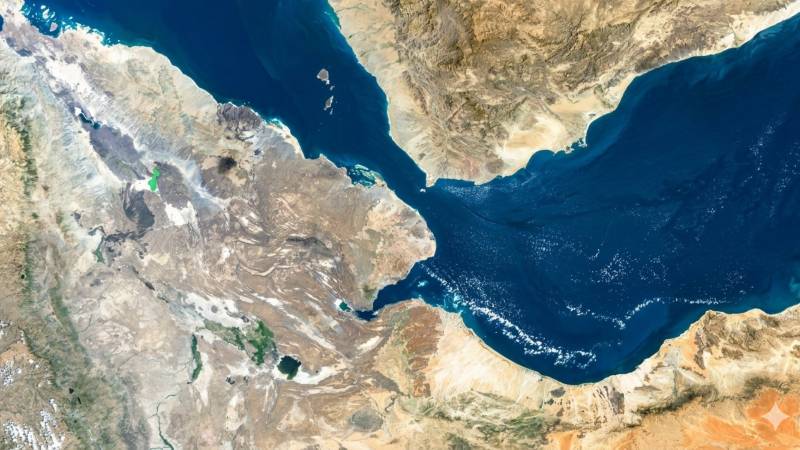
Islamabad watches the Red Sea narrow into a noose and finds its own name written into the fine print of a war it did not start. There is a bitter irony buried in the name of the strait now holding the world's oil markets hostage. Bab al-Mandeb — "the Gate of Grief" — earned its name centuries ago from the sailors it drowned. In September 2026, it is earning that name again, this time by drowning economies rather than ships. As the Houthis complete their encirclement of the 18-mile passage between Yemen and the Horn of Africa, the crisis they have engineered sits uncomfortably close to home for Pakistan — a country bound, by treaty and history, to a kingdom whose lifeline now runs through that gate.
For months, the world's attention was fixed on the Strait of Hormuz, effectively shut by the ongoing Iran-US war and responsible for choking off roughly a fifth of the planet's oil trade. Saudi Arabia's answer was to reroute its exports westward, pushing millions of barrels a day through pipelines to the Red Sea port of Yanbu — a fivefold surge over pre-war volumes. It was meant to be the escape valve. Instead, it has become the second trap.
On July 20, the Houthis threatened a naval blockade of Bab al-Mandeb aimed squarely at Saudi shipping, and by early September, they had seized Mayyun Island, the strategic outcrop that splits the strait into its two navigable channels, completing their control of Yemen's entire Red Sea coastline. Weekly crude loadings from Saudi Arabia's Red Sea terminals, which had touched 9.5 million barrels a day at the height of the westward pivot, have since collapsed, falling as low as 1.5 million barrels a day in August before a partial and fragile recovery in September. For a kingdom that believed it had found a way around one blockade, discovering a second closing in from the other side has been, in the words of more than one regional analyst, an execution rather than a mere disruption.
The stakes go beyond crude. Bab al-Mandeb carries only a fraction of the oil that transits Hormuz, but it sees close to a sixth of global maritime commerce and roughly a third of the world's container traffic — electronics, machinery, fertiliser and food. Agricultural shipments bound for import-dependent economies are especially exposed; a simultaneous closure of both chokepoints threatens what analysts have called a near-complete sea blockade for regional grain and fertiliser imports.
Pakistan's exposure here is not incidental, it is structural. When Hormuz seized up, Saudi Arabia began routing crude to its eastern dependents, including Pakistan, through the very Red Sea corridor that is now under threat. Islamabad, in other words, has watched its energy security migrate from one chokepoint straight into the path of another. But the deeper entanglement is not commercial; it is contractual. In September 2025, Pakistan and Saudi Arabia signed a Strategic Mutual Defence Agreement declaring that an attack on either country would be treated as an attack on both. Last month, that bilateral pact was widened into the Mecca Joint Defence Agreement, bringing Turkiye in as a third signatory and prompting immediate, if contested, comparisons to NATO's Article 5. When Houthi strikes on Abha, Khamis Mushait, Jazan and Najran injured dozens of Saudi civilians shortly after the ink dried, Pakistan's Defence Minister Khawaja Asif was blunt: there should be "no ambiguity" that aggression against any one member draws a response from all three, and the alliance would be "honoured."
Yet Pakistan's Foreign Office has been notably more careful in practice than the rhetoric from Islamabad's defence establishment might suggest. Spokesperson Sajjad Haider Khan told reporters there were no discussions, as of this writing, of a military response under the Makkah agreement, only that Pakistan would "act when the time comes." Pakistani sources have indicated that any conceivable response would be launched from Saudi territory, with an explicit understanding that troops from the three signatories would not enter Yemen itself. This caution is not indecision — it is the only rational posture for a country threading several needles at once.
Pakistan shares a long, porous and periodically volatile border with Iran, the Houthis' patron. A nuclear-armed Pakistan being drawn into a shooting war against an Iranian proxy carries risks of spillover that no amount of Gulf solidarity can offset. Several regional analysts have explicitly framed the Bab al-Mandeb crisis as a test of whether Islamabad can honour its Saudi commitments without triggering a direct confrontation with Tehran.
Having just signed a defence pact explicitly compared to NATO, Pakistan cannot appear to hedge indefinitely without undermining the very deterrent value the agreement was designed to project. Yet several diplomats and analysts, including at the Council on Foreign Relations, have already suggested that the Mecca agreement is more symbolic than operational — it establishes no joint command, no standing force and no automatic trigger mechanism. Pakistan's studied ambiguity may therefore be less a betrayal of the pact's spirit than an accurate reading of its actual architecture.
Pakistan's own economy, still climbing out of a balance-of-payments crisis, is acutely sensitive to oil price shocks and freight disruption. A double-chokepoint scenario, Hormuz and Bab al-Mandeb both constrained would hit Pakistan's import bill for fuel, edible oil and fertiliser precisely when the country can least absorb the shock, regardless of which flag flies over any warship sent to the Red Sea.
Three challenges will define how this plays out for Islamabad in the coming weeks. First, the question of what "activation" of the Makkah pact would actually require in practice — a legal and political ambiguity that Pakistan's own officials appear reluctant to resolve prematurely. Second, the risk that the international shipping industry's response — rerouting around Africa, as Maersk, MSC, Hapag-Lloyd and others have already begun doing, normalises a permanently costlier global trade map in which Pakistan, as a peripheral trading economy, has little leverage and only pays the price. Third, and most delicately, the danger that any Pakistani military gesture toward the Red Sea, however limited or symbolic, is read in Tehran as the crossing of a line that cannot be uncrossed.
The Houthis have framed their campaign as leverage transferred from Yemen's exhausted interior onto a corridor the Gulf cannot live without. Whether or not that calculation holds, the practical effect is a slow strangulation of two of the world's most important chokepoints at once — and a stress test for every alliance built around them.
For Pakistan, the choice is not really between war and peace. It is between the discipline of strategic patience and the temptation of premature commitment. The reading of the moment is that Islamabad has, so far, chosen correctly: honour the pact in word, reserve action for genuine necessity, and let the diplomats not the destroyers — do the first work. Whether that discipline survives the next Houthi strike on Saudi soil is the question that will determine whether the Gate of Grief claims Pakistan as more than a bystander.