

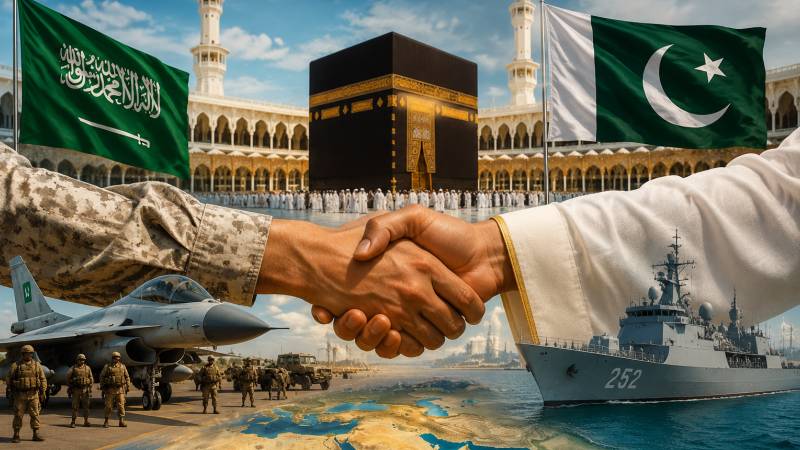
The signing of the Makkah Joint Defence Agreement by Pakistan, Saudi Arabia, and Türkiye has sent shockwaves through international policy circles. Promoted by enthusiastic headline-writers as an "Islamic NATO," the pact introduces a collective security clause stipulating that an armed attack on one member will be treated as an attack on all. However, applying the moniker "Islamic NATO" to this trilateral arrangement is profoundly misleading. Much like Voltaire’s famous critique of the Holy Roman Empire that it was "neither holy, nor Roman, nor an empire" this alliance is neither genuinely pan-Islamic, nor structurally comparable to NATO, nor built on a cohesive regional consensus. Instead, it is a narrow, elite-driven strategic arrangement born of shifting geopolitical landscape.
Geopolitically, the pact suffers from an acute identity crisis. In Western capitals, the agreement is quietly interpreted through the prism of containment, a pragmatic ‘Sunni’ security grouping intended to counter Iran’s axis of resistance and influence. Conversely, within the domestic and regional media spheres of the participating nations, the alignment is aggressively marketed as a shield against Israeli aggression and a response to the ongoing turmoil in Gaza and the broader Middle East.
This duality reveals a fractured architecture rather than a unified front. The broader Muslim world is conspicuously missing from the equation. Notable among the non-participants are Iran and Egypt, whose deliberate absence speaks volumes. Cairo opted out of the arrangement due to a combination of strategic prudence, historical aversion to foreign military entanglements that subvert traditional Arab leadership structures, and a calculated desire to avoid choosing sides between emerging blocs comprising Pakistan, Türkiye and Saudi Arabia on one side, and India, UAE and Israel on the other side. Iran and Egypt’s absence underscores that the agreement represents a sub-regional coalition rather than an authentic pan-Islamic consensus.
Much like Voltaire’s famous critique of the Holy Roman Empire that it was 'neither holy, nor Roman, nor an empire', this alliance is neither genuinely pan-Islamic, nor structurally comparable to NATO, nor built on a cohesive regional consensus.
From a structural realist perspective, the Makkah agreement aligns neatly with Washington’s evolving grand strategy. Burdened by overextension, failing to achieve its strategic goals in Iran, and a shifting focus toward great-power competition elsewhere, the United States is relying on a "buck-passing" strategy encouraging capable regional allies to shoulder the responsibilities of the West Asian security architecture.
By fostering a secondary centre of gravity comprising Türkiye’s (a NATO member) defence-industrial depth, Saudi financial muscle, and Pakistan’s (a Nuclear Power) military weight, the pact allows the USA to outsource regional deterrence against Iran. It is classic balance-of-power politics: creating local proxies or aligned minilateral blocs to maintain regional equilibrium without committing American boots to the ground.
While the agreement offers short-term diplomatic visibility, it runs fundamentally counter to Pakistan’s long-term national interests. Islamabad already possesses a formidable conventional military and a full-spectrum deterrence. In fact, Pakistan requires not an expansion of its security commitments, but dedicated efforts to counter insurgencies and terrorism inside the country.
The country faces severe domestic vulnerabilities, most notably persistent and intensifying insurgencies in Khyber Pakhtunkhwa and Balochistan, alongside severe economic fragility. Entangling Pakistan in distant Middle Eastern rivalries, without the approval of Parliament or democratic consensus, diverts precious administrative, intelligence, and military bandwidth away from critical domestic governance. Rather than projecting power abroad while its own house remains structurally unstable, Islamabad's primary strategic imperative should be internal stabilisation and economic revival.
Ultimately, sustainable security cannot be built on exclusionary foundations that isolate major regional stakeholders. A truly stable security architecture in West Asia requires an inclusive collective security framework that includes all regional powers, including Iran. Pushing key regional powers out of the diplomatic and security equation inevitably triggers a security dilemma, breeding mistrust and accelerating a dangerous new regional arms race. Modern history offers a sobering precedent: the failure of the Euro-Atlantic security architecture to incorporate Russia into a genuine collective security framework paved the way for toxic bloc politics and, ultimately, the catastrophic war in Ukraine.
If Pakistan, Saudi Arabia, and Türkiye wish to foster genuine peace, they must move beyond reactionary minilateralism. Constructive deterrence must be paired with inclusive diplomacy; otherwise, pacts designed to prevent war may inadvertently lay the structural blueprints for the next major regional conflict.