

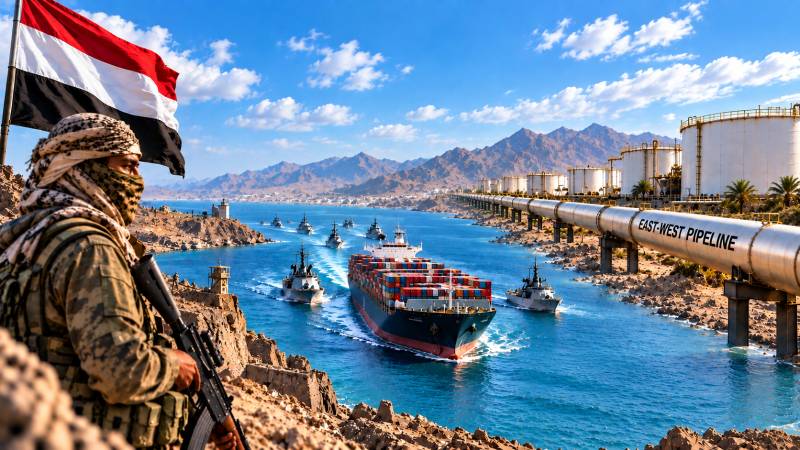
The recent offensive of the Ansarallah (i.e., Houthis) where they have swept the west coast and controlled the Bab al Mandeeb as well as threatened the Kingdom of Saudi Arabia with ballistic missiles and drones on its seven cities on 15th September, and Iraqi militant groups attack on the Saudi East West Pipeline on 12th September, halting the oil supplies of the 5 million barrel to the world through Red Sea. The halt in oil supplies has already increased the prices of the oil to $110 per barrel and Riyadh has informed its clients of its inability to fulfill its commitments in future. This will be a big concern for the European and Asian states as most of them rely on the Saudi oil and this will push them towards a new energy crisis in their respective states.
The Impact of the recent developments cannot be ignored as Riyadh is encircled by the hostile forces as the recent advancement of the Houthis in Yemen shown the loopholes in Riyadh’s strategy to counter the Houthis threat. The world is now on the brink of the worst fuel crisis to come in the modern times as the control of the two important choke points as well as the war in Ukraine has halted the gas and oil supplies from Russia marked a significant turnaround of events. The US has weakened before Tehran's continuous attacks on its military bases and installations around west Asia since 2026, and Washington cannot afford to lose the vital energy rich region to Tehran and its proxies. The control of Houthis over the Bab al Mandeeb has increased Tehran’s leverage over the geo- politics of the region and has further tilted the situation in its favor despite increased US sanctions on the regime. Washington is not in a good position itself as it suffered the losses of US$ 33.4 billion in the war and lost its military bases in the region. The economic and military losses does not reflect the actual situation of the region as the US image is superpower is also damaged and its allies lost the confidence in Washington’s security architecture.
The widening confrontation between Saudi Arabia, the Houthis and Iran-linked militant groups risks deepening regional divisions, intensifying sectarian tensions and creating a broader security crisis extending well beyond the Arabian Peninsula.
The trust issues with the US increased further due to Trump’s refusal to provide defense support to Riyadh against the Houthis despite their strategic partnership as well as Riyadh’s role in securing the petro dollar and US hegemony around the region and providing much needed US$ 600 billion investment to the Trump administration. Trump is critical of the Gulf States role in the Iran war as well as Abraham Accords, and is afraid to open the front against the Houthis in Red Sea and as per news reports US officials assured Houthis not to act against their newly gained territories in response Houthis will not stop the US and Israeli vessels. The US compromise with Houthis will not only secure a sea route for US vessels but also will corner Riyadh and compel it to accept the Trump’s demand for recognition of Abraham Accord.
The US refusal as well as continuous strikes on Saudi energy infrastructure will push to the Riyadh to explore new opportunities as the continuous strikes of Houthis and Iraqi militias on Kingdom and holy cities of the Muslims i.e., Mecca and Medina will increase the support towards Riyadh and Muslim world. The attacks on holy cities will portray Tehran and its affiliated groups negatively and a threat to Muslim unity and faith. The increased hatred towards these groups will lead the formation of new alliances led by the Saudi Arabia to counter the Iranian threats and regain the strength to a wider regional approach among the Gulf States to deal with Iran and its affiliated groups through the coordinated efforts of the regional military alliances.
In the absence of the US support and the lack of effectiveness of the Saudi forces the importance of the Mecca pact increased as the Pakistan’s military and political clout will provide a much needed support to the Riyadh in its effectiveness in dealing with the Houthis. The protection of the East- West Pipeline and the opening of the Bab al Mandeeb for Saudi vessels. The happiest state during these crisis is the Israel who wanted to engage the Muslim states with Iran at the first place but failed to do so during the 2025, and 2026 wars, but this time the war is expanding between the Riyadh and Houthis as well as Iraqi militias and this may lead towards the Iran. The engagement of Iran and Arab neighbors has benefitted Tel Aviv as the focus was shifted from the Israeli actions in Lebanon to the Houthis advancement in the region, and this provided it to continue its operations against Hezbollah and Iranian affiliated groups in the region.
The recent actions of Houthis has dented the Muslim unity so badly that the Muslim states are divided on the opinion of dealing with the Iran and its affiliated groups including Houthis. The states who stood neutral during the Iran war and has continuously looked to seek peaceful solution are now moving towards a more violent solution of the issue in the West Asia that is the confrontation with hostile forces including Houthis through the web of military alliances. The increased violence in the region may result the crisis of energy and food crisis around the globe and will be catastrophic for the region as the Muslim states around the region will suffer and Shia Sunni divisions will further increase that will also haunt the security of other Muslim states including Pakistan. This situation only best suits for the Israel as the weakened Muslim states will be unable to stop its actions leading towards establishment of its hegemony in West Asia through Greater Israel.