

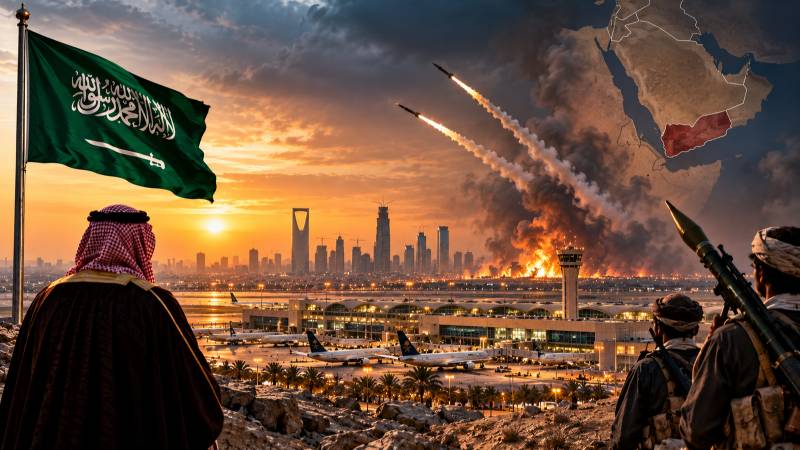
The attack on King Fahd International Airport in Dammam on Wednesday night, which killed one person and injured eight, has exposed a troubling reality: Saudi Arabia can intercept missiles and drones, but it has not yet deterred further attacks. The perpetrators of this particular incident have not been confirmed, although the Houthis have repeatedly targeted Saudi airports and energy infrastructure. On the same day, debris from an intercepted drone killed two people near the Shaybah oilfield. How long can a regional coalition remain largely defensive while civilian targets remain vulnerable?
This is not evidence of complete military inaction. Saudi forces have intercepted attacks and struck Houthi positions. Rather, it raises a question about the purpose of deterrence. If every interception is followed by another attempted strike, superior firepower is not translating into political restraint. The consequences extend beyond Riyadh: they test Pakistan’s and Türkiye’s commitments under the Makkah Joint Defence Agreement, and Pakistan’s ability to keep its relationship with Iran from becoming another casualty of the Yemeni war.
That makes Field Marshal Asim Munir’s visit to Tehran on 20 October particularly important. Pakistan has continued to engage Iranian leaders while maintaining its defence commitments to Saudi Arabia. Munir met President Masoud Pezeshkian and senior Iranian military officials, but Tehran made no publicly confirmed commitment to halt the Houthi offensive. The visit nevertheless helped keep a diplomatic channel open. Its significance lies as much in what the Iranians refused to concede as in what was discussed.
Iran’s security chief, Mohsen Rezaei, who showed off a deliberate cold physical response when greeting the Field Marshal, declared that no enriched nuclear material would leave Iran. The timing and body language deserves scrutiny. Russia has offered to receive Iran’s enriched-uranium stockpile, while President Trump has previously demanded that such material be removed. Iranian reports say Munir received Tehran’s response to an American proposal, without disclosing its contents. Was he carrying a renewed suggestion of Russian custody, prompting Tehran to reject it so publicly? Or was Iran pre-emptively establishing a red line before negotiations resumed? Without disclosure of the message, this remains a hypothesis, not a finding.
The distinction matters because retaining existing enriched uranium is not necessarily the same as insisting on unrestricted future enrichment. Indeed, the Islamabad Memorandum of Understanding, brokered through Prime Minister Shehbaz Sharif’s diplomacy in June, envisaged resolving the stockpile problem through an agreed mechanism, including at least on-site down-blending under International Atomic Energy Agency supervision. That framework subsequently unravelled, but it shows that nuclear risk can be addressed without treating the removal of every gram of material as the only possible solution. The question is whether Washington and Tehran still have sufficient trust to revive it.
The Houthis may invoke Yemen’s suffering, sovereignty, and past Saudi intervention to defend their struggle. These grievances deserve examination, but deliberate attacks on civilians or civilian airports and killing innocent people and violate the rules governing warfare cannot be defended as just conduct.
Yet the Tehran talks also left the immediate Saudi question unanswered. If Iran supplies influence, expertise and weapons to the Houthis but cannot deliver a cessation of attacks, are the Houthis beyond anyone’s control? Not necessarily. The movement has its own Yemeni leadership, political ambitions, and military calculations. Iranian support does not automatically mean every Houthi operation is directed from Tehran. Equally, Iranian claims of limited control do not eliminate Tehran’s responsibility to use whatever influence it possesses. This distinction makes direct engagement with the Houthis indispensable, rather than optional.
It also explains why Britain has increased its defensive support to Saudi Arabia while Washington has reduced its diplomatic exposure. The United States has ordered the departure of some embassy personnel and their families, but that should not be mistaken for a complete military withdrawal: US officials have described continuing intelligence assistance, even as Washington has avoided new direct strikes against the Houthis. Britain, meanwhile, has announced RAF Typhoon defensive patrols, air-defence assistance, and logistical support. London’s reasoning is not merely solidarity with Riyadh. Threats to the Red Sea and Bab al-Mandab endanger shipping, energy supplies, and British economic interests. Its stated military role is defensive, alongside support for a UN-led political settlement.
Türkiye is drawing a similar boundary. Foreign Minister Hakan Fidan has offered technical assistance, particularly in air defence and electronic warfare, while explicitly ruling out Turkish offensive operations in Yemen. That position has practical relevance for Pakistan. The Makkah agreement sets out collective-defence obligations, although Turkish ratification is pending. Its broad opening language sits uneasily beside a specific reference to aggression by another country or group of countries, raising questions about attacks by non-state actors. In any event, collective defence should not mean automatic participation in a cross-border war. Islamabad’s military decisions must remain subject to constitutional authority, operational necessity and international law.
So, one can wonder “Are the Houthis fighting a Just War? My doctoral research (2020) on military ethics helps frame the question. Drawing on Islamic jurisprudence, western theories, and scholars including Michael Walzer and Alex Bellamy, I examined why a proclaimed just cause does not, by itself, make warfare just. The tradition requires a just cause, legitimate authority, right intention, and proportionality. Jus ad bellum asks whether resorting to force is justified; jus in bello examines how that force is used. The Houthis may invoke Yemen’s suffering, sovereignty, and past Saudi intervention to defend their struggle. These grievances deserve examination, but deliberate attacks on civilians or civilian airports and killing innocent people violate the rules governing warfare and cannot be defended as just conduct. Nor does Saudi Arabia’s right of self-defence exempt its own operations from distinction, proportionality, and precautions to protect Yemeni civilians.
My thesis also applied Stephen Coleman’s distinction between an ethical dilemma and a test of integrity: understanding what the right is, is different from acting on it when institutional or political pressures intervene. Pakistani military leadership faces precisely this challenge. It has a duty to take Saudi security seriously honouring the Makkah pact, but also an obligation to distinguish defending a partner’s territory from expanding a war that diplomacy might contain. A soldier’s professional duty is not exhausted by obedience; it includes judgement about lawful limits. The Makkah Agreement stipulates that an external armed attack against one member will be treated as an attack against all. Yet Article 2 also refers specifically to armed aggression by another country or group of countries. This wording raises a significant legal question: how should collective defence obligations apply to attacks by the Houthis, who are a non-state armed movement?
Prime Minister Shehbaz Sharif’s role in negotiating the Islamabad Memorandum offers a practical diplomatic starting point, even though the earlier arrangement failed to hold. Pakistan should work with Saudi Arabia and Türkiye on immediate defensive protection while pursuing, through the United Nations and regional intermediaries, a verified halt to Houthi cross-border strikes, reciprocal restraint, guarantees for commercial shipping and renewed Saudi–Houthi talks. Tehran should be pressed to support that process without pretending it can simply command every Yemeni faction. Washington and Iran must separately return to verifiable nuclear arrangements rather than allowing the uranium dispute to poison every regional negotiation.
Military victory offers no easy substitute. In Yemen’s northern highlands, particularly around Saada, steep mountains, valleys, caves and fortified positions favour local fighters familiar with the terrain. The Houthis can disperse forces, conceal equipment and sustain guerrilla operations; fragmented opposition forces make a decisive ground campaign harder still. Years of air strikes have not dislodged them from their heartland. That does not make them invincible, but it does make the idea of winning this war from the air unrealistic. Pakistan’s responsibility is to help protect Saudi territory while advancing a monitored ceasefire and an inclusive Yemeni political settlement. The Houthis cannot bomb their way to justice, Saudi Arabia cannot bomb its way to peace, and Pakistan must ensure that collective defence does not become another endless war. Diplomacy must prevail when military power has failed. Because the most difficult military decision may not be when to fight, but when to prevent a defensible war from becoming an unjust one.