

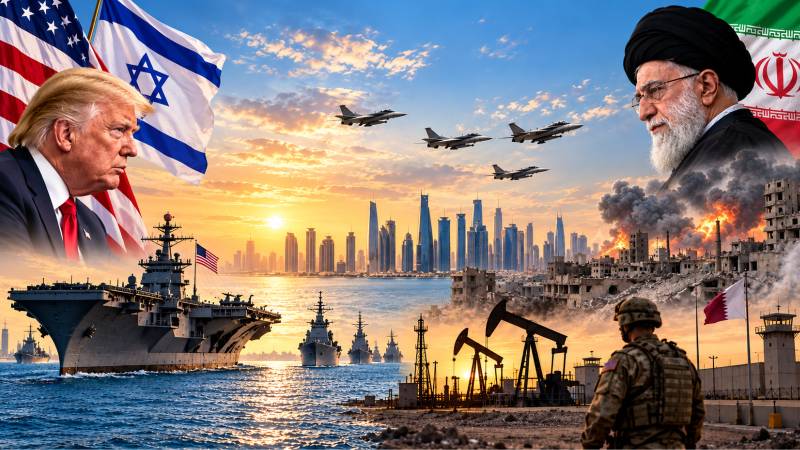
The USA security architecture constructed around the security of Israel, and the protection of Arab allies in the Middle East particularly the ruling dynasties by the President George H.W. Bush in the early 1990 after expelling Iraqi forces from Kuwait by establishing a string of military bases in almost all the Gulf States with a Regional Central Command in Qatar, and a formidable Naval presence in Bahrain. The USA’s military omnipresence in the region created a strong impression of its political, strategic and diplomatic primacy. This security architecture remained unchallenged for over three decades – small setbacks to this predominance notwithstanding.
This resulted in provocative and irritating situations: the foremost being strategic arrogance of Israel, and its military adventures. The second was the complacency of Arabs, and their weakening voice on the Palestinian issue. Although the USA pretended all along to support the resolution of the Palestinian issue by way of two nation state peacefully co-existing in the same land, it failed to deter Israel from expanding its de-facto borders by annexing the lands occupied in Arab-Israel wars, and expanding Jew settlements in the west bank in contravention of the UN resolutions. Its strategic intervention in the neighbouring countries remained unchallenged.
Considering the USA support as a given, the Israeli leaders drifted away from the two-nation state resolution making it practically difficult – if not impossible. The US Presidents exercised a degree of control on Israeli leaders; this disciplining admonition started eroding from the reign of George W. Bush. The last USA leaders could not hold their grip on their leash. President Donald Trump remained excessively charmed by Benjamin Netanyahu. He emerged as a strong headed Arab basher.
Under his stewardship, Israel followed a policy that aimed at weakening the strong nationalist states, and chipping away strategic pieces of land from the weak states. Its aggression in Lebanon, Syria continued and were supported by Trump and Joe Biden unabatedly. The Christian Druze in Lebanon and Syria remained under the thumb of Israel once the Syrian troops withdrew from Lebanon or the Asad dynasty’s grip on power began loosening.
The American security architecture gave Israel strategic confidence while weakening the Arab voice on Palestine and allowing the expansion of Israeli settlements and territorial control.
The Arab countries, given the American omnipresence in the Middle East, were overtaken by a revitalized sense of security in the face of the nationalist states including Libya, Syria, and Iraq after the lightening offensive of the coalition forces to drive out Saddam from Kuwait. Soon after the strategic scenario was interesting. On one side stood all the Gulf States and weak Arab states under the umbrella of the USA and Israel. On the other side stood Iran, Syria, Pro-Iran militias in Iraq; Hezbollah, Hamas and much later Hoathis. The Late Kaddafi was being deluded by the sweet talk of the USA to abandon its nuclear ambitions. The Arab monarchies were weary of Iran’s strategic maneuvers and growing contacts with Shia pockets of their populations. They were, however, assured of the American support in the event of any aggressive adventure by it. We remember how President Donald Trump waxed eloquent about Iran being the axis of terrorism in his first ever visit to Riyadh in May 2017. From Riyadh, he flew to Tel Aviv.
This security architecture received its setback during the Arab Spring. Was the Arab Spring really representing public uprising against Arab autocrats from beginning to end, or was it hijacked by the Western world to save their client Arab rulers, and settle old scores with the nationalists who posed a challenge to their dominance in the region? The Arabs were shocked when Hosni Mubarak was overthrown by domestic political challenges. The situation became worse when general elections led to the success of an Ikhwan-supported president Muhammad Morsi. This rang alarm bells all over the Middle East and forced the Arab monarchs to unlock their coffers for cash supports to their citizens. King Abdullah of Saudi Arabia had taken the lead.
The Arab monarchies funded military campaigns against Col. Kaddafi in Libya, and the Asad dynasty in Syria. Saddam Hussain had already been overthrown. The involvement of the Western world in the Arab Spring was quite apparent. All the pro-USA monarchies remained intact. The USA policy in the Middle East remained muddled and dubious supporting non-state actors, private armies, Kurd mercenaries in Arab civil wars, and crusading against terrorism as a matter of policy in other places. The Arab Spring refueled civil wars in Libya, Syria, Yemen, and Iraq killing and displacing hundreds of thousands. This did not move any Arab country to offer support for this displaced Arab population. Their attempts to migrate to Europe transported sad and heart wrenching tales.
The USA security encouraged two Gulf States to get involved in the civil wars in Syria, Libya, Sudan and Yemen. The latter, unfortunately, has never found peace and stability due to external intervention. For long years, Yemen remained divided into two states with the South ruled by a nationalist and the North run by a pro-monarchy government. The two states reunified for brief years before lapsing into the current wave of civil war because of the rebellion of Hoathis against the Saudi supported rule of President Al-Mansur. Sudan was facing a rebellion in Darfur exasperated by a wealthy Gulf State’s support, buying all the gold extracted from the Darfur region. President Bashar ul Asad survived the civil war with the help of Russia and Iran, but was overthrown in December 2024 by a Saudi supported militia headed by Ahmed Al-Shaara while his allies remained bogged down in wars.
President Donald Trump did not have the idea about the seismic consequences the war with Iran would have over the USA’s political, and strategic clout in the Middle East. The USA leadership had not thought through the unpredictability of a war, and the challenges it would pose. Iran had started investing in its defence plans since the withdrawal of the USA from the Joint Comprehensive Plan of Action in his under Pressure from Benjamin Netanyahu and Saudi Arabia. President Obama had spent years to strike the deal with Iran stopping its nuclear programme, and paving the way for gradual normalization. The Arabs had sensed President Donald Trump’s tilt towards Israel. But no leader dared to bell the cat. On the contrary, they were investing more money in weapons and giving him unusual gifts.
All the planning for war was done by Israel and Mossad. They made gross miscalculations about the Iranian preparedness, its war capability, and economic resilience. The invaders were acting on the assumption that the massive wave of airstrikes, and the decapitation of the political and strategic leaders would trigger a mass uprising against the clerical regime, which would come tumbling down within no time. A string of alternate leaders was already lined up counting a few political figures within the country and from abroad. They were ready to pick their bags and head towards Tehran. The strikes had astronomically opposite consequences.