

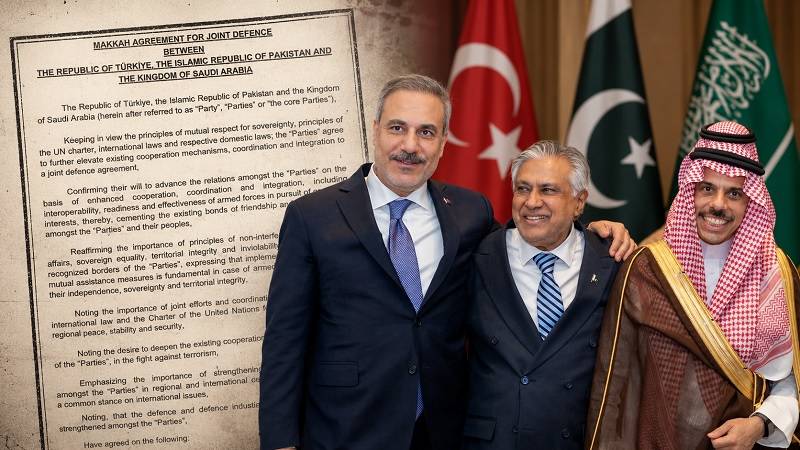
Voila! We finally have the text of the Makkah Joint Defence Agreement (MJDA). And no, it hasn’t been put out by the Government of Pakistan. Here, there has been no discussion on the agreement, no approval from parliament. It just happened, like things now do in this country. Vive le Pakistan!
We have got it from Turkiye. Not exactly a beacon of democracy that country, but it has been presented to its parliament and has found its way to the media.
When the trilateral MJDA, a most ungainly abbreviation, was signed and reported on, headlines focused on its collective-defence language: an attack on one is an attack on all. Expected, because a press release was all we had and this point was its hallmark. There was no written text to flyspeck and analyse. Now we have it.
Mercifully, read closely, the text tells a more cautious story. The pact — fortunately — promises much in principle but gives considerable wiggle room to the three state parties in practice. That, as should be obvious from my drift, is not a flaw, given the fraught circumstances that have birthed it. It also means that those who want to plunge Pakistan into the Middle East abyss need to temper expectations.
Let’s get to it.
The Agreement’s strongest provision is Article 1. If any Party’s territorial integrity, sovereignty, or recognised borders are threatened, the Parties “shall use all necessary means” to eliminate the threat. The wording is mandatory and expansive, though territorial integrity and sovereignty can still be broadly interpreted (does non-contact attack constitute a threat to territorial integrity and sovereignty? Non-contact can be non-kinetic — cyber — or kinetic).
Article 2 declares that an external armed attack on one Party “shall be considered an attack against all,” requiring the Parties to “immediately assist” the victim. Once again, the nature of such an attack is left ambiguous and links up with the questions above.
That said, the same article that creates this obligation also limits it. Support is to be determined “following an objective assessment of the assistance required,” and the Parties are to cooperate “within the limits of their available resources.” In plain terms, no Party has committed in advance to any specific level of military support. Put another way, one can assume that each case will be assessed on its merits, and each capital will decide what and how it can bring to the table.
That is a significant qualification. In treaty law the difference between a result obligation and a best-efforts obligation is the difference between a guarantee and a promise to try. Article 2 sits closer to the latter. The gap between Article 1’s sweeping (but non-specific) language and Article 2’s calibrated mechanism provides the manoeuvring space. One can try to reconcile it by arguing that Article 1 addresses threats, Article 2 actual attacks. But the practical effect is that the most concrete obligation in the document is also its most conditional.
Without the full context, Article 1 went a step further than NATO’s Article 5, a point I have noted in my earlier analyses. Now we have the context and the wording. Like Article 5, it does not guarantee automaticity, but calibration.
Two further clauses widen the escape route. Article 12 states that the Agreement does not prejudice obligations arising from prior international agreements. If in theory a Party has earlier commitments to a non-MJDA state that conflict with this pact, those commitments may prevail (for instance, Saudi Arabia has a formal 2019 strategic agreement with India, titled India-Saudi Arabia Strategic Partnership Council. How would Riyadh respond to an attack on Pakistan by India? Turkiye has NATO commitments).
Article 11 subjects implementation of MJDA to international law and also each Party's domestic law. These are additional legal filters. Neither clause is unusual, but together they mean the Agreement’s obligations operate subject to existing legal architecture, not above it.
The institutional provisions reinforce the point. The authority to make decisions rests with the “Core Parties,” that control accession, amendments, and the Secretariat’s rules by consensus. A Secretariat will be situated in Saudi Arabia, headed first by a Pakistani Secretary-General, a position which will rotate every three years.
The text also lacks any mechanism in case of difference of opinion. Article 14 requires only amicable consultation. To the extent of the present text, no sanctions follow a breach and no automatic trigger compels action. Enforcement rests on political will.
Does this make the Agreement toothless? Not necessarily. Framework defence pacts are rarely self-executing. I have mentioned NATO's Article 5 above. It is often invoked as the gold standard for collective defence. But the fact is — it’s known to those who know the negotiations that went into it and have actually read it — that it leaves the form of assistance to each member: such action as it deems necessary, including the use of armed force.
Since NATO keeps popping up as a comparison (Islamic NATO etc), let me very briefly mention a few facts here. This kind of agreement requires a hegemon. The US had kept NATO propped up.
This is evident from the crisis NATO is facing since the return of to the White House of Donald Trump. Trump’s disdain for NATO has forced a reckoning within the alliance and in the process exposed decades of European military dependency on Washington. And this is an organisation with polished institutional structures like a headquarters, joint command centres, interoperability, synchronised exercises and actual joint combat experience etc.
The operational reality is that European allies from the get go relied on the US for key strategic capabilities: C4ISR and intelligence is one. Satellite reconnaissance, early-warning systems, and high-level battlefield intelligence rely overwhelmingly on US capabilities.
Strategic airlifting and refuelling is another area. Moving large amounts of troops, heavy armour, artillery across distances and even continents independently is nearly impossible for European forces sans US transport fleets. Then there is ground air defence. European states are very deficient in comprehensive air and missile defence umbrellas and lean heavily on US hardware like Patriot/THAAD systems to guard their skies.
Add to this the intra-Europe logistics and mobility crisis. For instance, Baltic states have historically utilised different rail track gauges (old Soviet ones) compared to Western Europe. That complicates military rail transport. Many European roads, bridges, and tunnels cannot support the weight of modern main battle tanks (like the German Leopard 2 or American M1 Abrams) when transported in bulk. Despite decades of integration, moving ammunition and troops across internal European borders still requires peacetime regulatory permissions that delay rapid deployment.
This is why NATO Secretary-General Mark Rutte told the European lawmakers in Brussels: “If anyone thinks here... that the European Union or Europe as a whole can defend itself without the US, keep on dreaming. You can’t. We can’t. We need each other.”
The MJDA has therefore to be seen in light of what can actually be achieved in addition to political signalling. The Agreement establishes a standing consultative architecture, regular ministerial meetings, intelligence-sharing channels and joint training and defence-industrial cooperation. Technically speaking, over time, unless the entire Agreement fizzles out down the line, these can build genuine interoperability and trust — the quiet infrastructure of the Agreement.
The defence-industry provisions are the most important and in fact could bear fruit. Article 7 commits the Parties to joint production, joint research and development, technology sharing and personnel exchanges. Article 6 mandates joint exercises and deployments to improve interoperability. These are practical commitments with measurable inputs and outputs. They may prove more consequential than the headline security guarantee because they create dependencies and habits of cooperation that might outlast political moods or the immediacy of the circumstances.
So how should the Agreement be read? First, as a political declaration of intent with a legal skeleton, not a binding mutual-defence guarantee in the mould of a formal military alliance. Its language is strong where it is general and conditional where it is specific. I assume that that is a deliberate drafting choice, though I could be wrong in putting such premium on intelligent thinking! If it is, it is revealing.
For the Core Parties, the Agreement offers a framework to deepen defence ties without surrendering control over when and how they fight. For subsequent members it offers the protective rhetoric of collective defence without a firm guarantee. For regional rivals, it signals coordination without committing any Core Party to a specific response.
To be fair, none of this is unusual in international security agreements. What is different — and that’s interesting — most other such agreements are aspirational at the edges and precise at the centre. The MJDA inverts that pattern. It is precise at the edges with its committees, a secretariat, training schedules etcetera, and aspirational at the centre.
Let me end by saying two things, one of which I have already pointed to in my previous analyses. Who is this against? This question is important because two state parties are deeply embedded in the US security architecture and one, Pakistan, has a transactional relationship with the US. The current battle-lines are drawn between the US/Zionist entity/Gulf allies and Iran. Is it against Iran since it can’t be against the US and the Zionist entity? Nor is this a theoretical question. Egypt has been complicit in the genocide in Gaza and hasn’t lifted a finger to stop it. But it seems pretty keen to get involved in Yemen.
Second, which state is the hegemon here? None. That would have been fine if the Agreement had stayed clear of the mutual defence clause. Despite lacking teeth it creates unnecessary subterranean obligations. That’s a real problem because all three states parties have opaque, unaccountable systems of governance.
In any case, the test will come in a crisis. If a Party is attacked, what “all necessary means” mean. Saudi Arabia is at war. So far, Pakistan and Turkiye have chosen to support Riyadh without getting involved in the conflict directly. That is sensible; if anything, Pakistan also needs to dial down unnecessary anti-Ansar Allah statements. But that’s a different topic.
Corollary: we have an institutional framework in MJDA which is propped up by strong words but also has an escape hatch built into it. Darwin be praised.