

It was 5th June, 1967. Isreal launched a surprise preemptive air strike on Egyptian airfields. In the ensuing six days war, the Arab world suffered a humiliating defeat. Saudi Arabia, which had not participated directly in the War, was rattled. It reached out to Pakistan in 1967 for provision of training/advisory assistance. Thus, started the military cooperation between the two countries, which over the decades blossomed, with active Pakistan forces deployed in the Country.
Finally, Pakistan and Saudi Arabia signed their bilateral Strategic Mutual Defence Agreement (SMDA) in Riyadh on 17th September, 2025.The core clause declared that any act of aggression against either nation will be considered an aggression against both. For more than seven decades, starting on 14th February, 1945 when President Franklin D. Roosevelt met King Abdul Aziz aboard the USS Quincy, Saudi Arabia’s security architecture rested substantially on American power. Saudi Arabia invested billions of dollars in America especially its arms and armaments.
On 28th February, 2026, USA and Israel attacked Iran. Against all odds and despite suffering huge losses, Iran did not surrender. Not only did Iran use its control over Strait of Hormuz as a strategic weapon but she also attacked all the countries hosting American bases including Saudi Arabia. These attacks exposed the limits of Saudi Arabia ‘s reliance on an American-led security system. Consequently, Saudi Arabia faces the serious threat of a two-front war: Iran and closure of Hormuz and then by the Houthis, who partially control the Bab el-Mandeb Strait.
It is necessary to note that besides Saudi Arabia, other Gulf states have also been questioning the reliability of the US security role following the Iranian attacks. Over the past two decades, Saudi-Turkish relationship has oscillated. From being strong till 2010s, it deteriorated rapidly because of the 2017 Gulf crises, Turkey’s support of Qatar and the murder of Jamal Khasshoggi. But geostrategic developments, especially after Hamas attack on Israel in October 2023 and the resultant genocide of Gazans and Lebanese, have catapulted the relationship between these two middle powers.
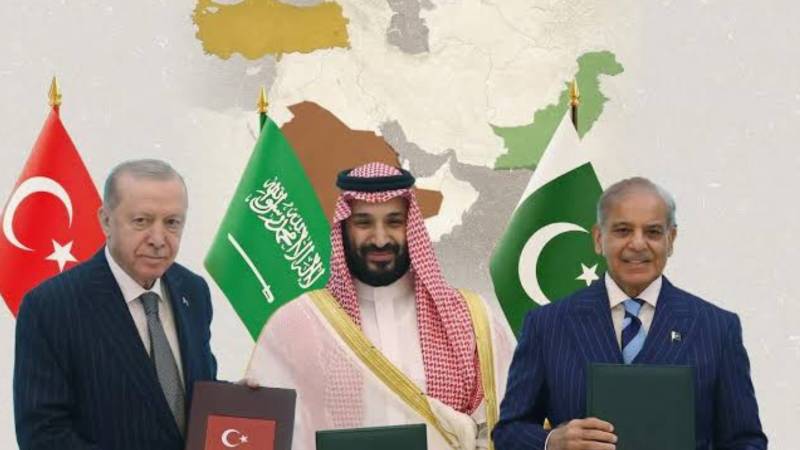
As a consequence of the ongoing Iran war, the serious threat of a large-scale war coupled with the fast-evolving geopolitical order of the Middle East and recalibration of American influence and power, Türkiye, Pakistan and Saudi Arabia signed the Mecca Joint Defense Agreement on 7th August, 2026. This pact is potentially one of the most consequential strategic developments for all the three Countries but especially for Pakistan in decades.
Pakistan is a nuclear power, Saudi Arabia is an energy power and Türkiye is a member of NATO with a very strong indigenous military base.
To understand its importance, some facts have to be understood: The total combined population of the three countries is 383 million people with the combined nominal gross domestic product (GDP) of approximately $3.48 trillion. As per Global firepower, they have 1.4 million active military personnel. They have 6046 Tanks, 7100 artillery/rocket systems, 3400 aircraft, including 815 fighter jets, 33 aerial tankers, 22 submarines, besides Cruise missiles, drones, cyber warfare systems and a host of other military equipment.
Moreover, Pakistan is a nuclear power, Saudi Arabia is an energy power and Türkiye is a member of NATO with a very strong indigenous military base. The clause, “An armed attack against one member is considered an armed attack against all”, creates the principle of collective deterrence. Thus, conceptually it is like the NATO article 5, but not institutionally. Resultantly, it has raised the strategic power of these countries. And if more Muslim countries join in, it can become a very powerful force. However, on ground realities may challenge the implementation of this agreement.
Pakistan’s primary strategic concern is India and Afghanistan while Saudi Arabia is threatened by Iran, Yemen and the Gulf whereas Türkiye sees Syria, Iraq and the Kurds as its adversaries. Thus, although strategic interests may overlap but they are not identical. Then, there is the issue of geography. None of the countries border each other. In such a situation, a genuine military integrated alliance would require air corridors, bases, naval logistics, intelligence sharing, inter-operability, command structures and other requirements before it could become operational.
The third major issue would be the different types of weapon systems. Whereas Türkiye and Saudi Arabia have predominantly American and European arms, Pakistan has a huge Chinese inventory. To ensure that all work in unison during a conflict would be a challenge. Another scenario which would test Pakistan would be if Iran and Saudi Arabia go to war. What would be our stance? And if India and Pakistan would go to war then would Saudi Arabia support Pakistan as it hosts millions of Indian nationals in Saudi Arabia.
Ultimately, the Mecca Agreement will be measured not on the written word but on the choices the signatories shall make when an armed conflict comes knocking. Its greatest promise lies in bringing Pakistan’s battle tested armed forces, Saudi Arabia’s economic and energy power and Türkiye’s NATO experience and its indigenous defense industry. And yet, its greatest vulnerability lies in its diversity. Three countries, three geographies, three threat perceptions, and three sets of distinct national interests.
The world is moving from a unipolar world to a more uncertain multi-polar one. United States, China and Russia are increasingly competing for influence in this emerging world order. In the immediate future, the Mecca agreement may therefore prove to be less about creating another military alliance and more about asserting a new reality that the Muslim world intends to shape its own security destiny. The significance of this pact is not simply that three Muslim countries have signed a defense agreement; it is that they are attempting to create strategic autonomy at a moment when decades old confidence in the American-led security architecture is waning. It may be the dawn of an Islamic awakening and its rightful place in human civilization.