

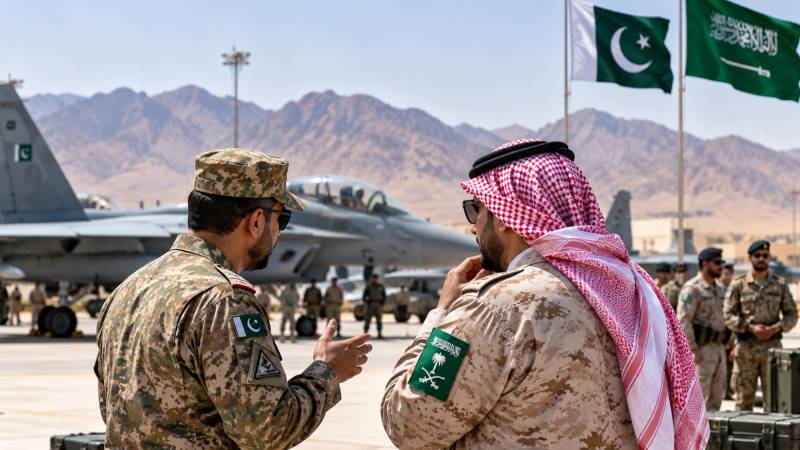
Saudi Arabia spent $83.2bn on its military in 2025, almost seven times Pakistan's $11.9bn, according to SIPRI. It was the world's largest arms importer in 2015-19 and the fourth largest in 2020-24, with the United States supplying 74 per cent. It flies F-15s and Typhoons and fields Patriot and THAAD missile defences. Yet in the past year it has signed a mutual-defence treaty with Pakistan, hosted Pakistani fighters, drones and air-defence units, and joined Pakistan and Türkiye in a collective-defence alliance now being activated against the Houthis.
The obvious explanation — a rich state hiring a poorer one's soldiers is wrong. Saudi Arabia does not need Pakistan to fight its wars. It needs Pakistan so that it can fight them. What Riyadh is buying is defensive depth, recent combat experience and a nuclear shadow. The events of 2026 show why each has become scarce.
The two armed forces were shaped by opposite pressures. Saudi Arabia's was built around regime security. Alongside the regular army sits the National Guard, rooted in tribal forces loyal to the ruling family and answering to its own ministry; the IISS has put the army at roughly 75,000 and the Guard at about 100,000. Parallel forces guarded the monarchy against concentrated coercive power. They did not produce a mass army organised for sustained war against another state. Oil wealth bought platforms instead: advanced aircraft, precision weapons and missile defences, all dependent on foreign supply chains and support.
Pakistan's was built around India, which spent $92.1bn in 2025, almost eight times as much. Facing a far larger neighbour, Pakistan built staff colleges, logistics and engineering formations, deep officer and NCO cadres, and a defence industry producing tanks, artillery, missiles and drones, with China central to modernisation. The JF-17, developed with China, captures the approach: credible capability at a price Pakistan can sustain.
Co-operation between the two dates to a 1967 training agreement and a 1982 protocol for Pakistani training, advice and deployments. For decades it ran one way: Pakistani expertise flowing into young Saudi institutions. The 2015 intervention in Yemen exposed the limits of the Saudi model. The coalition had air superiority, precision weapons and Western intelligence, yet could not produce a decisive outcome. The Houthis absorbed the bombing, exploited terrain and built increasingly capable drones and missiles. Air power could destroy targets; it could not hold ground, and Saudi Arabia leaned on Yemeni and Emirati-backed formations to do that.
Riyadh responded by trying to build its own defence industry. The General Authority for Military Industries, founded in 2017, says localisation reached 24.89 per cent of military spending by end-2024, against a 2030 target of half. But industry takes decades. The gaps Yemen revealed — ground manpower, sustained operations, and the ability to defend a vast territory against cheap, numerous threats could not be closed by procurement.
Yemen also produced the sharpest Saudi-Pakistani rift. In 2015 Riyadh asked for aircraft, warships and troops. Pakistan's parliament unanimously refused, while pledging to defend Saudi territory. That line defend the kingdom, stay out of its war has defined the relationship since. In February 2018 Pakistan's defence minister told the Senate that about 1,600 personnel were serving in the kingdom and more than 1,000 would follow, to train and advise, inside Saudi territory. Nearly 10,000 Saudi personnel had trained in Pakistan.
Then the relationship changed in kind. In early 2024 Saudi land forces spent six weeks training with the Pakistan Army's Multan Corps in conventional and sub-conventional warfare. In early 2025 JF-17 Block IIIs flew non-stop to King Abdulaziz Air Base for the multinational Spears of Victory exercise, using aerial refuelling — proof that Pakistan could put a functioning air package on Saudi soil quickly.
The trajectory is clear: training in 2018, interoperability in 2024-25, a treaty in 2025, operational formations in 2026, and collective defence by October.
On September 17 2025, days after Israel struck Hamas officials in Doha, the two signed a Strategic Mutual Defence Agreement: aggression against either is aggression against both. The text is unpublished. It does not mention nuclear weapons, though Defence Minister Khawaja Asif has implied it places Saudi Arabia under Pakistan's nuclear umbrella. The result is ambiguity rather than a guarantee but for an adversary weighing a major attack on the kingdom, ambiguity about a nuclear-armed ally is itself a deterrent.
Three developments this year explain why Riyadh moved from training partner to treaty ally.
First, interceptors. After the United States and Israel began striking Iran on February 28, Tehran hit Gulf states, including Saudi energy infrastructure. Gulf interceptor stocks were drawn down heavily. The arithmetic of modern air defence is brutal: a Patriot round costs millions, a drone tens of thousands, and production cannot be accelerated quickly. A kingdom of more than two million square kilometres — oil fields, pipelines, desalination plants, cities and the two holy mosques cannot be defended by expensive interceptors alone. It needs layers: radars, short-range systems, guns, counter-drone teams and crews to man them.
In early April, after Iranian strikes killed a Saudi national, Pakistan sent combat aircraft. In May Reuters reported, citing five security and government sources, that Pakistan had deployed about 8,000 personnel, a squadron of around 16 aircraft, mostly JF-17s, two drone squadrons and an HQ-9 long-range air-defence system, operated by Pakistani crews. Neither government confirmed it; Pakistani security sources called the report "angled". One source who had seen the treaty said it allowed for up to 80,000 Pakistani troops to help secure Saudi borders — a reported ceiling, not a commitment.
The difference from 2018 is not just scale. A fighter is not a capability on its own; it needs pilots, ground crews, weapons, maintenance and command. Pakistan can deploy aircraft and air-defence batteries as functioning units because the institutions behind them exist at home. That is what Saudi money has not been able to buy. There is a second advantage in the HQ-9. Operated by Pakistani crews, it gives Riyadh access to Chinese long-range air defence without Saudi Arabia formally acquiring it and without the friction with Washington that a direct purchase would bring.
Second, combat experience. In May 2025 Pakistan fought a short, intense air war with India. Two US officials told Reuters they had high confidence that Pakistan's Chinese-made J-10s had brought down at least two Indian aircraft, at least one of them a Rafale. Few air forces anywhere have recently fought a modern, Western-equipped opponent. Pakistan's has, and it has also defended against drone swarms. For a kingdom facing the same threats, that experience is worth more than another squadron of new aircraft.
Third, partners. Saudi Arabia's Yemen coalition depended on the UAE. In December 2025 the Emiratis pledged to withdraw their remaining forces after a crisis with Riyadh, and in January Saudi aircraft struck UAE-backed southern separatists. Washington has filled part of the gap, supplying intelligence and targeting data for Saudi air operations — but Reuters reported that President Trump rebuffed the crown prince's requests for direct support such as air strikes. Riyadh lost its main ground partner and could not get its main patron to fight. Pakistan and Türkiye are the replacements.
On August 7 Saudi Arabia, Pakistan and Türkiye signed the Makkah Joint Defence Agreement: an attack on one is an attack on all. In Istanbul on August 31 they renamed it the Makkah Defence Alliance, agreed a permanent secretariat in Riyadh and committed to joint exercises and joint defence production. On September 23 Pakistan named retired Lieutenant General Nauman Mahmood its first secretary-general.
The division of labour is clear. Türkiye supplies drones — Turkish aircraft bought before the war are already flying over Yemen — and NATO-standard industry. Pakistan supplies manpower, air defence, experience and the nuclear shadow. Saudi Arabia supplies the theatre and the targets. The test came quickly. The Houthis declared a naval blockade of the kingdom in July, seized the Red Sea port of Mokha on September 10 and struck southern Saudi cities; a drone was intercepted near Makkah. On October 5 the alliance's ministerial committee decided to move immediately to implement collective defence and rapidly deploy agreed forces to Saudi Arabia. The same day Saudi-backed Yemeni forces launched a counteroffensive.
Reuters reported on October 2, citing one Pakistani official, that 30,000-40,000 Pakistani personnel had arrived in waves to defend borders and intercept drones and missiles; Pakistan's Information Ministry called the report speculative. Whatever the number, its purpose is the core of the argument. Pakistani troops take over the defence of Saudi territory so that Saudi forces are free to fight in Yemen.
The case should not be overstated. There is no public evidence yet that Pakistani forces have changed outcomes. Iranian strikes hit Saudi facilities after the April jets arrived; the Houthis took Mokha after the May deployment. Integrating Chinese-built systems and Pakistani crews into a Saudi network built on American radars, data links and Patriot batteries is technically hard, and neither side has said how far it has gone.
Pakistan is also stretched. Since February 26 it has been fighting the Afghan Taliban and the TTP in Operation Ghazab-lil-Haq, striking targets inside Afghanistan; Islamabad says nearly 800 fighters have been killed. India remains the primary threat, a year after the most serious crisis between the two in decades. Balochistan is unsettled. Iran, on Pakistan's western border, was this year both Islamabad's mediation partner and Riyadh's attacker. Tens of thousands of troops in Saudi Arabia is a large commitment for an army already fighting on one frontier and watching another.
The 2015 line still holds, but it is thinning. Reuters reported that four Pakistani cargo aircraft flew air-defence systems, light artillery, drones and counter-drone equipment to Aden in September, and that Pakistani advisers were on the ground alongside Saudi counterparts supporting Yemeni forces. A Western official told Middle East Eye that Pakistani personnel were already in southern Yemen, in an unclear capacity. Asked whether Pakistan had joined strikes in Yemen, Asif said only that whatever means Pakistan had would be available to Saudi Arabia. The planned offensive is to rely on Yemeni ground forces and Saudi air power, and a Pakistani official said Islamabad had not decided to send troops in to fight.
The trajectory is clear: training in 2018, interoperability in 2024-25, a treaty in 2025, operational formations in 2026, collective defence by October. The progression has been from training to operational reinforcement to collective defence. Saudi Arabia still needs Pakistan's military — not because it is weak, but because the kind of war it now faces consumes the things money buys slowest: trained crews, depth, experience and credible deterrence. The harder question is Pakistan's. Its value to Riyadh lies in defending the kingdom so Saudi forces can fight elsewhere. The more successfully it does that, the closer it stands to the war it refused to join in 2015. The relationship's future may depend less on how many Pakistani troops are in the kingdom than on whether Riyadh and Islamabad can keep agreeing where defending it ends and fighting its wars begins.