

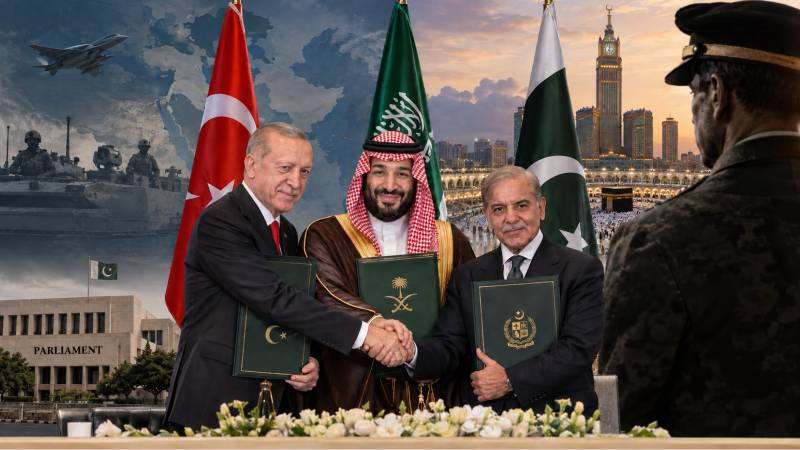
The signing of the Tripartite Makkah Joint Defense Agreement among Pakistan, Saudi Arabia, and Türkiye marks a significant development in the security architecture of the Middle East and South Asia. By combining Pakistani military manpower, Saudi financial resources, and Türkiye’s expanding defense-industrial capacity, the agreement is presented by its architects as a framework for collective security. Yet its broader significance for Pakistan cannot be evaluated strictly through the lens of external defense. The central question raised by such alignments is not simply whether they enhance Pakistan’s regional clout, but who within the state exercises that influence, to whom they are accountable, and whether external validation reinforces elected civilian institutions or deepens their systematic marginalization.
Pakistan’s political evolution presents a persistent paradox: periods of heightened geopolitical importance consistently expand the authority and institutional reach of the military establishment without producing durable democratic governance or positive national outcomes. Successive waves of military rule have repeatedly culminated in strategic and domestic crises rather than long-term stability. During the Ayub Khan era, participation in Cold War alliances like SEATO and CENTO prioritized security utility over representative governance, fostering the institutional overconfidence that led directly to the 1965 war with India. This militarized statecraft reached its nadir under General Yahya Khan, whose refusal to honor democratic electoral mandates and reliance on military enforcement resulted in the traumatic defeat and dismemberment of the country in 1971. Decades later, under Zia-ul-Haq, the Soviet invasion of Afghanistan transformed Pakistan into a frontline proxy; while this provided military rule with foreign capital and international legitimacy, it saddled the country with a massive refugee burden, violent radicalization, and an entrenched "Kalashnikov and heroin culture" that permanently damaged the domestic social fabric.
This destructive pattern reemerged under Pervez Musharraf, whose tenure vividly illustrated the hazards of unchecked military decision-making. The 1999 Kargil conflict initiated by the military leadership without the knowledge or consensus of the elected Prime Minister demonstrated how unilateral strategic adventurism damages state credibility and international standing. Following September 11, Musharraf leveraged Pakistan’s strategic indispensability to the West to insulate his regime from democratic pressure, pulling the nation into a War on Terror that ignited a devastating internal security blowback and a long-term terror crisis. Simultaneously, the 2006 assassination of Nawab Akbar Bugti exemplified the establishment's tendency to securitize political grievances, escalating a manageably delicate situation into the enduring conflict that destabilizes Balochistan to this day.
The central question raised by such alignments is not simply whether they enhance Pakistan’s regional clout, but who within the state exercises that influence, to whom they are accountable, and whether external validation reinforces elected civilian institutions or deepens their systematic marginalization.
Today, under Field Marshal Asim Munir, this historical cycle repeats itself with remarkable fidelity. Preoccupied with Middle Eastern volatility and South Asian fault lines, regional and global powers once again find it convenient to engage directly with military headquarters rather than an elected civilian apparatus. This dynamic has been intensified by recent developments. During the Operation Sindoor standoff with India, Rawalpindi projected a narrative of operational parity, framing the engagement as a decisive political and military display. Simultaneously, as external powers conducted sensitive regional negotiations, Pakistan’s strategic channels allowed the security apparatus to position itself as an indispensable mediator. Coupled with the diplomatic visibility of the Makkah Agreement, this projected potency has reinforced the institutional dominance of the military establishment.
Rather than encouraging a handover of power to civil authorities to solve the country's severe political and economic crises, this heightened confidence entrenches hybrid rule. When foreign powers conduct security dealings directly with military institutions, those institutions convert foreign recognition into domestic political capital. Under the rationale of managing complex diplomatic commitments, intelligence sharing, and defence production, crucial state decisions routinely migrate from constitutionally mandated bodies toward military headquarters. Parliament is reduced to a formal arena that merely validates choices made elsewhere, creating a self-reinforcing loop: the more central the security apparatus becomes to foreign policy, the more indispensable it appears, and the easier it becomes to justify excluding civilian institutions.
This centralization directly expands the military’s economic footprint, reinforcing what Dr. Ayesha Siddiqa conceptualizes as Milbus, a military-corporate enterprise that converts state power into commercial capital. External partnerships yield soft loans, foreign investment, and balance-of-payments support; yet, as economists like Dr. Ishrat Husain note, reliance on these "strategic rents" disincentivizes structural reform. Instead of fixing loss-making state-owned enterprises or expanding the tax base, the establishment uses foreign capital inflows to cushion fiscal shortfalls. Institutionalized through platforms like the Special Investment Facilitation Council (SIFC), military leadership now directly steers foreign investment and major economic assets. Because the security apparatus operates vast commercial foundations and industrial conglomerates, capital from defence cooperation disproportionately enriches military-linked enterprises over the civilian private sector. This fiscal fragility leaves elected governments perpetually dependent on unelected power centers to secure state solvency.
Far from addressing these governance failures, the establishment has leveraged its position to advance domestic initiatives that risk greater political volatility. A prime example is the top-down push to restructure Pakistan’s federal framework by dividing historical constituent units into smaller administrative provinces under the guise of efficiency. Driven by centralized planners rather than democratic consensus, these proposals expose a profound lack of long-term strategic vision behind hybrid rule. In a federal republic where constitutional protections explicitly guarantee provincial autonomy, attempting to redraw internal boundaries risks fracturing regional political bases and provoking deep anxieties over cultural identity and resource distribution, thereby destabilizing the federation.
When national security becomes the primary lens of statecraft, legitimate political disagreement and rights-based activism are routinely securitized. Regional movements, human rights advocates, independent journalists, and opposition leaders who challenge top-down engineering are labeled as threats to national stability or instruments of foreign adversaries. This expansive definition of security narrows public discourse and erodes pluralism. Over time, systematically excluding the Ministry of Foreign Affairs, parliamentary committees, and civil administrative bodies from high-stakes decisions deprives them of the opportunity to build expertise. Removing these functions from elected authorities creates the very civil incompetence that is later cited to justify their continued exclusion.
Ultimately, foreign policy achievements cannot be celebrated as unqualified national victories if they systematically push civilian political forces further to the margins. As Pakistan’s history demonstrates, strategic expansion abroad without constitutional civilian control at home is a proven formula for domestic crises and authoritarian entrenchment. Breaking this cycle requires more than holding periodic elections; it requires establishing strict civilian oversight over national security policy, adhering to federal constitutional norms, and building foreign relationships that do not treat military predominance as the default mechanism for international engagement.