

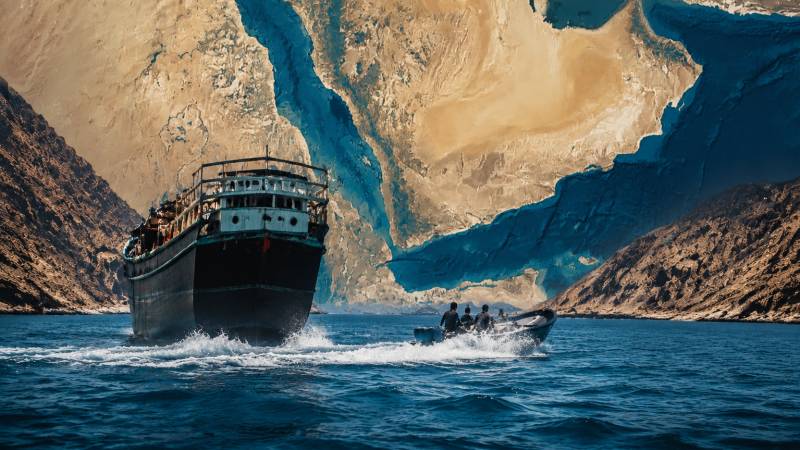
Two Saudi oil tankers bound for Asia reversed course in mid-July in mid-ocean right before they approached Bab el-Mandeb. Tracking data showed them turning away from their destinations rather than pressing forward. This was not a routine commercial decision. It was a response to the Houthis closing the narrow Red Sea passageway for vessels coming from Saudi Arabia. It has been almost a month since this incident. Houthis - the powerful rebel group in control of much of Northern Yemen - have targeted port infrastructure in Yemen, launched missiles at cities near the Yemen border in KSA but they have largely let most other ships pass through unobstructed. This may be because after their blockade in 2023, they received a thrashing and then some from the United States.They are reluctant to invite America’s wrath again. There are indications, however, that Iran is pressuring them to close Bab el-Mandeb once more while it closes Hormuz. If this happens, world trade will be impacted on a scale few have contemplated.
The World’s total trade is $35 trillion annually, of which roughly 80% moves over the high seas. Ships traversing these high seas have to pass through narrow passageways. Some are man-made and called canals. Most of these narrow alleyways are naturally formed and are called straits. The Middle East has two of these chokepoints on either side of the Arabian peninsula. While Hormuz dominates the headlines, Bab el-Mandeb is equally important.
Together these two straits bookend the Arabian Peninsula and underwrite a large share of global commerce. In a normal year roughly 20 million barrels of oil and products - about a quarter of seaborne oil trade and one-fifth of world consumption - pass daily through Hormuz, with nearly a fifth of global LNG following the same route, mostly to Asia. At the opposite end, Bab el-Mandeb handled 9.3 million barrels of oil per day in 2023 (roughly 9–12% of seaborne oil) and 8.7% of all seaborne trade by volume, serving as the southern gateway for the Suez corridor’s Asia–Europe container and bulk traffic. Close both at once and the only real alternative is the longer, costlier Cape of Good Hope route, directly hitting the $35 trillion in annual trade that still moves overwhelmingly by sea.
This is more than a temporary disruption. The global economy operates as an extended production chain. Crude that never clears Hormuz never reaches Korean or Japanese refineries. Feedstocks that fail to arrive leave European chemical plants idle. Container traffic forced to avoid the Red Sea must sail around the Cape of Good Hope, adding thousands of miles, up to two weeks of transit time, and sharply higher freight costs. The initial loss at the chokepoint is counted again at every downstream factory and warehouse that depends on timely delivery. Just-in-time manufacturing systems in the United States and Europe, built for efficiency rather than resilience, amplify the shock.
Recent history offers clear warnings. The 2021 grounding of the Ever Given in the Suez Canal - one ship, six days - disrupted roughly one-tenth of global seaborne trade. The Houthi campaign that began in late 2023 cut container traffic through the Bab el-Mandeb by as much as 90 percent, forcing major carriers to reroute around Africa at significant cost. Those episodes involved only one chokepoint. Simultaneous pressure on both Hormuz and Bab el-Mandeb removes the primary remaining workarounds for Gulf energy and for a large volume of containerized goods that normally transit the Red Sea.
Alternative routes exist on paper but collapse under volume and cost pressure. Saudi Arabia can load crude at Yanbu on the Red Sea and send it north through the Suez Canal or the SUMED pipeline. This path avoids Hormuz, yet it is poorly suited for Asian markets: a voyage that once took roughly 24 days to South Korea expands to more than 50 days when vessels must ultimately sail around Africa. Very Large Crude Carriers often exceed Suez draft limits, requiring partial offloading or substitution with smaller ships. Both options raise unit costs and reduce net throughput. Recent drone activity near Egyptian Mediterranean ports further erodes confidence that any Middle Eastern entry or exit point remains reliably secure. The bottleneck is no longer merely logistical; the routes themselves have become contested.
Simultaneous pressure on both Hormuz and Bab el-Mandeb removes the primary remaining workarounds for Gulf energy and for a large volume of containerized goods that normally transit the Red Sea.
The distribution of pain is uneven, but the systemic exposure is broad. Gulf commodity exporters face immediate revenue losses. Asian importers - China, India, Japan, South Korea, Taiwan, Indonesia, and Pakistan - depend most heavily on the roughly 40 miles of water that constitute these two straits. European and American consumers experience the effects more diffusely but no less certainly: elevated crude prices, higher energy and transportation costs, and supply-side inflation that monetary policy cannot easily offset. Oil cannot be printed, and a shorter route around Africa does not exist. Freight costs embed themselves in final goods prices. Empty shelves follow delayed inputs.
Behind the operational details sits a strategic reality. For four decades, the U.S. Navy underwrote freedom of navigation through these waters as a public good of the postwar order. That guarantee rested on credible forward presence and the assumption that no local actor could sustainably challenge it. The current conflict has tested that assumption. Iranian asymmetric capabilities and Houthi operations have shown that relatively low-cost systems can impose high costs on global commerce and on the political will of external powers. Escorts, mine clearance, and sustained strikes on coastal batteries are resource-intensive and still leave residual risk that commercial operators price into insurance and routing decisions.
What replaces the previous arrangement is not yet clear. Regional powers are exploring new security understandings, such as the recently signed Makkah Pact between Saudi Arabia, Turkey and Pakistan. China has economic interests but has shown limited appetite for the military entanglement required to guarantee passage. Other states lack the combination of naval capacity, basing access, and political bandwidth. In the interim, the dual closure functions as a stress test of the maritime order itself.
The problem is not that escape routes do not exist. It is that they are too narrow, too slow, and too expensive to carry the volume on which the modern economy depends. Geography has reasserted itself. The policy question for the United States and its partners is whether the restoration of reliable transit remains a core interest worth the sustained investment and sacrifices required, or whether managed, high-friction chokepoints will become the new baseline. The tankers that turned around have already answered the first part of that question. The second remains open.