

Every time Pakistan's energy crisis resurfaces, the discussion follows a familiar pattern. We debate rising electricity prices, fuel imports, and recurring power shortages. These are real worries, but they frequently distract us from a more pressing question: Are we investing in scientific innovations that will shape the future of energy?
The answer is becoming clearer all around the world. Countries are investing not only in renewable electricity but also in the technologies required to make clean energy feasible. One of the most promising is hydrogen, a fuel that has the potential to transform transportation, industry, and power generation while producing only water at the point of use.
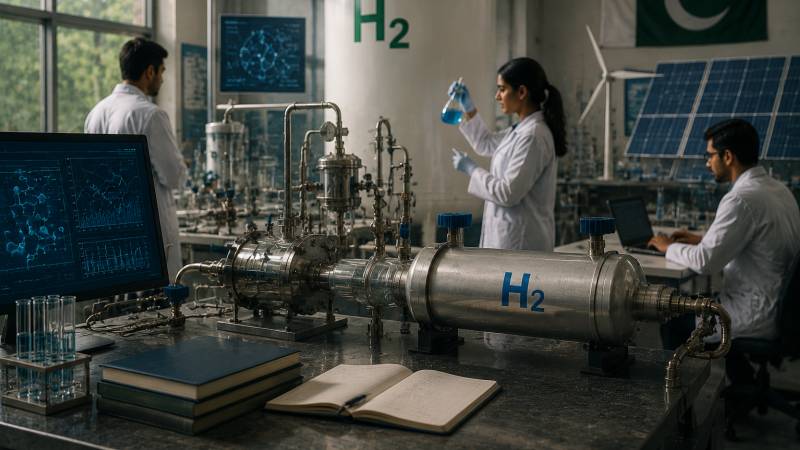
Hydrogen is frequently referred to as the fuel of the future. However, the most difficult aspect is something very simple: storing it. Unlike traditional fuels, hydrogen cannot be efficiently stored using standard methods. Its extremely low density makes storage technically demanding and economically expensive. Scientists all across the world are looking for innovative materials that can store hydrogen in a safe, efficient, and affordable manner. Solving this problem could move the world much closer to a cleaner, more sustainable energy system. This search is taking place not only inside laboratories but also inside computers.
Modern computational materials science enables researchers to examine thousands of potential materials before conducting a single laboratory experiment. Quantum-mechanical computations allow scientists to assess material properties, predict atom-to-atom interactions, and select potential candidates with amazing accuracy. This approach reduces research expenses, speeds up discovery, and helps in concentrating experimental efforts where they matter most. My personal exposure to this field began with a simple question: Could a specific material store hydrogen effectively?
The countries leading today's clean energy revolution did not reach that position by chance. They made continuous investments in scientific research, improved their universities, encouraged academic-industry collaboration, and saw innovation as a national goal rather than an academic luxury.
Finding the answer was not as straightforward as testing whether hydrogen could bind to the material. Before that, I first had to determine whether the material itself exhibits the structural and electronic properties needed for hydrogen storage. The next phase began only after the computations yielded encouraging findings.
From there, the detailed process of analyzing hydrogen adsorption, interpreting computational data, comparing results, and transforming hundreds of numerical values into graphs that revealed the material's behavior. The experience showed me that scientific research is rarely about big discoveries. More typically, it is a process of asking probing questions, validating every outcome, and relying on evidence rather than assumptions to lead to each decision.
That lesson applies to far more than just one research project. Pakistan has thousands of outstanding students who can contribute to scientific research. However, many encounter the same obstacles: limited research funding, insufficient computational resources, and inadequate opportunities to participate in internationally competitive research. As a result, promising ideas often remain confined to university classrooms instead of becoming innovations that benefit society.
Pakistan has the opportunity to make similar choices. Not every university can establish billion-dollar laboratories, but many can improve computational research, extend undergraduate research opportunities, provide access to high-performance computing, and provide mentorship and research funding to young scientists. In domains such as computational materials science, meaningful discoveries increasingly depend on intellectual capacity as much as expensive equipment. There is another investment that deserves equal consideration: science communication.
Research has the greatest influence when it extends beyond academic journals. When scientists describe their work in terms that students, teachers, policymakers, and the general public can comprehend, they strengthen trust in science and inspire future generations to conduct their own research. Scientific information should not be limited to professionals; rather, it should become part of national debate. Pakistan's energy future will not be assured only by importing advanced technologies. It will be shaped by our capacity to create, enhance, and advance global science. This begins with investing in individuals that ask difficult questions, test bold ideas, and work hard to create evidence-based solutions.
Hydrogen may not address every problem in our energy industry, but the development of improved hydrogen storage is even more crucial. It reflects the power of scientific curiosity to solve problems that affect millions of lives. The clean energy transition is already underway. The real question is not whether Pakistan can afford to invest in science. It is whether Pakistan can afford not to.