

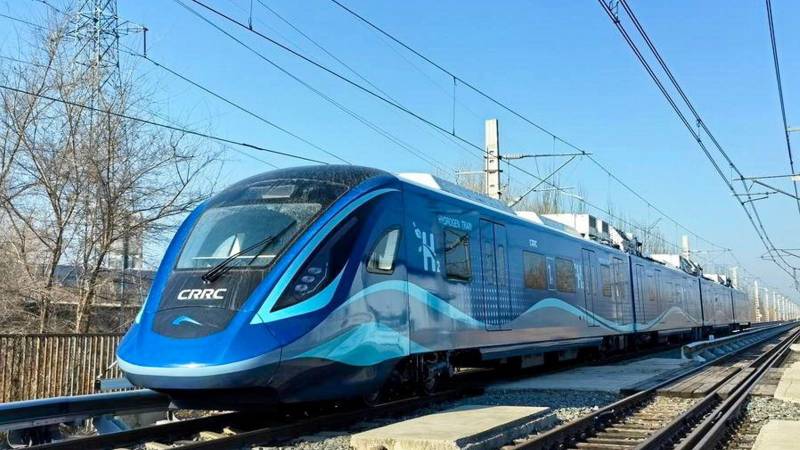
Over the years, rail transport has undergone a significant metamorphosis, moving from steam to diesel and electric traction. Hydrogen is believed to be the next step in the advancement of rail transport, but the question arises if we are witnessing the arrival of the future of rail or if it will only be another experiment with limited possibilities. The answer is worth careful consideration.
Hydrogen trains have stopped being a laboratory project. Germany was the first to launch hydrogen passenger trains, with Italy, China, and India working to create their own hydrogen-powered trains. The first hydrogen train in India, running between Jind and Sonipat, is considered to be an engineering breakthrough. The train uses hydrogen fuel cells to generate power. However, the successful launch of a train does not guarantee the success of the railway strategy.
One important aspect that is frequently overlooked while talking about hydrogen is that it is not an energy source, like coal or solar energy. Rather, hydrogen is an energy carrier. First, electricity is needed to make hydrogen. The resulting hydrogen is then compressed, stored, and transported. Finally, it gets converted back into electricity through a fuel cell which powers the train. Each step of the process uses energy. As a result of this, hydrogen trains are typically less energy efficient than electricity-powered battery-electric trains. Therefore, making hydrogen the choice only because it releases water vapour during the operation of a train is not right. The environmental benefits depend also on how hydrogen is produced. If it is produced with the use of renewable electricity such as wind or solar energy, it can genuinely be an environmentally friendly mode of transport. But if it is produced from natural gas without significant carbon capture solutions, it will not be very useful in terms of climate change.
So Why Are Railways Still Interested?
One of the key advantages of hydrogen comes in non-electrified railways. Electrification of the railway system will require large infrastructure costs consisting of overhead cables and telecommunications equipment. For lightly trafficked regions, remote areas, and mountainous areas, electrification may not be economically viable.
If it is produced from natural gas without significant carbon capture solutions, hydrogen will not be very useful in terms of climate change
Hydrogen represents an alternative since hydrogen trains can carry their own fuel. A project that is exciting is that of Italy’s hydrogen trains being developed on the non-electrified Brescia–Iseo–Edolo railway in Lombardy. The project involves the construction of infrastructure for hydrogen production, storage, and refuelling. Both the potential of the hydrogen project and the rest of its challenges are obvious: a hydrogen train requires an entire ecosystem.
Lessons From India's Experience
India's hydrogen train is of great interest to developing countries. On the Jind–Sonipat service, Indian engineers have the possibility to test the technology in real-life railway conditions. The most important aspect is not just the train, but the lessons learnt from its operations. India may collect information concerning:
- Hydrogen storage and refuelling
- Fuel cell effectiveness
- Safety protocols
- Requirements for maintenance
- Fuel cell degradation
- Energy consumption
- Reliability in a long-term perspective
- Operating costs
Such knowledge may provide answers regarding the future of hydrogen trains on large railways in India.
In terms of the future of rail transport, one specific technology alone may not again be leading the way. When it comes to busy rail routes and high levels of passenger traffic, electrification may remain the best solution. In situations involving short routes where there is no electrification, battery-powered trains could be a better option because they can use electricity in a more efficient manner. Hydrogen could also find its way onto non-electrified longer routes, especially when any issues involving battery range, charging time, or infrastructure arise.
What About Pakistan?
Pakistan must keep an eye on current changes which are taking place in the hydrogen sector. It is necessary to note that despite the extensive network of railways, Pakistan Railways primarily relies on diesel. However, the country possesses both wind and solar energy resources sufficient for producing green hydrogen. Nevertheless, Pakistan should refrain from significant investments into hydrogen technology at this point. It would be advisable for the country to develop a Hydrogen Rail Roadmap instead. It means that Pakistan Railways needs to engage with universities, engineering companies, and research institutions for the analysis of hydrogen technology and foreign experience implementation.
The railway corporation should also choose one of its lines not yet electrified in order to implement a pilot project. Thus, renewable energy should be spent on local green hydrogen production, so that in the end, Pakistan has a possibility to test any hydrogen trains and the full hydrogen supply chain system. Besides, the government should evaluate the advantages of hydrogen trains against diesel and battery-electric systems, as well as conventional electrification, in terms of start-up costs, efficiency, maintenance, emissions, and reliability of the fleet.
The Future Must Follow the Facts
Although hydrogen trains have potential, we should not be overly optimistic about their advantages. The industry must first solve many issues regarding the efficiency of the trains, the production of green hydrogen, and building the necessary infrastructure, as there are economic and technological issues associated with the introduction of hydrogen-powered trains. Thus, the key lesson to be learnt from case studies is not the need for every railway line to be powered by hydrogen technology, but the necessity to test the new technology, gather evidence from real-life experience, and only then invest heavily in the technology.
Hydrogen trains might not be a panacea for the transportation industry, but they can be a viable solution for some routes, and maybe that in itself is a success story. Sustainable railway transportation does not necessarily mean choosing between hydrogen, batteries, or electricity. Transporting goods and passengers sustainably means selecting the right technology for certain railway lines. For Pakistan, it is essential not to blindly follow the path of other countries, but rather learn from their experience when developing its own railway strategy that is in accordance with its goals.