

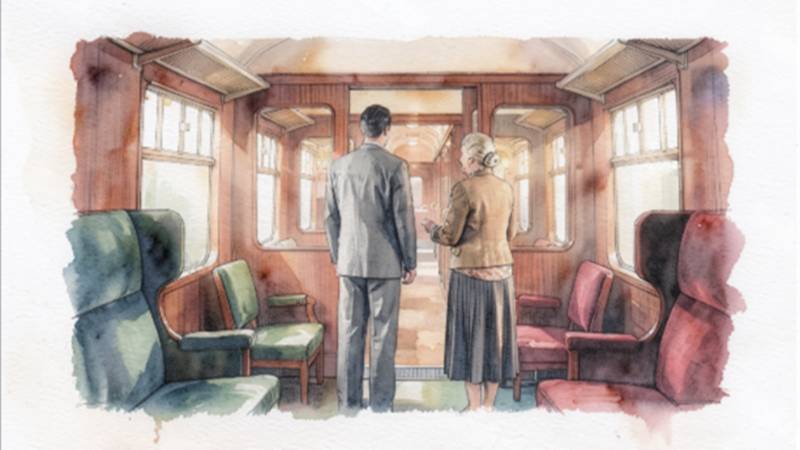
In The Midnight Train, an 81-year-old London bookstore owner named Wilbur Budd suffers a massive heart attack and awakens near death on a fog-enshrouded railway platform. There, he encounters an enigmatic Conductor operating a vintage locomotive known as the Midnight Train.
The book is divided into five phases, the first of which is concerned with death and departure. It begins with Wilbur taking a short piano lesson, receiving a bittersweet phone call from his ex-wife, Maggie, and then promptly dying of a heart attack at the age of 81. Upon his death, he awakens at a mysterious, foggy station and boards a vintage steam locomotive. He is greeted by Agnes Bagdale, his deceased childhood librarian, who once sold him his first book. Agnes becomes his guide as Wilbur is physically transformed back into a 29-year-old—the age at which he “came closest to his true self.”
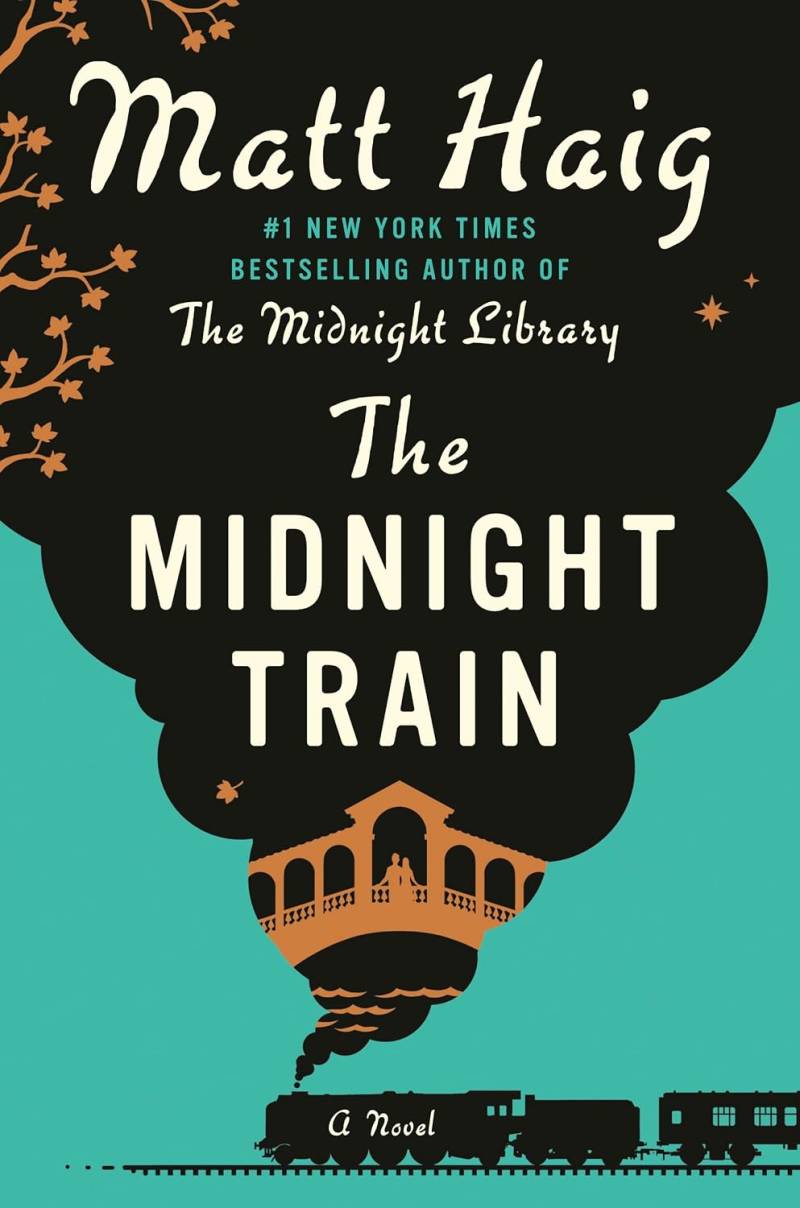
Title: The Midnight Train
Author: Matt Haig
Publisher: Canongate Books Ltd, 2026
The second part of the book explores the roots of Wilbur’s obsession with his work. His determination to achieve professional success comes at the expense of his personal life. As the train travels backwards through his life, Wilbur is forced to observe his past as an invisible “Ghost.” He revisits a difficult childhood shaped by his father’s death in the Second World War, the tragic loss of his brother Dougie in a car accident, and a troubled relationship with his mother.
These early traumas instill in Wilbur a deep-seated belief that his family’s suffering stems from poverty. Consequently, he becomes intensely focused on securing wealth, eventually transforming a single bookshop in Sheffield into a vast global bookstore empire.
The third part of the book examines the price Wilbur pays for his success. The train repeatedly stops at the central tragedy of his life: his failed relationship with Maggie. Wilbur retraces his journey from a deeply in love young man during their 1974 honeymoon in Venice to a distant and emotionally absent husband. His ambition gradually becomes an emotional defence mechanism, allowing him to use corporate success and long working hours to distance himself from his fear of grief.
This emotional neglect ultimately contributes to the heartbreaking dissolution of his marriage. Most painfully, Wilbur is not even there for Maggie when she miscarries their child. He is attending an unnecessary conference in New York and does not immediately return home.
Welcomed by his deceased childhood librarian, Wilbur Budd boards a vintage steam locomotive and physically transforms back into his 29-year-old self
Another aspect that makes the book deeply romantic is the way it explores the breaking of rules. Agnes warns Wilbur about the rigid rules of the afterlife: he is supposed to observe his past without interfering. Attempting to change events could cause a fracture in the timeline and jeopardise his place in eternity. Yet, overwhelmed by grief and desperate for a “do-over” of his life, Wilbur chooses to break the rules.
During his memories of his honeymoon in Venice, he follows his younger self and offers him advice. It is left to the reader to discover whether Wilbur can alter the trajectory of his romantic life—and, consequently, his professional life as well.
For now, all I can reveal is that there is resolution and peace. Through the resulting fallout and a series of short, episodic chapters, Wilbur gradually realises that the train is not intended to provide him with a magical rewrite of his life. Instead, it strips away his lifelong denial. He learns that although he cannot undo the choices that cost him his marriage, he can finally confront his hidden pain and forgive his younger self.
He achieves closure regarding Maggie, accepts the value of the life he actually lived, and peacefully moves forward along the tracks towards his final, eternal destination.
There are several beautiful passages in the book. At one point, Wilbur asks Agnes:
“But what if there are things that I did wrong?”
Agnes replies: “That, Old Bean, means that you have lived.”
The book also beautifully describes Wilbur’s initial love of reading as a young man: “He didn’t read because he wanted a good job. Though he absolutely did want a good job, when the time arrived. But no, he read because stories gave him room to grow beyond the world he was given.” Haig portrays stories as almost magical, showing how the lives Wilbur encounters in books become intertwined with his own. Stories make him stronger.
Haig also captures Wilbur’s gift for recommending exactly the right book to every customer who enters the original shop where he works. In this way, books become more than objects for Wilbur; they become a means of understanding people and connecting with their lives.
The novel is particularly rich because it draws upon and references many other works of literature, from Shakespeare to Around the World in Eighty Days. It also offers a poignant meditation on love:
“The thing about love,” the Ghost says, “is that it can feel so eternal that it can be mistaken for something that will be around for ever. Like a rock formation. Or the sky. But love is like every other human thing—it withers without attention. It’s like what Alfred told us. About it being a garden…”
Through this metaphor, the book reminds us that love, like a garden, must be tended and watered every day.
The Midnight Train is a wonderful combination of mystery and magical realism. It is ultimately a story about love, regret, loss, second chances and, perhaps most importantly, acceptance. To discover whether Wilbur’s ending is truly happy, and whether he succeeds in changing the course of his fate, I would advise you to rush to your nearest bookstore and read The Midnight Train for yourself.
It is a light, accessible and enjoyable read, and I would definitely recommend it to anyone who enjoys stories that blend fantasy, romance and reflections on the meaning of a life well lived. I thoroughly enjoyed reading it.