

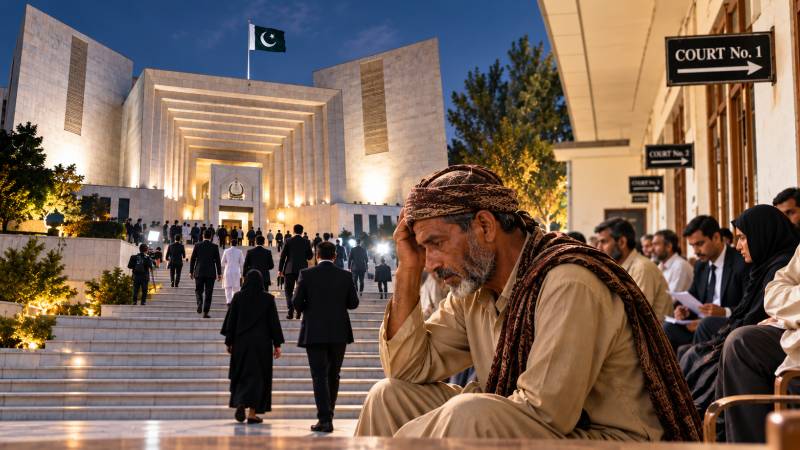
At midnight, when most citizens were preparing to sleep, Pakistan’s highest constitutional institutions were compelled to remain awake. On the night of April 9–10, 2022, the Supreme Court and the Islamabad High Court opened their doors amid an extraordinary constitutional crisis. The urgency was connected with the implementation of the Supreme Court’s order concerning the no-confidence vote in the National Assembly. The vote eventually took place shortly after midnight, resulting in the removal of the prime minister.
The opening of the courts at such an unusual hour raised questions, but the Islamabad High Court subsequently explained that, as a constitutional court, it could receive petitions beyond notified timings where extreme urgency was involved. In a constitutional emergency, judicial intervention may indeed be necessary. The Constitution cannot be protected by observing office hours alone. But one question continues to trouble the ordinary litigant: If justice can become urgent at midnight during a constitutional crisis, why does it so often become painfully slow during ordinary court hours?
This question is not an attack on the judiciary. It is a question about consistency, access and the human meaning of justice. Courts have a difficult responsibility. They must protect constitutional order, hear competing claims, maintain discipline and decide matters according to law. Yet the authority of a court is not measured only by the speed with which it responds to an emergency. It is also reflected in how it treats the powerless person who enters its courtroom seeking relief.
For a constitutional office-holder, an urgent hearing may determine the future of a government or the direction of the country. For an ordinary citizen, an urgent hearing may concern a demolished home, an unpaid salary, unlawful detention, domestic violence, a disputed inheritance or a criminal case that has consumed years of his life. The legal value of a citizen’s grievance should not depend upon his social position, financial strength or proximity to power.
A poor litigant may travel from a distant village to attend a hearing. He may borrow money for transport, leave his daily labour and arrive at court with the hope that, after months or years, his matter will finally move forward. Instead, he may hear that the case has been adjourned because a lawyer is unavailable, a report has not been received, a witness has not appeared or the court is occupied with other business.
Of course, every adjournment is not avoidable. A fair trial requires time, preparation and procedural safeguards. Witnesses may genuinely be unavailable, records may be incomplete and unforeseen circumstances may prevent a hearing. The problem arises when adjournments become routine rather than exceptional, when the case moves from one date to another without meaningful progress and when the cost of delay is carried almost entirely by the litigant.
For a constitutional office-holder, an urgent hearing may determine the future of a government. For an ordinary citizen, an urgent hearing may concern a demolished home, an unpaid salary, unlawful detention or a criminal case that has consumed years of his life.
For the court, an adjournment may be a date recorded on the order sheet. For a poor litigant, it may mean another day’s wages lost, another journey paid for and another month spent waiting for an answer. Delay does not affect all parties equally. A wealthy litigant may be able to sustain prolonged litigation, while a daily-wage worker may be pushed towards compromise, surrender or despair simply because he can no longer afford to continue.
The administration of justice must therefore look beyond the number of cases listed and disposed of. It must also ask how many people were required to return repeatedly without receiving a meaningful hearing. Judicial efficiency is not merely the disposal of files; it is the timely resolution of disputes in a manner that preserves fairness and dignity.
Another concern relates to the language used inside courtrooms. Judicial authority is essential, and judges must have the power to control proceedings. Lawyers and litigants cannot be permitted to disrupt hearings or disregard procedure. Yet firmness is not the same as humiliation. A sharp observation may sometimes be necessary, but language that belittles, threatens or unnecessarily embarrasses a litigant can damage public confidence in the institution.
A citizen who comes to court is not entering a place where his dignity is suspended. Article 14 of the Constitution recognises the inviolability of the dignity of man, while Article 10A protects the right to a fair trial and due process. These constitutional guarantees should not remain abstract words in legal texts. They must be reflected in the everyday conduct of judicial proceedings.
The question of whether a litigant may speak personally also requires a balanced understanding. Where a party is represented by counsel, the lawyer ordinarily addresses the court to ensure orderly and legally relevant submissions. This is a necessary feature of professional procedure. However, telling a distressed litigant repeatedly, “Your lawyer is here; please be quiet,” without allowing him to understand what is happening can make the courtroom appear inaccessible and intimidating.
A litigant may not be entitled to interrupt proceedings whenever he wishes, but he should not be treated as a silent object in his own case. Courts can preserve order while providing reasonable opportunities for clarification, interpretation, legal assistance and, where appropriate, a brief personal explanation with the court’s permission. The presence of a lawyer should strengthen a citizen’s access to justice, not erase his sense of participation.
The solution does not require courts to sacrifice independence or procedural discipline. It requires stronger case management, recorded reasons for repeated adjournments, meaningful consequences for avoidable delay and greater attention to the circumstances of vulnerable litigants. Courts may also consider litigant assistance desks, accessible information about case progress, legal aid mechanisms and training in courtroom communication. Such measures would not diminish judicial authority; they would reinforce public trust in it.
The midnight opening of the courts in April 2022 demonstrated that institutions can act with exceptional speed when constitutional circumstances demand it. That moment should not be remembered only as an episode of political and constitutional tension. It should also encourage a broader reflection: how can the same commitment to urgency, responsibility and institutional purpose be extended to citizens whose cases rarely attract national attention? The poor do not expect special treatment. They expect the law to recognise that their time, livelihood, dignity and suffering also matter. They do not ask every case to be heard at midnight. They ask why a matter that has already consumed years cannot receive serious attention during the day.
Justice must not have two clocks—one that moves swiftly for constitutional emergencies and another that moves slowly for ordinary citizens. A court’s doors may open at midnight when the Constitution is in danger. But the true strength of the justice system will be measured by whether those doors remain meaningfully open, during ordinary working hours, to the person who has no influence, no wealth and nowhere else to go. The Constitution must be defended in moments of crisis, but justice must also be delivered in the quiet suffering of everyday life.