

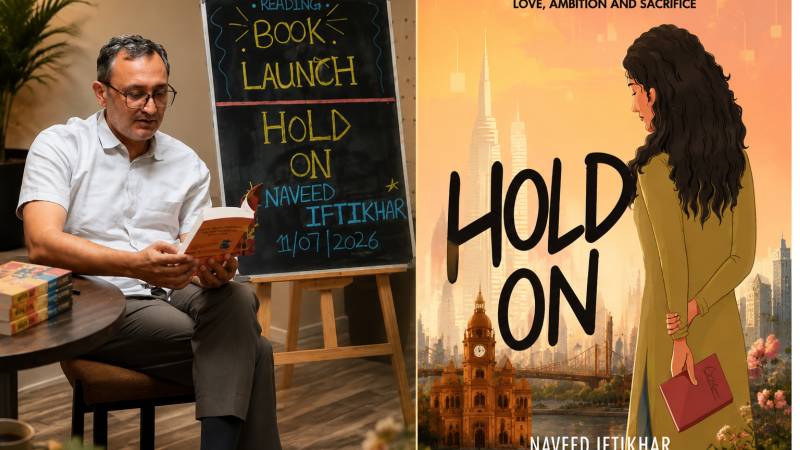
Naveed Iftikhar’s debut novel explores the journey of a young woman from Kohat to New York but it is also a journey of growth, awareness, understanding and acceptance of our emotions, consequences of our life’s choices and of circumstances beyond our control. The central message and title of the novel ‘hold on’ is chosen as a direct challenge to its more popular antonym, ‘move on’, which is a much easier if not a lazy piece of advice to give to anyone going through a tragic or difficult time in life. It is often a go to response from friends and family alike, admittedly, well-intended most of the times, but like they say, it is easier to say than to act and for some people, especially those who feel deeply, moving on does not work like a switch that one can turn ‘on’ and ‘off’ at will.
I am also among those who feel deeply and find it it terribly hard to ‘move on’ from broken friendships and broken heart, which is why, the concept immedietely attracted my attention. It seemed to have seen right through me and put my sentiments into words, giving voice to my thoughts that I had only ever kept wrapped securely inside my heart.
It was liberating and made survival lighter, like a drowning soul who survives not by thrashing against the water but by surrendering to its buoyancy.
While growing up, the world teaches us many things. It teaches us how to express joy and happiness and how to celebrate success. We are often very vocal about the good times in life and people gravitate naturally towards us when there is laughter to share. Good news always finds company, it is our sorrows and tough times that have no ears. Often, we don’t even have any words! All we have is our tears and a pillow. So this world teaches us many things, but it does not teach us often how to express our sorrow, how to reach out when things are tough, emotionally. We are conditioned into shunning negative thoughts and emotions. We almost feel guilty for having them. What we often don’t realise is that those emotions are as much a part of us being humans, as the good ones. The sorrows, the heaviness of the heart, the inconsolable tears, are all just as real and must be allowed to be felt without rushing to suppress them like they are somehow a disease. They are not.
I used to fight my sorrowful emotions just like I was taught to since childhood - ‘don’t cry’, ‘have water’, ‘move on’, ‘these things happen’, ‘forget about it’, ‘you are a brave girl’ – no one really let’s you stay with and process sadness. They think they are helping you out of your sorrow, that they are trying to make you smile again. I get that now, but I also get how necessary it may at times be, to hold on – not because you want to befriend misery, but because each pang of pain helps you truly understand the depth of your own self and who you are as a person. It tells you what matters to you so much for you to care so deeply. It shapes you and transforms you, sometimes, it may even strengthen you and prepare you for what is to come because the path to recovery begins, not with denial, not with suppression or rejection, but with acceptance.
As I grew up understanding this better, I started telling myself that grief is as much a part of my share of life as happiness is and I have to accept, that just as happiness does not last forever, grief too shall pass and till then I should let my body process it freely so it can play the role it is meant to and leave me stronger, wiser or humbler as a person. That was the day I stopped fighting with my emotions and embraced them all equally and whichever’s time was there - happiness or sorrow - I gave it full respect and allowed myself to experience the entire spectrum of it. It was liberating and made survival lighter, like a drowning soul who survives not by thrashing against the water but by surrendering to its buoyancy. There are moments in life when salvation lies not in striving, but in holding on. We mistake frantic effort for strength, when sometimes the gentlest act is to become still. The water has always known how to hold us; we need only stop fighting to let it. When I first saw Disney Pixar’s ‘Inside Out’ and ‘Inside Out 2’, that’s when I first saw this thought about the spectrum of emotions having a role and purpose in our life onscreen and Iftikhar’s book, ‘Hold On’ is the second such work that resonates deeply with my own outlook towards emotions when he says, ‘it is good to embrace emotions, spend time mulling over them and to understand the messages they carry’.
That was the day I stopped fighting with my emotions and embraced them all equally and whichever's time was there—happiness or sorrow—I gave it full respect and allowed myself to experience the entire spectrum of it.
The book traces the life and journey of a female protagonist – Hira, from Kohat, to Peshawar, Islamabad and eventually New York navigating through the social and economic challenges of being born a daughter in a small town in a family with several siblings - an elder sister and younger brothers, a mother whose fears and world view is limited to the confines of what the society has determined for daughters and a progressive father, the only breadwinner, determined to learn from the mistake of not educating his elder daughter, who is now living through an abusive marriage, and keen to support Hira in her education, defying all odds to ensure she gets a better chance at life. Hira’s journey from her traumatic and reclusive childhood to an independent young woman making her own choices in life and choosing to live with the consequences of those decisions is what the story is mainly about.
The author himself admits his limitation as a male when writing about a female protagonist and that reflects, especially in the early chapters, in how he has developed ‘Hira’ as a character who needs constant support from those around her to find her calling. Someone who needs constant saving, whether it is through her only friend Sadia who is expected to always be there for Hira, through the well-read and meticulous Ahmed, who has both sorted her life, guiding and directing it in ways that can become overbearing or through Sana, her former teacher, who eventually plays a central role in connecting Hira to what enables her to eventually face her own battles and embrace her emotions. The only time Hira appears to give back the courtesy and generosity she has always felt entitled to receive from Sadia, Ahmed and others, is when she tries to be there for a colleague, Sarmad but even there she ‘wishes’ to help more than she is able to ‘think’ how she could do so.
It might come across as frustrating at times, but Hira’s story can easily be that of most young women in Pakistan growing up in households with social anxiety and pressures of marriage, culture and honour coupled with appearance that does not fit the standards of beauty that can brighten prospects of finding suitors. How mothers navigate this pressure, how it can fuel bullying in school, how it can make a person shrink into a shell is all very real. To find hands that help you out from such darkness, like a father supporting his daughter, a friend who listens without judgement or a mentor who shows you light when you hit ground zero, are the kind of connections we may all need in different times of our lives. Hira did too, but her emotional dependence on other people could not last forever if she had to really grow as a person. Her entitlement did get the best of her but she chose to hold on to her emotions vowing to learn from them to craft a better life and so Hold On is also a journey of rising from the ashes like a phoenix towards emotional maturity that only the depths of our lowest moments in life can help us achieve.
For a first time author with no literary background, Iftikhar makes a decent attempt to narrate a story rooted in Pakistan, making references to popular icons like Kaifi Khalil and cultural landmarks from different Pakistani cities, especially the ones less explored in Pakistani literature, like Kohat, Peshawar and Islamabad, all while addressing common plight of young working women along the way. Weaving this story among familiar timelines that shaped Pakistan and global markets, the impact of Covid19, the rise of remote working, dilemmas of educated people wanting to make a difference for Pakistan and the challenges of doing business here, all make for a relatable, socio-economic and political backdrop. The story however, keeps oscillating between various timelines from past and present which is distracting and there were some issues with consistency and timeframes as well as early character development and arcs that could have been handled better but overall the main message is the acceptance of emotions without being imprisoned by them which makes Hold On a definite read.