

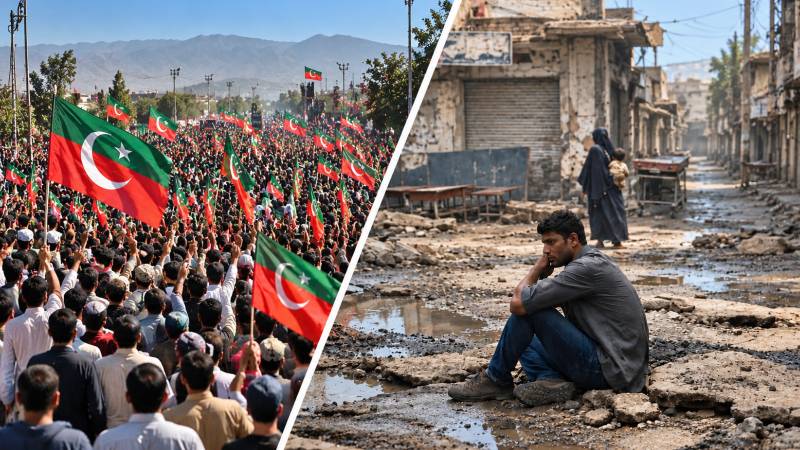
For over two decades, the beautiful, rugged landscape of Khyber Pakhtunkhwa has borne a burden too heavy for any land to carry. From the frontlines of the global war on terror to the relentless resurgence of local militancy, our people have sacrificed their peace, their economy, and their children. Yet, as our province bleeds, its political leadership seems chronically distracted, treating this traumatised region not as a sanctuary to be healed, but as a launchpad for violent federal political confrontations. It is time for a painful but necessary truth from a son of this soil: KP needs a break.
The statistics paint a grim picture of a province left vulnerable. According to data compiled by the South Asia Terrorism Portal (SATP), terrorist attacks in KP nearly quadrupled between 2021 and 2025, surging from 111 annual attacks to 413. This upward trajectory collided with a massive nationwide escalation documented by the Pakistan Institute for Conflict and Security Studies (PICSS), which noted that combat-related deaths skyrocketed by 74 per cent to a multi-year high, while monthly terrorist incidents recently peaked at a harrowing 12-year high. The realities on the ground are so volatile that the federal government was forced to formally designate 26 districts of KP as "hard areas", approving an extraordinary 250 per cent security risk allowance for the administrative and police officers trying to hold the line in terror-affected regions.
Behind these staggering data points are real human beings. Walk through the villages from Waziristan to Bajaur, Bannu, Lakki Marwat or Dera Ismail Khan, and you will find a landscape populated by grieving mothers and broken families. In our culture, the Hujra is meant to be a place of lively storytelling, music, and the legendary Pakhtun hospitality (Melmastia) where guests are welcomed with an open heart. Today, too many of our Hujras sit in a heavy, grief-stricken silence. There is the unspeakable plight of mothers whose children have been ripped away by suicide blasts, targeted IED attacks, or cross-border militancy. Alongside them are the parents of young political workers who, fuelled by fiery rhetoric, have found themselves languishing in prisons far from home following violent protests.
These mothers do not care about federal power plays, constitutional amendments, or partisan defiance. They care about empty seats at the dastarkhwan. They care that while senior party figures give fiery speeches from air-conditioned rooms or safe coordinates, it is the rural, lower-income sons of KP who are left facing the police batons, the anti-terrorism courts, and the cold prison floors. Our elders often say, "Khpal kor, khpal jahan"—one’s own home is one’s own world—but today, the peace of our homes is constantly sacrificed for political battlefields that are not our own.
Yet, our political leadership remains utterly insulated from this domestic tragedy. Nothing exposed this deep and troubling rift more brutally than when a local journalist looked the Chief Minister in the eye during a presser, asking a direct, anxious question about the crumbling law and order situation and the rising death toll of our citizens. The Chief Minister dismissed it with shocking ease, openly declaring that the government’s primary worry was the incarceration of Imran Khan, and questioning why the reporter was wasting time asking about local security instead. To witness the chief executive of a bleeding province treat the physical safety of millions as a secondary annoyance is a jarring revelation. It exposes a leadership whose priorities are entirely misplaced, leaving the public to navigate a deadly security crisis alone.
This apathy extends a dark shadow even over those who swear an oath to protect us. The most heartbreaking manifestation of this disconnect is how the provincial leadership has distanced itself from the ultimate sacrifices of the KP Police. When a deadly attack at the Kohat Police Lines left 15 of our brave officers martyred, the rows of coffins were met with a glaring political absence. While top civil and military officials stood in the funeral lines, the chief executive of our province skipped the prayers, choosing instead to travel across provincial borders to handle party politics. In Pakhtun tradition, standing in a funeral line is a sacred declaration to a broken family that their loss is the community's loss; "Mray da khawand pa laso drond vee"—a body is most honoured when lifted by its own guardian. When a leader can rush across the country for party rallies but cannot cross the city to shoulder the coffin of a martyred policeman, the message to our law enforcement is devastating: you are on your own.
The mothers of KP do not care about federal power plays or partisan confrontations; they care about the empty seats at their dastarkhwans, the sons they have lost and the families left shattered by violence.
Terrorists and militant networks are keenly aware of this governance vacuum and are taking full advantage of it. While the provincial machinery is distracted by political standoffs, containers, and rallies on the borders of Islamabad, extremist groups are going from strength to strength, expanding their footprints across the length and breadth of the province. Misplaced political priorities have given these elements the breathing room they need to reorganise, operate with near-impunity, and terrorise local communities who have been forced to hold massive peace rallies just to be heard. Every resource diverted to fuel a federal protest is a resource stripped away from our thinning law enforcement agencies on the ground.
The KP chapter of Pakistan Tehreek-e-Insaf (PTI) must remember that the people of this soil have given everything to the party. We voted them into power repeatedly, offering an unconditional loyalty. But look at what this blind trust has brought to the tribal belt. It brings to mind the bitter Waziristani proverb, "Koor me weesev kho deewaleena me pokha shwal"—our houses have burnt to the ground, and all we are left with are the hardened, baked walls of our own ruin.
It is time for the leadership to finally repay that favour and show genuine kindness and responsibility. True Pakhtun leadership is rooted in Ghayrat (honour) and the sacred duty to protect one's flock. To continue resting someone else's rifle on our bruised shoulders and using the passionate youth ofKPas mere cannon fodder for federal power plays is a deep betrayal of that sacred bond. It is not honourable for central figures to sit safely on the edge of the opposite mountain watching the fire burn while asking a traumatised people to bleed for a political throne in Islamabad. The leadership must show maturity and step up to protect the very people who built their political empire.
This is an appeal born out of deep love for our soil, not partisan malice. KP has no more blood left to give for political experimentation. If PTI wishes to pursue its struggle for the release of its leadership, it must recognise that the ultimate resolution to these political demands lies within the chambers of parliament and the corridors of our courts, rather than on the volatile streets. However, if the party believes it absolutely must take its grievances to the public square, the heavy burden of these street protests must be shared responsibly to ease the immense suffering of the people of KP.
It is time for the untapped chapters and significant electoral mandates in Punjab and Sindh to step forward and carry that weight. Let the political chapters of Lahore, Karachi, and Faisalabad organise the sit-ins and navigate the federal apparatus. Let the chief minister and cabinet of KP stay where they are desperately needed—in Peshawar, Bannu, and Swat. Our police need their leadership; our counter-terrorism departments need administrative backing; and our people need to feel that their lives matter more than an opposition rally. Give KP a chance to mourn its dead, rebuild its economy, and secure its borders. We are the sons of this soil. We love our homeland too much to watch it burn at the altar of a federal power struggle. For the sake of our mothers, our martyrs, and our future—please, give KP a break.