

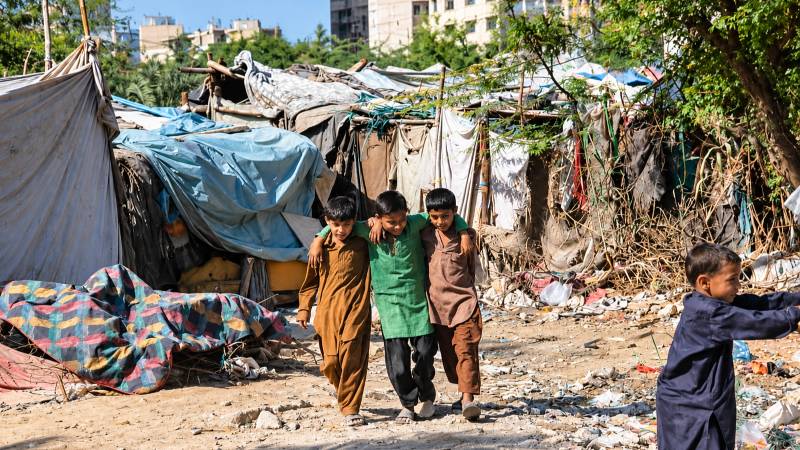
Life in Pakistan runs through at least four crevices of discrimination – class, gender, religion and ethnicity. While gender, religion and ethnicity can be cross cutting, class divisions are socially constructed with fissures so deep that it is not even funny. The urban poor women in Karachi work in homes. They use their traditional skills of cooking, cleaning, washing, ironing and whatever else you ask them to do. They live in rented homes where water, gas, and electricity are issues they are unable to mange. They take loans from where they work and if lucky may buy a home, get solar system installed, pay for their children’s education as they themselves are illiterate. In this struggle they carry a burden of loan, which they try to pay on a monthly basis from their meagre income, and the family pools in.
Look at this situation one such working lady found herself in :
Her husband had signed on a stamp paper that he would be the guardian for the loan taken by his brother. His brother took a Rs 15 lakh loan ; bought a house; then sold the house and disappeared. His two little children along with his wife now live with his mother-in-law.
She accumulated her loans over a period. She took one for her son who finished his intermediate. He bought a rickshaw, then business went a drift and he took another loan. Young brother took a loan to pay his school fee. She took a loan for a solar system as load shedding left the family breathless. Then came the authorities to demolish her home, though she had papers for it. She had to sell the house and buy another, and a loan was needed. For 6 months she could not pay the monthly instalment as the son was without a job. Once he got a job, monthly instament of Rs 20,000 was started again.
The ones who had given the loan of Rs 15 lakhs, descended on their family and started to hound the husband for the money. They threatened him; beat him up; but he just did not have the money. The women of the loan givers came and sat in the house and demanded that they pay the amount. Police was asked to intervene but police said as you had signed the paper you have to pay. The loan givers were relentless. They wanted the whole amount when the family offered to pay monthly installments.
The empirical realities of women burdened by loans does not factor into the policy domain of our elite governing leadership. What could be the nature of a State that can be a protector of people like this woman?
She went from pillar to post to get a loan but remained unlucky. Her home was in her name but her papers were not accepted so every Bank turned her away. Her family is caught in an arrangement of the informal sector that gives loans easily but returns are problematic. The capital is to be returned and any monthly instalments have no bearing on the original loan which remains in tact. What can somebody like her do? She is a domestic worker – an informal worker.
Karachi has an estimated hundreds of thousands to over a million domestic and informal care workers, though exact official municipal headcounts are limited because most of the sector operates through informal arrangements. So, she is one of those millions of poor urban women who have no recourse to their everyday problem. She is a hardworking, honest woman who maintains her dignity despite her poverty.
The empirical realities of women burdened by loans does not factor into the policy domain of our elite governing leadership. What could be the nature of a State that can be a protector of people like this woman? When policy makers and people in power are disconnected with the grown realities at the micro level, only some informal arrangements can help. This gap between the needy and those with power to make rules and intervene is ruthless. All those who claim to be supportive are unable to help the woman concerned.
Imagine an office where this woman could go and narrate her tail. Can she be protected by the police who could stop the loan-giver from being physically abusive. Can a loan be given for her to repay the loan, and she will return loan in easy instalments based on the earning power of the family? A poor woman struggling to survive making her two ends meet, is without any support. What could she do ?