

For decades, persons with disabilities (PWDs) in Pakistan were too often viewed through the narrow lens of charity and dependence. The prevailing approach was largely centred on relief rather than rights, and on assistance rather than opportunity. In Punjab, however, the policy landscape concerning persons with disabilities has been undergoing a significant transformation. The promulgation of the Punjab Empowerment of Persons with Disabilities Act, 2022 (PEPDA 2022) has provided a comprehensive legal framework for moving from a welfare-oriented approach towards one based on dignity, equality, participation, accessibility, and empowerment.
The Act is important not merely because it introduced a new law, but because it placed the rights and entitlements of persons with disabilities within a structured institutional framework. It seeks to promote the effective inclusion of PWDs in the community and protect their rights in accordance with the Constitution of Pakistan, the UN Convention on the Rights of Persons with Disabilities, and international best practices. It covers areas ranging from non-discrimination and accessibility to education, employment, social protection, rehabilitation, political participation, and access to justice.
One of the most important institutional developments under the Act has been the establishment of the Council on the Rights of Persons with Disabilities (CRPD). The Council provides a platform through which the Government of Punjab can coordinate, monitor, and implement policies relating to persons with disabilities. Its mandate extends well beyond conventional welfare. It is responsible for executing government policy concerning employment, rehabilitation, and welfare, undertaking projects, coordinating implementation, conducting surveys and research, facilitating training and taking measures for effective implementation of disability rights.
The Council has therefore become an important bridge between legislation and the everyday lives of persons with disabilities. Its significance lies in converting statutory rights into practical interventions. The Social Welfare & Bait-ul-Maal Department (SWD) Punjab, being the custodian of PEPDA, 2022 and the mandate given under Punjab Government Rules of Business, 2011 for “Registration, Assessment, Training, Employment, and Rehabilitation of Disabled Persons” has a central role in this process, and also because a large number of the initiatives for PWDs in Punjab are being delivered through its field formations.
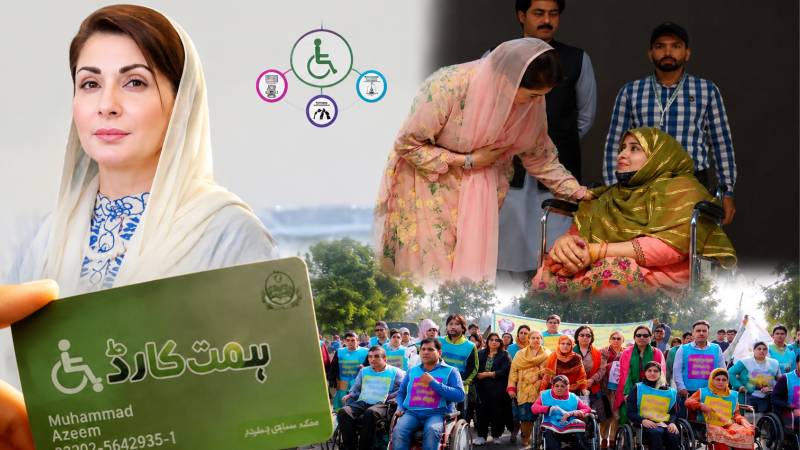
Perhaps the most visible example of this change is the Chief Minister Himmat Card Programme. Under the programme, PWDs who have been certified by the Social Welfare Department and assessed as not-fit-to-work are being provided quarterly financial assistance of Rs.10,500. The assistance is specifically designed for those who are unable to earn their livelihood and who meet the prescribed socio-economic eligibility criteria. So far, 100,000 PWDs have been issued Himmat Card.
The importance of the Himmat Card goes beyond the amount of money involved. For a person who cannot work because of disability, even modest regular financial assistance can help meet basic personal needs and reduce dependence upon family members. More importantly, it represents recognition of a person's right to social protection.
Financial support, however, is only one dimension of empowerment. A person who is unable to walk, hear, see or perform everyday activities without assistance cannot fully participate in society solely through a cash transfer. Recognizing this reality, the SWD launched the Chief Minister Assistive Devices and Wheelchair Programme, under which wheelchairs (manual & electric), hearing aids, walkers, white canes, prosthetic limbs, tricycles and other assistive devices are being provided free of cost to eligible persons with disabilities. By 30th June 2026, number of beneficiaries reached to 18,000 PWDs.
Employment is perhaps the most sustainable form of empowerment. The 3 per cent employment quota for persons with disabilities in Punjab provides an important statutory mechanism for bringing PWDs into the economic mainstream.
The significance of assistive devices is sometimes underestimated. A wheelchair can mean access to education, a hearing aid can mean communication, a white cane can mean independent mobility, and a prosthetic limb can mean the possibility of returning to work. Thus, assistive devices should not be regarded simply as assistive goods. They are instruments of independence and participation. The subsequent introduction of advanced bionic prosthetic limbs has further demonstrated the Punjab Government's willingness to bring modern technology into disability rehabilitation.
Another important development is the Government's response to the needs of visually impaired persons who are fit-to-work but remain unemployed. This is an entirely different category from those receiving Himmat Card assistance. Such persons do not necessarily require long-term dependency based support, rather, they require an opportunity to earn with dignity. The Punjab Government has approved a monthly stipend of Rs.12,000, initially for 5,000 registered visually impaired persons, alongside measures to facilitate their employment under the existing disability quota.
This distinction is important because disability policy cannot follow a one size fits to all model. A person who is unable to work needs social protection, while a person who is capable of working needs access to employment, skills, and an enabling environment. The emerging policy approach in Punjab increasingly recognizes this difference.
Employment is perhaps the most sustainable form of empowerment. The 3 per cent employment quota for persons with disabilities in Punjab provides an important statutory mechanism for bringing PWDs into the economic mainstream. The challenge, however, has historically not been the existence of a quota alone, but its actual implementation. The SWD has therefore, placed emphasis on obtaining departmental data, identifying shortfalls, and ensuring that reserved posts are actually filled according to quota distribution within 3% disabled quota.
The enforcement mechanism has also been strengthened. Inspectors have been appointed under the disability rights framework to monitor implementation of various provisions, including accessibility requirements and employment-related obligations. In cases where establishments fail to employ the prescribed number of persons with disabilities, the law provides for financial contributions towards the rehabilitation fund. The appointment of inspectors is significant because legislation can only produce meaningful change when there is an institutional mechanism to monitor compliance and take action against violations.
The provisions of PEPDA, 2022 are being implemented through the District Welfare and Rehabilitation Units (DWRUs) which have been established in each district across Punjab as the disability rights cannot be implemented effectively from Lahore alone. The real test is what happens at district and tehsil level, where persons with disabilities interact with government offices and seek certification, rehabilitation, financial assistance, assistive devices and employment opportunities. The district-level mechanism can therefore help bring the rights-based approach closer to the PWDs.
The role of Chief Minister Maryam Nawaz Sharif in giving political visibility to disability issues is also noteworthy. Her approach has been reflected not only in the announcement of individual schemes but in the manner in which persons with disabilities have been placed within the broader welfare and development agenda of Punjab. At the launch of the Himmat Card, she publicly emphasized the State's responsibility towards persons with disabilities and interacted directly with beneficiaries. At the launch of the Assistive Devices and Wheelchair Programme, she personally distributed assistive equipment and highlighted the objective of enabling persons with disabilities to live more independent lives.
This change in direction is important. A truly inclusive society is not one in which persons with disabilities are simply given financial assistance. It is one in which they can travel independently, enter public buildings without barriers, receive education, obtain employment, participate in community life, access information, use public transport and make decisions about their own lives.
Punjab has therefore reached an important stage in its journey towards disability inclusion. The promulgation of PEPDA 2022 provided the legal foundation, the establishment of CRPD created the institutional mechanism, and initiatives such as the Himmat Card, Assistive Devices and Wheelchair Programme, employment quota enforcement and targeted support for visually impaired persons are translating the policy framework into practical interventions.
The journey is not yet completed. The real measure of success will be determined by whether these rights reach every person with a disability in every district of Punjab. Continued investment in accessible infrastructure, inclusive education, vocational training, digital accessibility, public transport, rehabilitation services and private-sector employment will be essential. Equally important will be the participation of persons with disabilities themselves in policy formulation and monitoring. The emerging experience of Punjab demonstrates that when legislation, political commitment, departmental leadership, institutional capacity and targeted social protection work together, disability policy can move beyond charity towards respectable and inclusive society.