

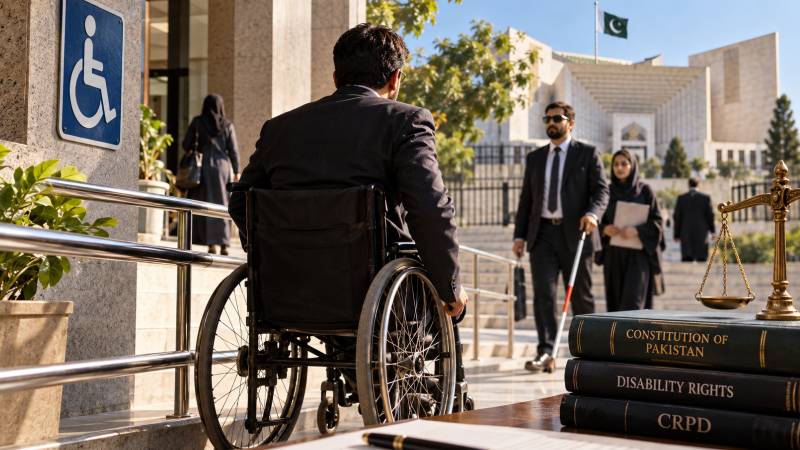
In 2008, Saima Saleem became Pakistan’s first visually impaired diplomat, and in 2018, Yousaf Saleem became Pakistan’s first visually impaired judge. The Federal Government reserves 2% quota for Persons with Disabilities (PWD), while Sindh Government reserves 5% quota under Sindh Empowerment of Persons with Disabilities Act (SEPWD), 2018.
The Islamabad High Court, in Writ Petition No.1949 of 2021 titled Tahir Mehmood vs Election Commission of Pakistan, observed that the Council on the Rights of PWD in consultation with the Establishment Division should ensure that every public sector organization comes up with its own HR plan to give effect to provisions of the ICT Rights of Persons with Disabilities Act, 2020, which plan is then published on the website of the respective organization for purposes of awareness and to inform PWD about job opportunities within such organizations.
In April, 2026, The Sindh High Court (SHC) directed the provincial authorities to complete within two months the requisite exercise for appointing PWD on the quota reserved for them. In February, 2026, Chief Minister of Sindh approved the establishment of an AI-based Job Portal and a Complaint Resolution System to link PWD to employment opportunities and institutional support across the province. Pakistan ratified the Convention on the Rights of Persons with Disabilities (CRPD) in 2011. The rights of PWD is not directly recognised under the Constitution, but they are protected, along with other vulnerable persons, under Articles 4, 9, 14, and 25.
In Pakistan, PWD are protected under the Mental Health Ordinance, 2001 (repealing the Lunacy Act, 1912); the Disabled Persons (Employment and Rehabilitation) Ordinance, 1981; the Accessibility Code of Pakistan 2006 (to ensure that buildings and public spaces are constructed in a way that is accessible to PWD); the Balochistan Persons with Disabilities Act, 2017; SEPWD; the Khyber Pakhtunkhwa Rights, Rehabilitation, Accessibility & Empowerment of People with Disabilities Act, 2018; the Gilgit-Baltistan Persons with Disabilities Act, 2019; the ICT Rights of Persons with Disability Act, 2020; the Policy for Financial Inclusion of Persons with Disabilities, 2021; the Punjab Empowerment of ‘Persons with Disabilities’ Act 2022.
Justice Syed Mansoor Ali Shah, in C.P.L.A.140-L/2015, titled Malik Ubaidullah v. Government of the Punjab dealt with determination of 2% employment quota for PWD, and held that support and facilitation for persons with disabilities has been recognized as ‘Reasonable Accommodation’ under the CRPD, and that the Reasonable Accommodation can be through assistive technology, which is an umbrella term that includes assistive, adaptive, and rehabilitative devices for PWD. He directed the government to discontinue using the words like ‘disabled,’ ‘physically handicapped’ and ‘mentally retarded’, and use ‘persons with disabilities’ or ‘persons with different abilities’.
The use of pejorative words such as ‘crippled’ or ‘disabled’ in judgments seriously offended the right to be a person thereby infringing constitutional guarantees like right to life, right to human dignity and right to non-discrimination of persons with disabilities.
The Supreme Court of Pakistan (SCP), in Mst. Beena v. Raja Muhammad and others (PLD 2020 SC 508), held that the use of pejorative words such as ‘crippled’ or ‘disabled’ in judgments seriously offended the right to be a person thereby infringing constitutional guarantees like right to life, right to human dignity and right to non-discrimination of persons with disabilities, thereby violating Arts. 9, 14 & 25 of the Constitution. This verdict further dealt with the issue of a custody of child with a mother with disability and held that in determining the welfare of the child and his custody neither the mother’s physical condition nor her income were determinative factors. In 2021, the SCP placed a ban on the death penalty being applied to those with mental disabilities.
According to the facts in appeals No.538 of 2024, and No.561 of 2024, pending before the Sindh Service Tribunal, Police Constable Muhammad Yaqoob had filed an application for retirement and pensionary benefits after completing 25 years of service, because his eyesight had worsened, but the application was deliberately not processed upon for four months by the appellants Senior Clerk Muhammad Nawaz Magsi and Junior Clerk Mohsin Ali Solangi. Disheartened, frustrated and hopeless, Yaqoob committed suicide by setting himself on fire. Both appellants were dismissed in the disciplinary proceedings initiated against them, however, Muhammad Nawaz Magsi’s dismissal was converted into reduction in rank for three years, and dismissal of Mohsin Ali Solangi was converted into reduction in pay by three stages by the appellate authority.
Justice Adnan-ul-Karim Memon, in Constitution Petition No. 4100 of 2025, titled Abbas Ali v. The Registrar Federal Urdu University, held that where an employee acquires disability during service, the employer is under an obligation to consider reasonable accommodation, adjustment to a suitable post, or alternative duties before resorting to compulsory retirement or removal from service.
In Service Appeal No.18 of 2025, titled Muhammad Javed Solangi v. the Inspector General of Police Sindh, the appellant was a Police Constable, and became visually impaired during his service, and was declared invalidated. He was not entitled for pensionary benefits because of not completing the required period of service. The appellant approached the Sindh Service Tribunal for his reinstatement, and the Tribunal directed the appellate authority to decide the pending departmental appeal while keeping in view his special needs. The Tribunal was informed that the appellant was reinstated through the order dated 7th September, 2026, passed in the departmental appeal. The Tribunal and the appellate authority were assisted by Shamsuddin Chandio, Inspector (Law) in Sindh Police, who produced the relevant laws and the recent view of the SHC before the concerned authorities.
This case demonstrates that the Police Department is protecting its specially-abled officials, but there is a need for a legislation to protect civil servants when they become specially-abled during service, and because of which they can no longer perform their duties, and therefore, should be entitled for the pensionary benefits in case of their invalidation, if there period of service required for the pensionary benefits is not completed.