

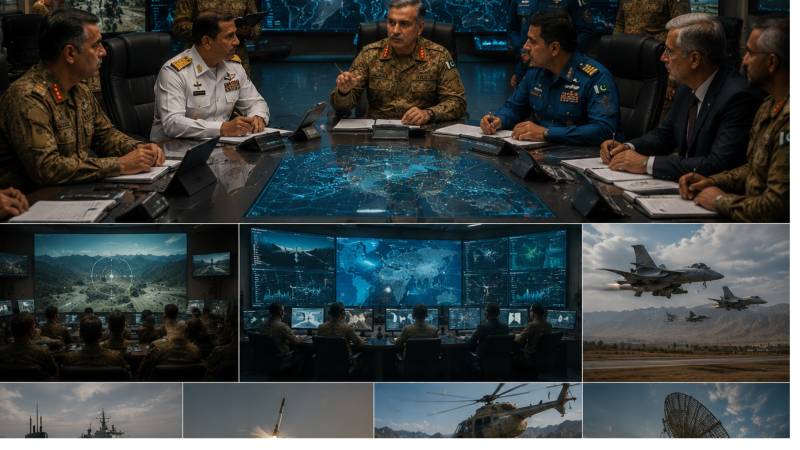
Pakistan has appointed its first Commander of the National Strategic Command, a four-star officer rank, that would command the strategic forces of all three services besides heading the Strategic Planning Division, that was earlier under the now abolished appointment of Chairman Joint Chiefs of Staff Committee. This is an important step to achieve a meaningful operational synergy in the employment of tri-service strategic assets. Additionally, it would bring employment and development planning functions through Strategic Planning Division under Commander Strategic Command achieving symbiosis between planning, development and operational employment.
The establishment of a Tri Service National Strategic Command is in line with the concept of tri-service combatant commands of USA where four stars command the unified combatant commands, which are operationally under the Commander in Chief i.e President of the USA, but are dependent on the respective services for their human resource and force readiness needs. Indians also are in the process of establishing their tri service commands called integrated theatre commands. They started with the establishment of the appointment of Chief of Defence Staff (CDS) in 2020, taking full 20 years to operationalize a recommendation of the Kargil Review Commission Report in 1999.
Indian Army had suffered a large number of casualties in Kargil conflict 1999 due to lack of adequate coordination between the Indian Air Force and Army; a fact highlighted by the Indian Army Chief General V P Malik in his book, “Kargil: From Surprise to Victory”. He mentions that it took him three weeks to convince Air Chief Marshal Tipnis to use Air Force on the Kargil heights. This wasted three precious weeks when the Indian infantry was badly mauled by the Pakistani mountain posts. The Indians however had several hiccups and disagreements over the structure and mandate of their integrated theatre commands. The Air Force was reluctant to subsume its identity in integrated commands and cited shortage of fighters for dedicated roles in integrated commands as an excuse to retain centralized control. Reportedly, the Indian Integrated Air Defence Command could not so far be operationalized due to Air Force objections.
As a result, at present the Indian theatrisation of tri service commands has not fully taken off the ground but they are slowly going that way. They intend establishing integrated theatre commands to facilitate integrated planning and coordinated application in specific geographic regions. So far, they have two functional theatre commands i.e Andaman and Nicobar Command, and a Strategic Force Command while the Western Theatre Command (Pakistan focused and headquartered at Jaipur), Northern Command (Focused on China and headquartered at Lucknow), and Maritime Theatre Command (Headquartered at Trivandrum) have not been operationalized as yet. These theatre commands could be commanded by officers of either service who would exercise operational control over the employment functions leaving administration, human resource and logistics to respective service commanders.
The Indians are also planning an Integrated Maintenance Command for providing maintenance services to all three services and have so far established logistic and operational support organizations such as Armed Forces Special Operations Division, Defence Cyber Agency, Defence Space Agency that operate under Integrated Defence Staff. The Indian CDS heads the Department of Military Affairs (DMA) under the Ministry of Defence, thus making the CDS as one of the four Secretaries under MOD. He being the principal military advisor to the Prime Minister does not exercise direct command over the three services or the field commands.
In Pakistan, so far, we do not have tri service commands and the operational integration between the three services during war is ensured through operational liaison between the individual services in bi-service or tri-service mode i.e Army and Airforce or Army Navy or Navy Airforce, depending upon the employment contingencies. Erstwhile Joint Staff Headquarters was a mere coordinating headquarters between the three services with no control over their operational employment.
In Pakistan, so far, we do not have tri service commands and the operational integration between the three services during war is ensured through operational liaison.
Now with the abolition of Joint Staff Headquarters and the introduction of the CDF Headquarters, the three services are practically under the command of CDF including their vital component of strategic forces like Army Strategic Force Command, and Air force and Naval Strategic Commands. Earlier on, their asset employment was subject to established security protocols but their assets were practically maintained and controlled by respective services. Now with the Commander of National Strategic Command's appointment, all three strategic force components of three services would be commanded by the Commander Strategic Command.
This will ensure greater operational synergy and coordination between the strategic components of the three services. The headquarters of the Commander National Strategic Command would most probably be in the premises of the CDF Headquarters, ensuring better coordination with CDF and Strategic Plans Division (SPD). By having an erstwhile Chief of the General Staff (CGS) and a trusted commander to mind the Strategic Forces, the CDF will have his hand strengthened in CDF Headquarters as the detailed operationalization of the Headquarters gets underway incrementally.
In due course the CDF Headquarters should get more tri service orientation with a “Tri-service Military Operations Directorate” under it. Presently, the most important planning and execution element of the Army in GHQ is the Military Operations Directorate (MO Directorate) which is considered the brain of the military. The two smaller services i.e Air Force and Navy also have their operations’ directorates but those do not exercise the kind of clout enjoyed by GHQ's MO Directorate. The CDF headquarters might create a tri service MO Directorate now which may have representation from the three services. Would GHQ's MO Directorate cede the space to that organization, only time will tell as the operationalization of the CDF Headquarters gets underway incrementally.
Modern warfare demands multi domain integration and already cyber commands at separate service level have come on ground. In times to come the tri service cyber command might also emerge as a possibility. The multi domain warfare in air, land, sea, space and cyber domains demands tri-service integration and unified structures that provide operational as well as well as logistic support functions, without operating in silos as per erstwhile stove piped approach. This is the age of modern warfare where the networks and integrated domains would always achieve decision support superiority over the non-integrated organizations.
While the Indians are still coming to grips with their command and integration issues, Pakistan has taken a big leap in establishing a truly functional and empowered tri-service headquarters led by the CDF. which is again an empowered appointment exercising effective command over all three services. This by implication brings all warfare domains under one command, reducing decision making delays due to inter service differences. This indeed is the most puissant integration and unity of command that was found wanting in the previous wars.
Pakistan does not need the geographically fixated theatre commands like Indians due to its peculiar geography and advantage of operating on interior lines, but certainly requires greater tri-service integration in logistics, air defence, conventional missile forces, autonomous weapon systems, cyber warfare, AI, and robotics. Existing integrated functions like medical, maintenance engineering services, public relations, and intelligence need to be further combined in the interest of economy as well as operational synergy. Incrementally, the three services also need to bring the welfare, and force readiness functions under the tri-service umbrella. An effective commander over three services and a truly functional CDF headquarters were the need of the hour, but now, the three services must rise above individual turf interests to truly integrate, and ensure that this jointness translates into operational edge on modern battlefield.