

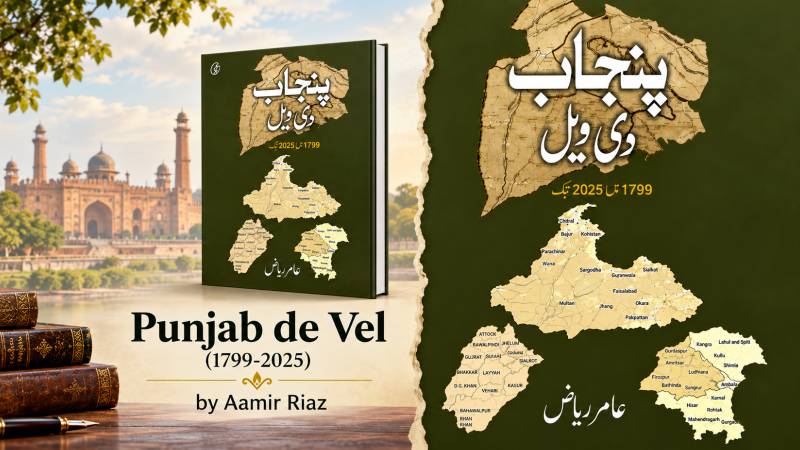
Book: Punjab di Vel
Author: Aamir Riaz
جھوٹ آکھاں تے کجھ بچدا اے
سچ کہاں تے بھانبڑ مچدا اے
Bulleh Shah’s immortal words contain a profound philosophy of truth: truth exposes what falsehood tries to preserve. A lie may protect an established narrative for a time, but truth carries the power to unsettle generations of inherited assumptions.
“The first step in liquidating a people is to erase its memory. Destroy its books, its culture, its history. Then have somebody write new books, manufacture a new culture, invent a new history.” — Milan Kundera
A prominent Pakistani writer, publisher, progressive activist, broadcaster, and intellectual based in Lahore, Aamir Riaz approaches Punjab’s history through an intellectually compelling process of reverse engineering. Rather than beginning in the past and simply arriving at the present, he begins with the realities of the present. The past, in his method, is not a dead archive; it is the hidden architecture of the present and a blueprint for understanding it.
Aamir Riaz’s Punjab di Vel is a remarkable work of historical inquiry, but its greatest strength perhaps lies in the depth of knowledge with which the author approaches Punjab. He does not merely narrate events; he searches beneath them for the forces that shaped Punjab’s political destiny, cultural memory, language, geography, and collective consciousness.
Published in 2026, the 524-page Punjabi volume traces the history of Punjab from 1799 to 2025 through a wide range of historical sources, political movements, languages, trade routes, resistance movements, and cultural traditions. Having read the book closely as an analyst, I find that its significance extends beyond that of a conventional history of Punjab.
Aamir repeatedly asks questions about power, memory, geography, and loss. His extensive research is evident in the use of more than one hundred references throughout the book. He does not leave his sources suspended in the text; towards the end, in the Zameema, he substantiates his historical arguments through a substantial list of reference books, along with the names of their authors.
The most meaningful place from which to enter this history is Lahore Darbar. Maharaja Ranjit Singh emerged as the central political force in Punjab in 1799 and, during his rule, succeeded in bringing together territories, communities, and political interests into a powerful state. His achievement was not simply military. He developed the administration, strengthened the army, promoted economic activity, and maintained a political order in which people of different faiths could occupy important positions. The government of Lahore Darbar cannot therefore be adequately understood through the narrow description of a purely Sikh state. Ranjit Singh was personally a devout Sikh, but his state was markedly pluralistic in its administration, with Muslims, Hindus, Sikhs, and Europeans serving in significant positions.
Historical scholarship has also noted the secular character of the Lahore Darbar and the diversity of its governing structure. This distinction is important because colonial historiography often reduced the political complexity of Punjab to convenient categories. Ranjit Singh’s death in 1839 changed the balance of power. The succession struggles that followed weakened the Lahore state, and the Anglo-Sikh wars ultimately brought British annexation in 1849. Thus, the British did not simply conquer an already helpless Punjab; they encountered a powerful state during Ranjit Singh’s lifetime and consolidated their control after its internal political structure had weakened. The contrast is historically significant.
Partition transformed Punjab’s living networks of rivers, roads, markets, and cultural exchange into political boundaries that divided families, languages, and histories. A saying traditionally attributed to Ranjit Singh, “Sab laal ho jai gaa”, everything will become red acquires an almost haunting resonance when read against the later history of Punjab. The colour red can be read not literally as a prophecy, but symbolically: Punjab would repeatedly experience conquest, division, violence, and bloodshed.
The tragedy is that the land that once possessed considerable political strength gradually became the land upon which competing imperial and communal designs were tested. This is where Aamir’s chapter, “Purani Likhtan Nawian Peeran”, becomes particularly important. He returns to earlier writings and examines how Punjab’s history was represented by influential colonial writers such as Griffin and Napier, among others.
His concern is not simply that individual historians made mistakes; it is that historical interpretation itself could become a political instrument. When people’s past is repeatedly described from the perspective of those who ruled them, memory itself becomes vulnerable to manipulation. This historical consciousness becomes even more painful in the chapter dealing with “Jallianwala Bagh”. The massacre following the Rowlatt Act was not merely an episode of General Dyer’s brutality. In Aamir’s reading, it must be situated within a larger colonial political structure in which Punjab was subjected to extraordinary repression and collective punishment.
The bloodshed at Jallianwala Bagh therefore becomes part of a much wider history of colonial hostility towards Punjab and its political consciousness. The silence or inadequate response of major regional political leadership at the time, including Gandhi’s position in the aftermath, adds another troubling dimension to the historical record. The question is not simply who fired the bullets, but what political circumstances made such violence possible.
Aamir’s “Angrez Mukhalftan de Wadeh Ghate” deepens this argument by moving from political repression to language, education, and cultural inheritance. His discussion of James Mill and the intellectual climate surrounding colonial knowledge shows how regional languages could be associated with religious divisions while English was elevated as the language of power, administration, and modern education.
The damage was therefore not confined to territory. Language and script were also political territories. Once a people begin to regard their own language as inferior, colonialism has already entered the mind. This becomes especially significant in the context of Punjabi. Punjab possessed an extraordinarily rich literary inheritance, written in different scripts and nourished by Sufi, Bhakti, Sikh, Muslim, and folk traditions. Yet the political treatment of language gradually separated communities that had historically shared a cultural space.
The colonial classification of language through religious identity helped create divisions whose consequences survived the end of British rule. The chapter “Dharm Pari te Lusani Jhaire, Nishana Punjab” further exposes the relationship between religious politics and linguistic conflict. Here, the history of Punjab appears not as a natural progression towards division, but as a complicated process in which identities were increasingly organised around political categories. This leads directly towards “Nishana Punjab”, where the question becomes larger: why did Punjab so repeatedly become the target of political restructuring?
Language and script were also political territories. Once a people begin to regard their own language as inferior, colonialism has already entered the mind.
The answer becomes devastatingly visible in the history surrounding 1947. The author’s chapter, “Punjab te Punjabi di Wandan ute Punjab Mukhalftan 1947 tou Ajj Dehar Teek”, follows the continuing consequences of Partition and argues that Punjab had been divided repeatedly, reaching five major divisions by 2025. His concern is not only the drawing of political boundaries. It is the fragmentation of Punjab’s geographical heritage, its historic routes, its cultural continuity, and its economic connections.
The old Silk Route and the river-based geography of Punjab represented networks of exchange that existed long before modern borders. Partition transformed these living connections into political boundaries. The most painful irony is that Punjab was divided in the name of religious identity, although its historical civilisation had been shaped by centuries of interaction among different communities. The division of Punjab therefore meant more than the division of territory. It divided families, memories, languages, markets, rivers, roads, and cultural landscapes.
This historical background gives Punjab di Vel particular relevance to the present. In September 2026, the question of creating new provinces or administrative units is again being publicly debated in Pakistan. Parliamentary Affairs Minister Tariq Fazal Chaudhry has said that the issue is expected to be debated in Parliament. The present debate should therefore be examined carefully rather than emotionally. Administrative reform, better governance, and empowered local government are legitimate subjects of public discussion. But history also gives us reason to ask a deeper question: when Punjab is repeatedly reorganised, what happens to its historical geography, cultural memory, and linguistic identity?
The question is not whether every administrative change is necessarily a conspiracy. History rarely permits such simple conclusions. The more serious question is whether an old colonial habit of governing through fragmentation can survive in altered forms within postcolonial political structures. Punjab has already paid an enormous price in land, blood, language, and cultural memory. Formal colonial rule ended in 1947, but structures of dependency, inherited political thinking, and the habit of treating people as administrative populations rather than historical communities can survive much longer.
This is ultimately why Punjab di Vel matters. It does not allow Punjab’s history to remain safely locked in the past. It places Lahore Darbar beside Jallianwala Bagh, language beside political power, Partition beside geography, and historical memory beside the political questions of the present. Its central lesson is not merely that Punjab was divided. It is that every division leaves something behind that cannot easily be reconstructed. Punjab has repeatedly surrendered territory, language, cultural continuity, and human lives to political designs larger than itself.
The challenge before the present generation is not simply to preserve a map, but to understand the history behind that map. If Punjab’s future is again to be debated through new boundaries, the memory of its old ones must not be forgotten. Punjab di Vel gives us the historical material to ask that question with seriousness. The final answer, however, belongs not to history alone, but to the people and institutions that will shape Punjab’s future.
Aamir remains hopeful that Punjab needs no further provinces or divisions, but rather the revival of its languages, cultural resources, and historical consciousness within a genuinely secular outlook. Punjab di Vel is a historical document destined to serve generations of researchers. Through this book, Aamir Riaz has mounted a powerful historical defence of Punjab and Punjabis, turning research into a voice for a wounded land. It is not merely a book to read; it is a book to remember, question, and preserve.