

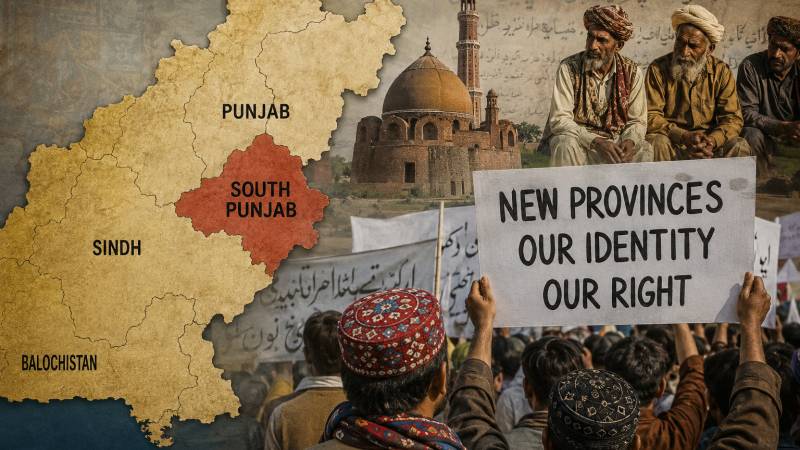
Fawad Chaudhry, in his recent appearance on a TV talk show held to launch a public debate and further the cause of new provinces in the country, made an unqualified assertion that the different languages spoken in Punjab are merely dialects of Punjabi. This has been a recurring refrain among people in central Punjab, particularly within its intellectual circles, who have consistently sought to disavow the distinct ethnic identities of those who speak languages other than Punjabi.
Even Khawaja Ghulam Farid, the renowned Siraiki poet, was acclaimed as a Punjabi poet. To support this contention, many eminent personalities from central Punjab contributed to research journals in an effort to appropriate Khawaja Ghulam Farid as part of the Punjabi literary tradition.
The Gazetteer of Bahawalpur State (1904), however, states on page 414: “People living in Kot Subzil and of its suburbs speak Bahawalpuri and Sindhi dialects and this language is called Siraiki.” Thus, the Siraiki language existed as a distinct linguistic tradition for a long time. Khawaja Ghulam Farid, who belonged to Kot Mithan and spent most of his life in Cholistan, spoke Siraiki. Dr Christopher Shackle, in his seminal work Siraiki: A Language Movement in Pakistan, published in 2008, writes: “‘Sirāikī’ is the language of the middle Indus valley, while the ‘Sirāikī movement’ that seeks to improve its standing is based in the central part of this region, the South-West Panjab, principally in its most important cities, Multan and Bahawalpur.”
In fact, the denial of Siraiki’s distinct identity serves to bolster central Punjab’s cultural hegemony and, consequently, entrenches its economic dominance. The economic surveys of Punjab speak volumes about the discrimination faced by the people of South Punjab. Recently, I was confronted with the argument that a considerable proportion of Pakistan’s ruling elite has historically come from South Punjab. Why, then, did they fail to contribute to the socio-economic development of the region?
The denial serves to bolster central Punjab’s cultural hegemony, and consequently it entrenches economic dominance.
The ruling elite have always looked towards the centre to consolidate their share of power and have had little contact with the ordinary people of the region. They disregarded the plight of the people they claimed to represent. In many households belonging to this elite, the language of communication is either English or Urdu, and their children do not speak a word of Siraiki.
This rejection of the language and culture of their own region reflects their affiliation with the movers and shakers of power rather than with the people they claim to represent. The elite inherited this tendency to look towards the centre of power from their ancestors, who readily served the colonial rulers. In return for their loyalty and services, they were granted power and privileges that enabled them to suppress their own people and inhibit resistance and rebellion.
Moreover, they emulated the elite of central Punjab, who distanced themselves from their own language and culture and adopted Urdu or English as the languages of communication with their children. In contrast, the Baloch, Sindhi and Pashtun elites have generally preferred to speak their mother tongues.
The movement in South Punjab to assert the distinct identity of Siraiki and secure greater official recognition for the language began in the 1960s. It was led by intellectuals from the region who were among the first to challenge the dominance of central Punjab. The state responded by branding them as traitors. This was the era of One Unit, when those who asserted ethnic identities were dealt with harshly because such claims were perceived as a challenge to the concept of one nation.
In fact, it was the masses who were the true harbingers of the ethnic identity movement. They sought recognition of their language and culture, as well as their rightful share of the country’s economic resources.
The people of the region have been demanding a province of their own ever since. Over time, all major political parties acknowledged their demand. During the 2018 elections, the Janoobi Sooba Mahaz was launched and was later merged into the PTI at the behest of the power circles. The launch of the Janoobi Sooba Mahaz brought immense joy to the people of the region, and a huge welcome rally was held in Multan. However, those hopes were ultimately dashed, and the promise proved to be little more than a political hoax.
The recent debate about carving out new provinces on administrative grounds does not address the fundamental demand of the people of the region. They want a province that represents their ethnic identity. They see the creation of provinces purely on administrative grounds as an attempt to curb their ethnic identity and further centralise power. For them, such an approach negates the spirit of the Constitution, which upholds federalism and seeks to protect the rights and identities of the country’s diverse ethnic communities.