

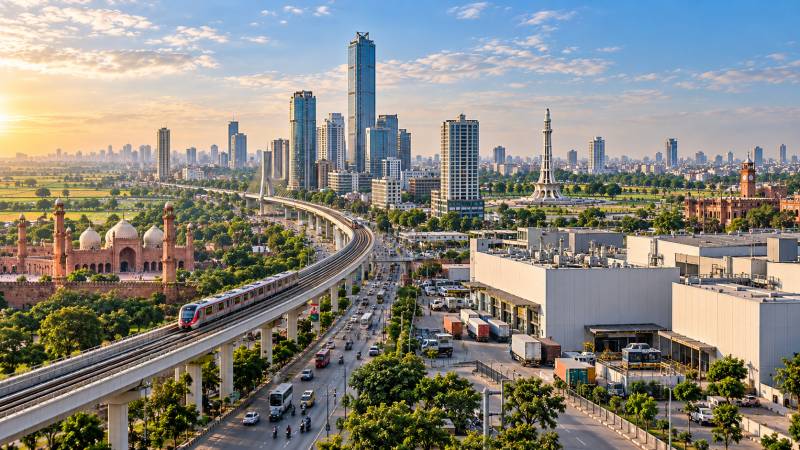
For decades, Punjab’s economic story has largely been told through the lens of agriculture. Its fertile land, large rural population and agricultural production have shaped the province’s economic identity. But that picture is changing. Punjab is becoming increasingly urban, and its cities are beginning to play a much larger role in determining the province’s economic future. The question is no longer simply whether Punjab will urbanise. It is whether it can turn urbanisation into a productive economic transformation. According to the Asian Development Bank’s Pakistan National Urban Assessment, urban development and economic growth are closely connected in Pakistan. Punjab contains eight of the country’s 13 major cities identified in the 2017 census and remains Pakistan’s largest provincial economy. Major cities increasingly concentrate employment in industry and services, making urban areas central to the country’s economic trajectory.
This creates an opportunity for what could be described as a “new urban economy” of Punjab, one in which cities are not merely places where people live, but centres of manufacturing, services, technology, trade, education and entrepreneurship.Lahore remains at the centre of this transformation. As Punjab’s largest metropolitan area, it has developed a diverse economy spanning services, education, retail, finance, technology and creative industries. But focusing exclusively on Lahore risks overlooking another important development: the rise of Punjab’s intermediate cities.
Sialkot, for example, has long been internationally connected through its export-oriented manufacturing economy, particularly sports goods, surgical instruments and other specialised products. Faisalabad remains an important industrial and textile centre, while Gujranwala has developed a strong manufacturing base. Multan and Bahawalpur are increasingly important regional centres for commerce and services.These cities demonstrate that Punjab’s urban economy does not have to revolve around a single metropolitan centre. Recent evidence suggests that intermediate cities can make a substantial difference when municipal institutions are given better planning and financial tools. The World Bank reports that its Punjab Cities Program supported 16 intermediate cities, with more than 4.5 million residents benefiting from improved municipal infrastructure and services by 2025. The programme also reported significant increases in the cities’ own-source revenues.
Punjab’s urban economy does not have to revolve around a single metropolitan centre; its intermediate cities can become powerful engines of manufacturing, exports, services, innovation and regional commerce.
Yet the transition from urban growth to an urban economy is far from automatic.Punjab’s cities have expanded rapidly, often without the infrastructure necessary to support that growth. The Urban Unit has highlighted the expansion of urban footprints and the prevalence of unplanned development across the province. Its analysis found that, among Punjab’s major cities, residential land use dominated urban space, while comparatively little land was allocated to commercial and industrial activities. This matters economically. A city is not productive simply because it has a large population. Productivity depends on connectivity, reliable electricity and water, efficient transport, digital infrastructure, education, housing and functioning local institutions.
When workers spend hours travelling because public transport is inadequate, when businesses face unreliable municipal services, or when industrial areas lack proper infrastructure, the economic cost is ultimately paid through lower productivity.This is why Punjab’s emerging urban economy requires a different approach to development. Urban policy cannot be limited to building roads, housing societies and commercial plazas. Cities need to be planned as economic ecosystems.
That means connecting universities with businesses, industrial clusters with transport networks, residential areas with employment centres, and smaller cities with national and international markets.The idea is particularly important for cities outside Lahore. If Sialkot can connect its export industries with better logistics and skills development, if Faisalabad can move further up the textile value chain, if Gujranwala can modernise its manufacturing base, and if Multan and Bahawalpur can strengthen their roles as regional service centres, Punjab could develop a more geographically diversified economy.
There are already signs of this shift in public policy. The Asian Development Bank has supported urban programmes focused on cities including Bahawalpur, Dera Ghazi Khan, Multan, Muzaffargarh, Rahim Yar Khan, Rawalpindi and Sargodha, with an emphasis on urban planning, municipal services and infrastructure. The challenge, however, is to ensure that urban growth produces jobs and productivity rather than simply larger urban footprints.
Pakistan’s broader urbanisation trajectory makes this increasingly urgent. The ADB’s national assessment argues that cities face pressures from inadequate housing, weak public services, insufficient planning and climate risks. At the same time, these same cities possess significant potential to support economic development if urban governance and investment improve.Punjab therefore stands at an important economic crossroads. Its future may depend less on whether its population becomes urban and more on what its cities actually do with that urbanisation.
The province has the population, industrial base, universities, entrepreneurial networks and geographic position to develop a much stronger urban economy. But achieving that potential will require moving away from the idea of cities as simply expanding settlements.The new urban economy of Punjab should instead be built around productive cities: cities that create employment, attract investment, support innovation, connect businesses to global markets and provide residents with the infrastructure needed to participate in economic life. Punjab’s next economic transformation may therefore not begin in its fields, but in its cities.