

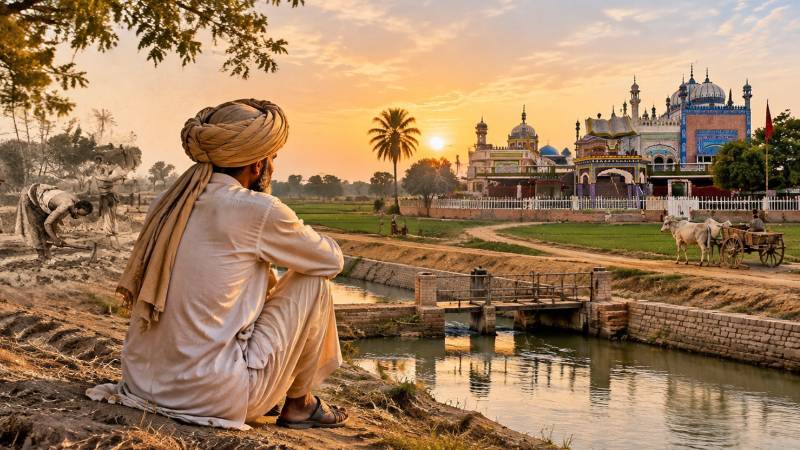
This is my homeland,
Here I was born and here live my dreams.
Pablo Neruda
These days I am in Charlotte, NC, USA. The other day while driving downtown, my son and I had to detour the highway. It was crowded and we chose to go by the back road. It was calm and we met a few passers by on our way. But as we entered a certain neighborhood my son grew uneasy, who was behind the wheel. When inquired of his urgency, he said it was a dangerous area since African Americans were living in the neighbourhood. I was appalled to see the place. Its roads were dilapidated and the surroundings were squalid. It was all done by design. My son had never encountered any trouble while passing through that place, but the identity of African Americans had been socially constructed in such a way that he never thought to question the prevailing narrative. “I am overdetermined from without”, as Frantz Fanon would say.
It reminded me of my days of the year 1978-1980. I was a sophomore of Khawaja Fareed College Rahim Yar Khan then. Rahim Yar Khan is a city of Abadkars. Research on the Bahawalpur State’s agricultural colonisation provides important figures. By March 1943, approximately 669,832 acres had been allotted under the Abadkari scheme across Bahawalpur State. Of this total, 142,694 acres were in Rahim Yar Khan district. By March 1946, the government had allotted almost all available colony land, bringing the principal phase of the settlement programme to completion. These figures demonstrate that the Abadkari programme had become firmly established in Rahim Yar Khan before the partition of India in 1947. 1927 marks the beginning of the organised Abadkari scheme in Bahawalpur State, while the 1930s and early 1940s represent the principal period of its expansion into Rahim Yar Khan district.
Historian Zahid Ali Khalid argues that the canal-colonisation programme favoured immigrant agricultural communities, particularly Punjabi Jats and Arains, while many local landless communities were disadvantaged. His research also describes tensions between the newcomers and the indigenous Saraiki-speaking population over land, cultural identity and political influence. The settlement programme therefore had consequences beyond agricultural development. It also altered the social and demographic character of parts of Rahim Yar Khan district.
Shar Balochs, who speak Sindhi and Siraiki and Gopang Balochs who speak Siraiki are the sons of the soil. However, the settlers portrayed the indigenous population as thieves and robbers. This process turned the local people into strangers in their own homeland.
It was an instrument of power. In his celebrated work Black Skin, White Masks, Frantz Fanon argues that human identity is not merely an expression of one’s own self. At times, society imposes an identity upon individuals from which they cannot easily escape. A person is defined in the eyes of others even before being recognised as an individual. Their personality, language, and cultural background are judged through preconceived notions and deeply entrenched stereotypes.
A study published in the International Review of Social History, “British Punjab and the Dialectics of Primitive Accumulation,” examines how pastoral communities were stigmatised as inferior and criminal while immigrant agricultural settlers were presented as productive and civilised. The study explains how the expansion of private property and canal colonies contributed to the marginalisation of indigenous pastoral populations. This distinction was politically consequential. If settlers were represented as hardworking and progressive, while indigenous communities were characterised as thieves or troublemakers, the resulting stereotypes could help justify unequal treatment.
First, economic power creates social privilege. Then social privilege becomes associated with moral superiority. Finally, the supposedly inferior population is represented as a threat to the established order. Toni Morrison is of the view that those who possess social power often acquire the authority to define the identities of others. The people being defined may have little control over the stereotypes imposed upon them.