

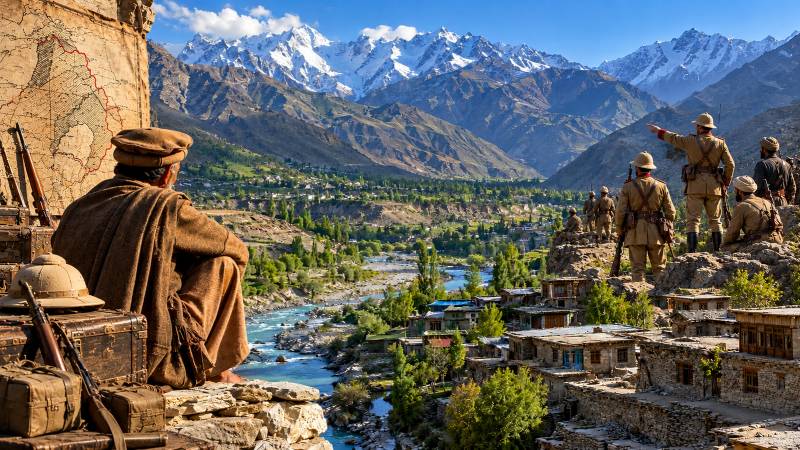
The historical trajectory of the indigenous Dardic communities of Northern Pakistan, inhabiting the high-mountain valleys of the Hindu Kush, Karakoram, and western Himalayan ranges, offers an extraordinary case study in the dynamics of multi-layered colonisation, cultural dispossession, and psychological alienation. For centuries, these high-altitude populations have lived at the crossroads of imperial friction, subject to successive waves of conquest, administrative restructuring, and cultural erasure. From early imperial incursions and Kashmir-based feudal expansions to the decisive northward march of Pathan hegemony, and later the rigid cartographic imposition of the British Raj and postcolonial state structures, external powers have systematically reframed and defined the Dardic peoples.
However, the deepest consequence of this long history of subjugation is neither geographical displacement nor political marginalisation, but an intimate, existential rupture. Imposing an external religious and historical narrative has conditioned the colonised to turn against their own past. They disown their pre-conversion ancestors, reject historical heroes as Kafirs and infidels, and internalise a triumphant account of their own conquest. Deprived of a coherent collective memory, these communities experience acute internal fragmentation, marked by intense clan-based tribalism and petty doctrinal disputes among local scholars. Drawing on critical frameworks including Frantz Fanon’s work on colonial psychology, Homi Bhabha’s concept of mimicry and ambivalence, Edward Said’s Orientalist binary constructions, Mikhail Bakhtin’s dialogic theory and Antonio Gramsci’s concept of cultural hegemony, this essay explores how the layered colonisation of the Dardic mountain communities has systematically colonised the mind, erased indigenous historical agency, and redirected subjugated energy inward.
To understand the depth of historical amnesia within the Dardic communities, one must draw upon postcolonial and critical social theories that examine how power operates beyond military violence. In Black Skin, White Masks (1952) and The Wretched of the Earth (1961), Frantz Fanon articulated the psychological mechanics of colonial dominance. Fanon demonstrated that colonisation is not satisfied merely with holding a people in its grip and emptying the native's brain of all form and content. Rather, by perverted logic, it turns to the past of the oppressed people, distorting, disfiguring, and destroying it. Stripped of an autonomous cultural mirror, the colonised individual internalises the colonisers’ values as the sole measure of human worth. This generates a state of self-alienation or neurosis, in which the colonised subject seeks redemption by identifying entirely with the conqueror and rejecting their own indigenous selfhood.
Homi Bhabha, in The Location of Culture (1994), adds further nuance to this dynamic through the concepts of colonial mimicry and ambivalence. Bhabha argues that the colonial state seeks to produce a class of subjects who are “almost the same, but not quite”, meaning individuals who mirror the dominant power's language, religion, and institutional norms. Yet, this process creates ambivalence. The colonised subject adopts the master's discourse. Still, because they are constantly reminded of their original “inferiority,” they become enthusiastic guardians of the very ideology that subjugated them, demonstrating loyalty to prove their complete break from their “savage” past.
This structural dominance is maintained through what Antonio Gramsci termed cultural hegemony. Hegemony occurs when a dominant group establishes its worldview as society's universal “common sense”. Rather than relying perpetually on physical force, the dominant class uses educational, religious, and political institutions to persuade subjugated groups to accept their lower status as natural, divinely ordained, or historically inevitable. When applied to the Dardic context, the invaders and imperial hegemonies transformed the history of mountain conquest into a moral binary of enlightenment versus ignorance, converting the subjugated peoples into active participants in their own cultural erasure.
The geographical isolation of the northern mountain valleys long preserved unique linguistic, social, and spiritual lifeways. Historically, Dardic-speaking peoples, including the Torwali, Gawri, Shina, Khowar, and Kohistani populations, practised intricate animistic, shamano-Buddhist, or localised polytheistic traditions closely tied to mountain ecology, sacred landscapes, and ancestral lineages. However, their strategic location made them targets for surrounding empires and expanding regional powers.
Central Asian empires, Kashmiri rulers, and regional dynasties launched sporadic campaigns against the valleys to control trade corridors and alpine resources. Between the 15th and 17th centuries, Pushtun tribes (notably the Yousafzai) moved northward into Swat, Dir, Kohistan and adjacent mountain valleys. This expansion was not merely territorial; it brought a structured feudal land-tenure system, Wesh, and a rigid socio-religious identity. The indigenous mountain dwellers were either pushed further into high-altitude headwaters, reduced to landless agrarian client classes faqeer and deqaan, landless or tenants or forcibly integrated into the dominant social order.
The indigenous Dardic communities of Northern Pakistan have endured centuries of conquest, cultural dispossession and psychological subjugation, leaving them alienated from their ancestral heritage, divided by internal rivalries and struggling to reclaim their historical identity and right to self-determination.
In the late 19th and early 20th centuries, the British Raj imposed state boundaries, legal codes, and geopolitical buffer zones such as the Durand Line, and ruled indirectly through local Princely States like those of Swat, Dir, and Chitral. The Raj codified tribal identities, reinforcing dominant feudal and Pushtun structures to maintain administrative order and freezing fluid indigenous social boundaries into fixed legal categories. Through these historical layers, the indigenous Dardic populations were progressively dispossessed of their territorial sovereignty and economic autonomy. However, the most lasting damage occurred when this physical conquest became a spiritual and historical imperative. Central to the subjugation of the Dardic communities was the complete restructuring of identity through an imported, highly politicised religious paradigm. Under the hegemony of the expanding southern forces, conversion to Islam was accompanied by a total reinterpretation of history. The indigenous past replete with oral epics, unique mountain cosmologies, regional heroes, and ancestral genealogies was systematically classified under the monolithic category of Jahiliyyah (pre-Islamic ignorance) and kufr (disbelief).
According to Fanon's psychological model, colonised communities underwent an internal rupture. They learned to view their own pre-conversion ancestors not as brave defenders of high-mountain autonomy, but as “Kafirs” whose memory was a source of spiritual shame. They stripped historical figures who resisted external invasions of their heroic stature and cast them as villains opposing the light of truth. This creates a striking manifestation of Bhabha’s colonial mimicry. The descendants of the conquered now take great pride in the very narrative that subjugated them. They celebrate the conquests of southern forces and regional warlords who subdued their valleys, adopting the conqueror’s historical lineage as their own. In doing so, the colonised attempt to purge the “stigma” of their indigenous origin by proving themselves more zealous than their conquerors. The community's collective memory is erased and replaced with an imported historical narrative that begins only at the moment of conquest. Indigenous oral traditions, folk songs, and ancestral tales are discarded as backward or un-Islamic, leaving the community historically disembodied.
While the colonised internalise shame, the coloniser's historical memory functions through a lens of uncritical triumph. Dominant regional powers recount the history of mountain subjugation not as material dispossession, economic exploitation, or cultural destruction, but as a heroic and civilising mission. When regional historians and community elders among dominant groups share their ancestors' history, they do so with immense pride. History is filtered exclusively through a religious-conquest lens. The subjugation of the highlands is framed as a moral duty that brought order to chaotic and lawless mountain tribes. The violence of conquest, the displacement of indigenous clans, and the reduction of mountain peoples to subordinate client classes are erased or justified as necessary steps toward spiritual alignment.
This triumphalist history relies on what Edward Said identified in Orientalism (1978) as binary construction. The dominant power constructs itself as rational, noble, civilised and spiritually pure, while projecting its inverse irrationality, wildness, barbarism, and spiritual blindness onto the indigenous mountain populations. Because the dominant power records, writes, and institutionalises history, this unilateral perspective becomes the official record. The colonised, lacking written institutions and having abandoned their own oral traditions, are rendered incapable of countering this narrative. They cannot tell their own history because they must use the conqueror's language, categories and moral framework.
Far from being an inherent, “primitive” trait of mountain societies, this internal friction is a direct byproduct of layered colonisation. As Fanon observed in The Wretched of the Earth, the colonised subject, living in a permanent state of tension and powerlessness against the oppressor, periodically unleashes this built-in aggression against his own brother. The tribal feud and the scholarly dispute become safe outlets for a frustration that cannot be directed at the overarching structures of marginalisation. Historical colonisers, both imperial administrators and regional elites actively manipulated tribal rivalries to prevent a unified mountain consciousness from emerging. By favouring certain clans over others and elevating compliant religious factions, the dominant powers ensured that the indigenous populace remained perpetually divided.
Without an intact, unifying historical narrative or ancestral hero to rally around, the community lacks a collective ethical centre. Mikhail Bakhtin’s monologic-versus-dialogic framework is instructive here. Imposing a single, rigid, monologic narrative suppresses the rich, dialogic plurality of local voices. Deprived of their shared indigenous heritage, people retreat into the smallest possible units of identity—the immediate clan or the narrow religious sub-sect leading to endless squabbling over trivialities. The ultimate tragic cycle of this historical process is the mirror effect. As the colonised Dardic communities internalise the dominant ideology, they begin to mirror the structural behaviour of their conquerors within their own micro-societies.
Postcolonial elites and educated individuals within these mountain communities often become the fiercest opponents of indigenous language revitalisation, cultural preservation, and historic reclamation. When native scholars try to document local languages, preserve folklore, or celebrate pre-colonial heritage, community members often attack them from within. Internal critics, operating entirely through the internalised lens of the coloniser, accuse cultural advocates of promoting “tribalism,” reviving Jahiliyyah, or undermining religious unity. Thus, the colonised community takes over the role of its own oppressor. The mirror effect makes hegemony self-sustaining. The dominant power no longer needs to actively suppress the indigenous identity, because the colonised subjects willingly police themselves, limiting their own mother tongues, ridiculing their traditions and cultural practices, and erasing what remains of their ancestral past.
The story of the colonised Dardic communities of Northern Pakistan illustrates how deep-seated conquest operates far beyond the battlefield. Through successive layers of invasion, regional dominance, and institutional marginalisation, physical control became psychological occupation. By replacing indigenous memory with an imported, binary historical narrative, the conquerors succeeded in alienating the mountain peoples from their own ancestors, stripping them of their historical heroes, and leaving them historically speechless. The resulting societal pathologies—incessant clan warfare, petty scholarly infighting, and the internal suppression of native heritage are the enduring psychological shadows of multi-layered trauma. For these communities to heal and reclaim their human agency, economic development or modern infrastructure alone is not enough. They must undergo a process of critical historical decolonisation.
As scholars of subaltern history and language revitalisation emphasise, decolonisation requires the laborious, courageous work of unearthing buried memories, documenting and promoting ancestral languages, re-evaluating oral traditions, reclaiming past native identities, respecting lands and resources and re-stitching the fractured narrative of the past. Only by recognising that their internal divisions and historical erasure are the artificial products of conquest can the Dardic communities transcend the mirror of colonisation, honour the full complexity of their ancestral heritage, and speak their history in their own voice. This is what is known as self-determination.