

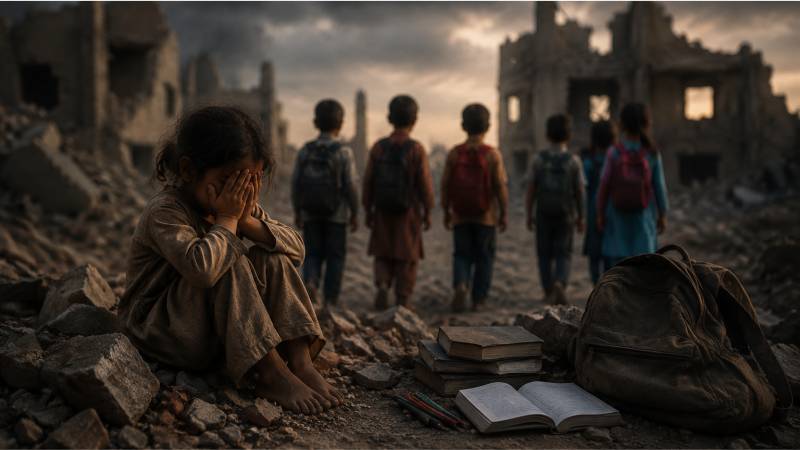
This piece is about three categories of people in Pakistan. The first are the changemakers who are, in their own way, a little like Sarah Norman, the deaf woman at the heart of Children of a Lesser God, insisting on being heard by a system that would rather they weren't. These "stupid" people refuse to stop insisting on being heard. They keep showing up to hearings that get adjourned. They keep running helplines nobody adequately funds. And, notably, they are rarely social media stars, a status that has become, for many, the real measure of a person's worth and clout. The second category is the system itself: one that works reliably for elites and almost no one else. The third, and the actual subject and emotional centre of this piece, is Pakistan's disadvantaged children. I would ask editors not to cut the word "emotional" it does not erase fact or logic; it simply names what is at stake.
One clarification: this is not an investigative report. I did not have the time or resources an investigation would require, and government offices which in my experience rarely answer written/email queries in any useful timeframe were not pursued further. Pakistan is home to between 25.1 and 26 million out-of-school children among the highest such figures anywhere in the world according to a 2026 Civil Services Academy review citing UNICEF assessments. Worth noting: the government's own Economic Survey 2025-26 reports a more optimistic trend by a different measure the out-of-school rate falling from 38 percent in 2023 to 28 percent in 2025. Both figures can be true at once; a falling rate against a large and growing population base is not the same thing as fewer children actually left behind.
Public spending on education and health combined comes to about 1.6 percent of GDP — education at 0.8 percent (Rs 962 billion) and health at 0.8 percent (Rs 942.2 billion) in FY2025 according to the Economic Survey 2025-26 itself. Nearly 40 percent of children under five are stunted. And child sexual abuse abduction, sodomy, rape, gang rape, murder after abuse has become, in the driest sense of the word, "routine": According to a national level reputed NGO Sahil's Cruel Numbers 2025 report logged 3,630 cases reported in newspapers alone last year, more than nine children a day, an 8 percent rise on 2024 and that is only what was reported and made it into print. I still become curious and concerned, despite knowing the details of this broken system, whether there was ever a real intention to fix it or whether what exists is a system that works exactly as designed: pro-corruption, pro-elite, and, when convenient, pro-justice.
Classism and aristocracy are the enduring inheritance of monarchs and colonial rulers everywhere.
Despite what can feel like a qaht-e-rijal an old Urdu phrase for a dearth of good, capable people Pakistan still produces, and this is one of its quieter miracles, passionate, sometimes foolishly stubborn change-makers: the Sarahs who choose to live and work here and keep struggling anyway. Bushra Iqbal Hussain, a seasoned broadcast journalist, media trainer, and CEO of the child-protection campaign Mahfooz Bachpan, is one of them. She still dreams of a system free of misogyny, and hopes she told me in a recent conversation tied to a court case she is following closely for a fairer sense of priority from the judicial system.
One small, telling example, which I first came across on Facebook and WhatsApp before following it further, is a case story of what that struggle looks like up close: Constitutional Petition No. 23 of 2017, filed by an eminent activist and a Supreme court advocate Zia Ahmed Awan. He founded Lawyers for Human Rights and Legal Aid (LHRLA) in 1989 alongside a group of fellow lawyers, and later developed the Madadgaar helpline to provide telephonic counseling, crisis intervention, and free legal aid for victims of abuse, exploitation, and violence. Even he has to spent nine years and at least a dozen hearings asking 37 federal and provincial bodies to coordinate on missing, trafficked, kidnapped and street children and still has no final order. By the petitioner's own account, the statutory National Commission on the Rights of Child (NCRC) operational since February 2020 took nearly two years to file a report the Court had ordered, with several implementing rules still pending according to submissions before the Court as recently as October 2025.
None of this happens in a vacuum. Education spending remains among the lowest in South Asia as a share of GDP, even after a "National Education Emergency" was declared in 2024. Health spending sits at the same low level Pakistan spent roughly $68 per person on public healthcare in 2022, against $475 in Iran and $623 in China, according to World Bank data compiled by Dawn. Those are not abstractions. They are the reason a missing-children helpline exists in the first place, the reason shelter homes are undercapacitated, the reason a law named the Zainab Alert Act. The Zainab Alert, Response and Recovery Act (ZARRA) of 2020, Pakistani law enacted to protect children from abduction and abuse by establishing a rapid-response system for nationwide awareness and recovery. Named after six-year-old Zainab Ansari, whose tragic 2018 rape and murder in Kasur, Punjab, sparked massive national outrage, the legislation mandates a dedicated federal agency to ensure instant state mobilization whenever a child goes missing.
It remains, more than five years after passage, incompletely implemented, according to proceedings before the Islamabad High Court in June 2026. All this should have been inevitable. I am citing our enemy neighbour India's example. India's National Commission for Protection of Child Rights has operated under statutory rules since 2007, sitting inside the Ministry of Women and Child Development with a working mandate to monitor child-protection laws thirteen years before Pakistan's own Commission became operational in 2020. Emergency child-abduction alert systems, the kind of rapid-response mechanism the Zainab Alert Act was written to create, already function in more than twenty countries worldwide, including the United States, Canada, Malaysia and South Korea, coordinated in part by the International Centre for Missing & Exploited Children. The gap is not conceptual. It is institutional will.
Look closely at the categories this petition uses street children, begging children, trafficked children, missing children and each one is not just a description but an accusation. A "street child" is a child the state has already failed to house. A "begging child" is a child the state has already failed to feed or educate. A "trafficked child" is a child the state has already failed to protect. These are not neutral administrative buckets; they are the residue of decisions made, year after year, in budget rooms and cabinet meetings. And so many of our honourable legislators and senior public figures who sign off on an education budget of 0.8 percent of GDP find, somehow, the composure to post pictures of their own children graduating from Ivy League universities or private colleges abroad degrees that are almost always self-financed, we are told, as if that detail settles the matter. It does not. It only sharpens some basic but risky questions.
What strikes me, writing this, is how unremarkable the cruelty has become. Nobody is shocked anymore by "nine children abused a day." Nobody stages a national reckoning over a Commission still waiting on key implementing rules. These numbers get cited, footnoted, filed away, and the news cycle moves to the next crisis a currency slide, a border skirmish, a celebrity scandal. Meanwhile files like CP 23/2017 sit in registries somewhere, adjourned, according to LHRLA, until after the next round of court vacations. I do not think this is random incompetence but a purposive pattern. A system that consistently fails one particular group of people, in the same particular ways, year after year, is not failing by accident. And yet. People keep filing petitions. People keep running helplines with more calls than capacity. People keep showing up to hearings that get adjourned again. Call it stupidity, if you likeI sometimes do, on the bad days. But it is also the only thing standing between a paper law and a functioning one.
What still hurts, though, is the absence of any visible remorse.
"Incremental progress cannot be mistaken for resolution," said Zia Ahmed Awan, "We will continue to press for the Zainab Alert rules to be notified without further delay, and for the outstanding directions on registration, rehabilitation and coordination sought since 2017 to finally be complied with." "The real challenge is the implementation; delay in notifying rules and enforcing them timely [is] creating loopholes in child protection systems," said Advocate Benash of the Society for the Protection of the Rights of the Child (SPARC) founded by celebrated lawyer Anees Jillani in 1992. Ms.Asiya Arif, SPARC's current Executive Director, added: "The harmonization of child protection laws is important in Pakistan. ZARRA Act 2020 needs improvisation in terms of first response and a swift coordination between the police and authorities regarding the kidnapped child. Any public interest litigation calling upon authorities to address fundamental rights violation (trafficking, child sexual exploitation (CSEA)/ sexual abuse/ rape and murder in this case) needs attention and brisk response. "
It is a sign of life that other organisations are engaged too. None of this is meant to devalue the many non-profits often themselves led by people with considerable privilege and connections who regularly document the depth of what these silenced categories of children endure. But I remain unconvinced by a landscape where NGOs and public departments dealing with children's and human rights so rarely work in full agreement. Why is there no visible outcry, no real unrest, over the mere existence of these categories of children? Why does it not shame the legislators? I think I know the answer. Across my various engagements with this class, from Boomers to Gen Z, the mindset has hardly shifted. I have heard them say, with startling audacity, even in front of foreign diplomats, "Who will do the work then?" mean the housemaids, domestic helpers, including the children among them.
Classism and aristocracy are not unique to Pakistan; they are the enduring inheritance of monarchs and colonial rulers everywhere. What still hurts, though, is the absence of any visible remorse. I have done a diagnosis. I leave it to Sarahs in the field to call for action,urgent, inclusive, visible, authentic. It will help these children, and it may also improve the moral and spiritual health of those who still sleep soundly, a smiling, shining photo of their own children propped beside them at the table.