

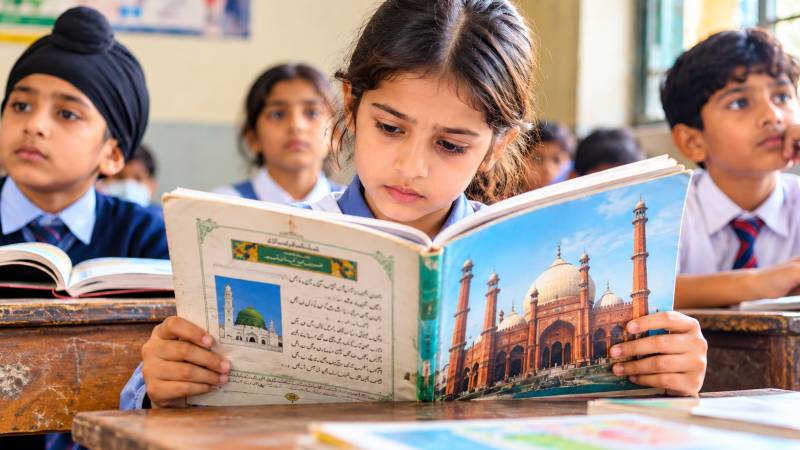
Picture a child — Hindu, Christian, or Sikh — opening a school textbook on the first day of term, expecting lessons in grammar, general knowledge, or the history of the country she calls home. What a decade of research keeps finding instead is a textbook built almost entirely around a faith that isn't hers, one she is nonetheless expected to study, memorise and be examined on.
This is not a new complaint. What is new is how consistently it keeps being proven. Two independent audits published this year, using different methods, on different sets of textbooks, by researchers with no reason to coordinate, arrived at strikingly similar conclusions. That convergence is itself the story: it suggests Pakistan's textbook bias is not a leftover problem awaiting one more reform, but a structural feature of how the curriculum gets made.
Start with the numbers. A 2023 review by the Centre for Social Justice (CSJ) of 145 compulsory-subject textbooks for Grades 1–10 found religious content so thoroughly folded into supposedly secular subjects — English, Urdu, General Knowledge, Social Studies, History, Pakistan Studies that non-Muslim students end up studying and being examined on Islamic teachings as a matter of course. The concentration was highest in Pakistan Studies (15%), followed by History (4%) and Urdu (0.66%). The same CSJ report found openly derogatory language too: references to a "Hindus' mentality," claims of "complete dominance of Hindus over Muslims," and caste slurs like "untouchable," sitting inside one-sided victim-and-oppressor narratives about religious communities.
Article 22(1) of Pakistan's Constitution is unambiguous on exactly this point: “No person attending any educational institution shall be required to receive religious instruction, or take part in any religious ceremony, or attend religious worship, if such instruction, ceremony or worship relates to a religion other than his own.” The official guideline built on that article is equally clear — curricular material “should be unbiased and non-controversial.” The trouble is that the curriculum built to implement that guideline routinely violates it. The government's own corrective, the Single National Curriculum introduced in 2020–21, was meant to fix exactly this. For the first time, it produced a dedicated "Religious Education" syllabus for five minority communities — Christian, Hindu, Sikh, Baha'i and Kalasha replacing the vague "Ethics" subject those students had previously sat through. On paper, that aligns with Article 22(1).
In practice, implementation crawled. Minority textbooks announced in 2020 were still not reaching the market years later, and rollout since formal 2023 approval has been hampered above all by a shortage of qualified teachers, particularly in schools with only one or two minority students. The SNC also ran into political trouble on its own terms: Sindh's assembly rejected it outright in 2021, though for reasons that had little to do with minority education specifically — the province called it a breach of the provincial autonomy guaranteed under the 18th Amendment, objecting to a federally written curriculum imposed without consultation. Whatever the reasoning, the practical result is the same: a minority child's classroom experience still depends on which province they happen to live in.
The omission of minority festivals, the routine inclusion of Islamic teachings in secular subjects, and the uneven treatment of other faiths are not merely gaps in representation. Together, they shape whose history is remembered, whose beliefs are understood, and who is made to feel that they do not quite belong.
There is real, recent movement worth crediting here. In April 2026, Sindh's Curriculum Council approved dedicated Hindu religious textbooks for Grades 3 to 5 — the first time Hindu students in the province's government schools will study their own faith rather than sit through a generic "Ethics" substitute. It will reach an estimated 129,000 Hindu students, concentrated in Tharparkar and Umerkot. It is a genuine, overdue step, and it points to what researchers have long argued is the more realistic fix — targeted, provincial, and concrete rather than waiting on a rewritten national curriculum.
The two 2025 studies fill in the texture elsewhere. A review of Punjab's primary-level textbooks by AFI and the Weaving People to Grow Foundation, using a CSJ-style methodology, documented 51 separate instances across the primary curriculum where Article 22(1) was violated — almost entirely through Islamic content folded into Urdu, English and general-knowledge books rather than confined to Islamiyat. It found a Grade 4 Ethics chapter on Judaism that renders Moses as "Hazrat Musa," teaching a minority faith through the majority faith's own vocabulary. It found festival content naming only Eid, leaving out Easter, Diwali, Christmas and Baisakhi, though it also credited a few chapters, including one naming Christmas, Holi and both Eids together, as proof that balance is achievable inside the existing structure.
The second study, by the London-based watchdog IMPACT-se, examined 86 government-approved textbooks across the Punjab, Sindh and Federal boards against UNESCO's tolerance benchmarks and added an axis largely missing from earlier Pakistani research: the treatment of Jews. It found comparative-religion chapters covering Hinduism, Christianity, Confucianism and Taoism that omit Judaism altogether despite Pakistan's own small historic Jewish community in Karachi and found Jewish tribes described in Grade 5 and 6 Islamic Education textbooks as having broken treaties "as usual," language the report notes echoes old blood-libel tropes. Tellingly, the same textbooks also contain sincere tolerance passages — a Grade 7 Urdu lesson insisting no religion teaches hatred, a Grade 8 Ethics passage on protecting minority rights. The bias, in other words, isn't blanket hostility. It's selective and deniable, which is precisely why it has survived every round of reform aimed at it.
None of this stays confined to the page. A Hindu student from Sindh recalled classmates telling her, more out of ignorance than malice, that she would never enter heaven unless she converted. A Christian mother described discrimination trailing her children through something as basic as their names — severe enough that she has considered leaving Pakistan altogether. This is the mechanism worth naming plainly: textbook bias doesn't stay theoretical. It licenses playground bullying, quiet pressure to convert, and pushes minority families toward emigration as a private workaround for a public failure.
None of this needs a fully rewritten national curriculum to start correcting. Provinces could audit their own textbooks against Article 22(1), the way CSJ and AFI already have, and strip majority-religion content out of English, Urdu and general-knowledge books rather than simply adding minority electives alongside it. Textbook boards could fast-track qualified teachers for the minority-faith syllabi that already exist on paper but sit unused in classrooms with too few staff to teach them. And provinces still weighing whether to follow Sindh's lead — for Christian, Sikh and other communities, now have a working, funded template sitting right next door. Pakistan's Constitution already says what the classroom should look like. The gap between that guarantee and the textbook on a child's desk is not a glitch in implementation. Closing it, as Sindh has just shown, does not require waiting for consensus in Islamabad.