

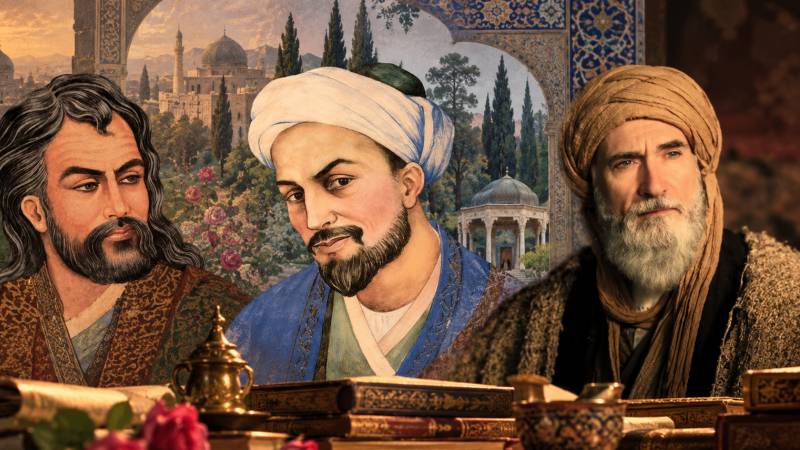
In its final stages of publication, The Mingling of the Oceans: A Theory of How Civilizations Can Live Together, forthcoming from Ambassador Akbar Ahmed, Frankie Martin and myself, explores how people today can live together despite their differences. At a time of wars, genocide and ethnic cleansing, the book offers a resource for policymakers, media professionals, teachers and students around the world. Its title is inspired by the Mughal Prince Dara Shikoh’s Majma al-Bahrain, or The Mingling of the Oceans.
The book examines some of history’s greatest figures who transcended the boundaries of their own groups to respect and reach out to humanity. We call them the Minglers. In contrast are the Anti-Minglers—those who build walls between cultures and nations, see only their own group and reject an empathetic perspective towards others. The world today desperately needs more Minglers. We see the consequences of Anti-Mingling in those who promote hatred, support wars and place barriers between communities. Against this destructive tendency, three great Persian and Islamic voices offer a different vision: Ibn Arabi, Hafez of Shiraz and Shaykh Saadi of Shiraz. Ibn Arabi speaks to the mingling of spiritual paths; Hafez to the mingling of hearts; and Shaykh Saadi to the mingling of humanity itself. Their teachings remain remarkably relevant to our fractured world. They suggest that peaceful civilisation does not begin only with political agreements, but with a transformation of the individual.
Ibn Arabi: The Mingling of Spiritual Paths
Muḥyī al-Dīn Muḥammad ibn ʿAlī ibn al-ʿArabī al-Ḥātimī al-Ṭāʾī, known simply as Ibn Arabi, was born in Murcia in al-Andalus in 1165, in present-day Spain. He grew up in Seville and travelled extensively throughout the Islamic world, encountering scholars, mystics and communities across North Africa and the Middle East. He eventually settled in Damascus, where he died in 1240. Known as “The Greatest Master”, or Shaykh al-Akbar, Ibn Arabi is associated with more than 850 treatises and is regarded as one of the most influential thinkers in Islamic mysticism. He viewed human diversity not as a flaw in creation but as part of the richness of Divine creation. One of his most famous expressions of this expansive spiritual vision appears in The Interpreter of Desires:
“My heart has become capable of every form:
it is a pasture for gazelles and a monastery for monks,
a temple for idols and the pilgrim’s Kaaba,
the tables of the Torah and the book of the Qur’an.
I follow the religion of Love; wherever its camels turn, Love is my religion and my faith.”
The heart, in this vision, becomes spacious enough to encounter religious difference without fear. This does not require anyone to abandon their own faith. Rather, Ibn Arabi asks whether commitment to one's own tradition can coexist with humility before the faith of another. His Bezels of Wisdom explores the wisdom associated with different prophets and spiritual traditions. Religious history is not presented simply as a contest between communities. Instead, Divine wisdom appears through different prophetic forms, with no single human formulation capable of exhausting the mystery of God.
Ibn Arabi’s treatment of Jesus is particularly significant. In the chapter devoted to Jesus, he describes him as a sign of Divine life and spirit. His Meccan Openings records spiritual experiences, visions and encounters with cities, scholars, mystics, women, pilgrims and ordinary people. Spiritual knowledge, therefore, is not acquired only through books but also through encounters with the diversity of humanity.
Ibn Arabi's encounter with Nizam in Mecca offers another dimension to his thought. He dedicated The Interpreter of Desires to her and described her as a figure of extraordinary beauty, intelligence and spiritual refinement. His treatment of the beloved demonstrates how human love can become a language for spiritual perception. His metaphor of the heart is ultimately a metaphor of capacity. The heart can become larger. It can encounter unfamiliar forms without immediately rejecting them. Genuine interfaith dialogue does not mean claiming that all religions are identical. It means creating enough space for people to listen, learn and recognise the dignity of the other. A civilisation incapable of imagining the sacredness of another person's experience will struggle to live peacefully with difference. A civilisation whose hearts are spacious enough for encounter has another possibility before it.
Hafez: The Mingling of Hearts
Hafez Shirazi is among the most beloved and enduring literary teachers of the Persian-speaking world. Known as Hafez of Shiraz or Hafiz Shirazi, his full name was Khwāja Shams al-Dīn Muḥammad Ḥāfeẓ-e Shīrāzī. He was born around 1315 CE in Shiraz, Persia, and spent most of his life there. Hafez's poetry transcends boundaries with remarkable fluidity. He developed the concept of the Rind—a spiritually free person who may appear sinful but possesses a sincere heart while contrasting this figure with hypocritical displays of piety and worldly power.
His poetry speaks of the beloved, music, gardens, longing and joy, and even wine. Beneath these worldly images lies a profound mystical sensibility. Like Shah Abdul Latif Bhittai's Shah Jo Risalo, the beloved can become a symbol of the Divine, while earthly love becomes a doorway to spiritual love. For the purposes of the Mingling of the Oceans, Hafez offers an important insight: the antidote to division is not necessarily argument, but the opening of the heart.
Human beings often divide the world into “us” and “them”—our religion and theirs, our nation and theirs, our community and theirs. Hafez unsettles these distinctions by reminding us that before we are representatives of categories, we are human beings capable of longing, suffering, joy and love. This is why the language of the heart is so powerful for peacebuilding. The heart recognises something that political language can sometimes obscure: the stranger has an interior life as rich and vulnerable as our own.
A famous story associated with Hafez illustrates the tension between worldly power and spiritual freedom. According to later tradition, Timur was angered by a verse in which Hafez suggested that he would exchange the cities of Samarkand and Bukhara for a single dark mole on his beloved's cheek. When summoned before Timur, Hafez reportedly explained that his generosity was precisely why he had been reduced to poverty. Whether historical or legendary, the story captures an important aspect of Hafez's poetic personality. The ruler possesses cities and armies; the poet possesses imagination. The ruler thinks in terms of ownership, while the poet speaks in the language of love, where value cannot be measured by territory.
Hafez also repeatedly challenges religious hypocrisy. His famous image of the tavern represents a space beyond rigid respectability, where the seeker is released from pride, judgment and self-righteousness. This remains relevant to contemporary peacebuilding. Moral language can itself become a form of vanity. A person may speak constantly of virtue while remaining incapable of compassion. A community may defend its purity while treating others with cruelty. Hafez asks us to look beyond appearances. The heart, rather than public performances of righteousness, is the true measure of a person. His poetry does not deny difference; instead, it asks whether difference must inevitably produce distance. The answer is no. To live together does not require sameness.
Mingling does not mean dissolution. Oceans mingle without losing their waters. Civilisations can meet without surrendering their histories, and religions can encounter one another without pretending that their theological differences do not exist.
Shaykh Saadi: The Mingling of Humanity
If Ibn Arabi speaks to religious encounter and Hafez to the heart, Shaykh Saadi of Shiraz speaks directly to our shared humanity. Abu Muhammad Muslih al-Din bin Abdallah Shirazi, better known as Shaykh Saadi, was one of the great poets and moral thinkers of Persian literature. His two best-known works, Bustan (The Orchard) and Gulistan (The Rose Garden), remain treasures of world literature.
Bustan presents an ideal moral world shaped by justice, generosity, humility and love. Gulistan combines prose and poetry through stories involving rulers, dervishes, travellers, scholars and ordinary people. Together, they explore ethical governance, humility, mercy, justice and human behaviour. Saadi's universal appeal was recognised in the West. Ralph Waldo Emerson admired him deeply, while Goethe regarded him as a great moral educator. His works have been translated into numerous languages and continue to speak across cultural boundaries.
Among Saadi's most famous verses is Bani Adam, or The Children of Adam, displayed in Persian calligraphy at the United Nations Headquarters in New York:
“All human beings are like parts of a body,
created from the same essence.
When one part is hurt and in pain,
the others cannot remain in peace and be quiet.”
Saadi does not begin with politics. He begins with the human body. We are limbs of one another. If one part suffers, the rest cannot remain indifferent. At the United Nations, these words embody an idea that is both ancient and urgently contemporary: humanity shares a common dignity, and the suffering of one part cannot ultimately be isolated from the rest. The question therefore changes from “What happens to my people?” to “What happens to humanity?” That shift from “my people” to “our humanity”—may be essential for peace.
Saadi's stories repeatedly challenge distinctions based on wealth and status. A king may need the counsel of a poor man; a scholar may learn from a labourer; and a beggar may possess greater dignity than a ruler. Political authority, in Saadi's moral vision, is legitimate only when it serves human welfare. Tradition holds that Saadi spent decades travelling through the Islamic world, encountering scholars, rulers, merchants, dervishes and ordinary people. While some details of his biography have been shaped by later legend, his literary identity is that of a traveller who experienced societies beyond his birthplace. His poetry therefore speaks to a central principle of the Mingling of the Oceans: human character cannot be judged by nationality, wealth or appearance.
From the Heart to Humanity
Ibn Arabi, Hafez and Shaykh Saadi lived in different circumstances and belonged to different generations, yet their visions can be brought together around a single idea. Ibn Arabi teaches us to make the heart spacious enough for difference. Hafez teaches us to open the heart through love. Shaykh Saadi teaches us to recognise the suffering of another human being as connected to our own. Together, they offer a philosophy of mingling.
Mingling does not mean dissolution. Oceans mingle without losing their waters. Rivers meet without erasing the landscapes from which they came. Civilisations can meet without surrendering their histories. Religions can encounter one another without pretending that their theological differences do not exist. Perhaps the richness of civilisation lies precisely in the ability to remain distinct while entering into meaningful relationships.
The metaphor of the ocean in Dara Shikoh's Mingling of the Oceans captures this beautifully. Human beings can maintain their identities while recognising their deeper connection. If each person recognises the dignity of the other as a fellow human being, the impulse to dominate or destroy becomes harder to justify. Mingling requires curiosity, humility and the courage to discover that the other may possess something we do not.
These ideas also have practical implications for education, diplomacy, interfaith dialogue and peacebuilding. A young person taught to approach difference with curiosity rather than fear is being prepared for peaceful citizenship. A religious leader taught to recognise the dignity of another tradition is better equipped to build bridges between communities. A university that brings students from different cultures and faiths into genuine conversation is not merely teaching tolerance; it is teaching the skills of civilisation.
Before people can live together, they must be able to imagine one another as fully human. Before communities can forgive, they must be able to imagine that the other has suffered. Before religions can enter dialogue, they must be able to imagine that the Divine may be approached through forms they do not themselves inhabit. This is the deeper lesson of the Minglers.
In a world marked by war, division and fear, the wisdom of Ibn Arabi, Hafez and Shaykh Saadi reminds us that peace is not created only through treaties or political agreements. It also begins with the human heart with our capacity to recognise difference without hatred, to encounter others without demanding sameness, and to understand that the suffering of another ultimately concerns us all. Under today's wars, I pray and hope that understanding and compassion, strengthened through education and policymaking, can prevail worldwide. The wisdom of these great teachers can help restore dignity to humanity and remind us that the purpose of civilisation is not merely to survive, but to learn how to live together.