

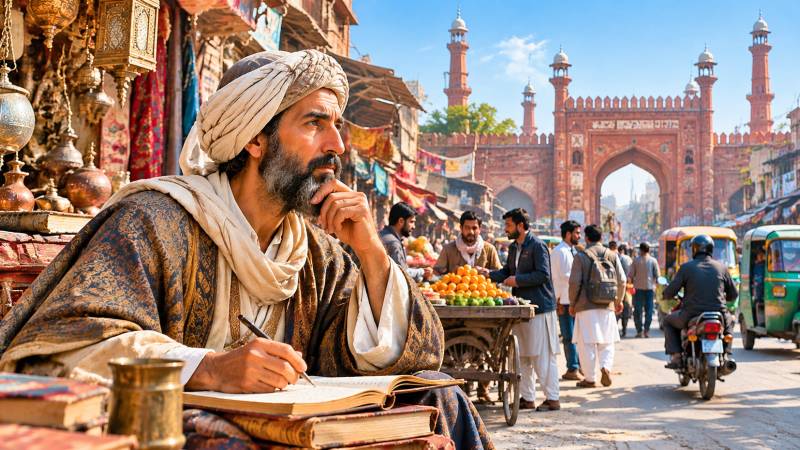
Imagine Ibn Khaldun renting a modest house in Lahore in current day Pakistan, somewhere close enough to the old city to hear its morning commerce and far enough from its busiest roads to work. He spends his first days walking through the markets around Delhi Gate, watching traders negotiate, craftsmen repair what others would discard, and young people conduct businesses on phones whose workings would astonish him. The city’s energy would hold his attention. So would the question that eventually drew him away from the intrigues of medieval courts and towards writing the Muqaddimah. What allows a society to prosper, and what causes those who govern it to undermine that prosperity?
Lahore would give him much to admire. Here is a city repeatedly reshaped by conquest, migration and political upheaval, yet still producing enterprise, scholarship, art and argument. Its resilience would caution him against easy predictions of collapse. But travelling between its crowded commercial streets, government offices and affluent residential enclaves, he would begin to examine how opportunity is distributed. Who obtains land, credit and permission to build? Who waits for a connection, a refund or a court decision? How much of a businessman’s success comes from making something better, and how much from knowing someone powerful?
Ibn Khaldun understood political connections well. He had served rulers, fallen out with them, suffered imprisonment and sought protection elsewhere. His autobiography records a career spent navigating the uncertain boundary between scholarship and power. Pakistan’s changing alliances would therefore seem familiar to him, although its institutions would be very different from the dynasties he knew. He would study the constitution, then ask how decisions are actually made. Which offices possess authority, which people exercise influence, and what happens when the two disagree.
Pakistan’s founding would deserve his careful attention. In 1947, a new state emerged from partition amid immense violence, displacement and uncertainty. Families rebuilt their lives, officials assembled an administration, and a political aspiration acquired territory and institutions. He would recognize the extraordinary collective effort involved. His concept of asabiyyah, the solidarity that enables people to act together, would help him understand that achievement. He would then ask how the solidarity of a founding movement could be sustained across a country divided by geography, language, class and competing expectations of citizenship.
The loss of East Pakistan would become central to his inquiry. A common religion had helped justify a common state, but it could not settle questions of representation, autonomy and the distribution of power. When the Awami League secured a national majority in the 1970 election, the political system failed to accommodate the result. Repression, armed resistance and war followed, ending in Bangladesh’s independence. Ibn Khaldun would find here a terrible distinction between the cohesion of a governing establishment and the cohesion of the society it governs. A ruling group may remain united in defending its position while losing the cooperation of people essential to the country’s survival.
That history would shape his reading of Pakistan’s subsequent disputes with its provinces and peripheral communities. Security threats are real, and he knew that governments must maintain order. Yet he would examine whether the methods used to establish order also sustain political allegiance. Citizens who can pursue grievances through credible institutions have reasons to invest in a common future. Citizens who repeatedly encounter exclusion may organize their loyalties elsewhere. For a federation, representation, fair treatment and dependable arrangements for sharing resources are therefore part of the infrastructure of national security.
Pakistan’s succession of civilian governments, martial laws, military takeovers and hybrid arrangements would occupy another chapter. He would observe that each incoming administration offers an explanation for its predecessor’s failure and a promise of national renewal. Some have delivered meaningful reforms, others have deepened existing problems. His interest would lie in what survives their departure. Does a judge become more capable of resisting pressure? Can a civil servant apply a rule without seeking protection? Can political opponents expect the same legal treatment? These questions would reveal more about institutional development than the confidence of a new ruler’s opening speech.
He would also scrutinize civilian power. An election can confer a mandate while leaving patronage, dynastic succession and discretionary government intact. Parties that defend constitutional authority in opposition must be assessed by their conduct in office. Ibn Khaldun’s experience would make him alert to leaders who gradually narrow participation, distribute positions among dependable associates and equate their own continuity with the public interest. Pakistan’s enduring problem, through his lens, would be the difficulty of making authority answerable to rules that remain binding when they become inconvenient.
At Lahore’s markets and workshops, his political analysis would become economic. A manufacturer considering new machinery must judge whether customers will buy the additional output, whether electricity will be affordable and whether financing can be repaid. He must also assess whether tax treatment will change, a contract will be honoured or a competitor will obtain a privileged concession. Ibn Khaldun argued that injustice damages prosperity because it weakens the incentive to work and accumulate. Applied today, that insight explains why legal uncertainty belongs in an investment calculation. Its costs appear in projects postponed, businesses kept small and capital committed for shorter periods.
Elite capture would concern him for much the same reason. He warned that a ruler entering commerce could exploit advantages ordinary merchants did not possess. In Pakistan, the relevant inquiry would extend across public enterprises, politically connected businesses and any commercial organization benefiting from preferential access to the state. He would ask whether land, procurement, regulation and taxation operate on comparable terms. The IMF’s recent governance diagnostic identifies weaknesses in precisely this terrain. Reform would require exposing and reducing privileges, with safeguards to ensure that selling a public asset does not simply place an entrenched advantage in private hands.
The tax system would attract particular scrutiny. Ibn Khaldun described how increasing fiscal demands can discourage activity and eventually erode the revenue they are intended to produce. Pakistan cannot finance schools, courts, infrastructure and public safety without adequate taxation. Its challenge is to collect revenue through arrangements citizens can understand and regard as reasonably fair and transparent. A system that repeatedly reaches for identifiable salaried employees and compliant businesses while leaving influential interests favourably treated undermines both incentives and trust. Simpler rules, fewer discretionary exemptions and credible appeals would help establish taxation as a shared obligation.
He would resist turning his argument into a promise that every tax cut generates more revenue. He understood that government expenditure circulates through society and sustains commerce. Visiting an under resourced school or meeting a family struggling to obtain medical care, he would have reason to question the composition of spending as well as its size. Fiscal discipline should preserve effective services and productive investment while confronting waste, poorly designed subsidies and losses that recur without accountability. A government can balance an immediate financing requirement and still weaken its future economic foundations.
Pakistan’s economic history since the 1960s would reinforce the importance of those foundations. The growth of that decade brought industrial expansion and agricultural gains but also depended on continuing external assistance. Later periods have likewise demonstrated how access to financing can relieve pressure without resolving underlying weaknesses. Foreign support can be valuable when it funds productive change. It becomes a poor substitute for reform when its arrival is treated as the principal evidence of success. Ibn Khaldun would examine what happens between crises, whether exports become more competitive, investment broadens and public institutions improve.
Living in present day Lahore, he would acknowledge economic recovery where it occurs. He would also insist on examining its reach. Aggregate growth can coexist with limited gains per person, weak employment prospects and households still recovering from inflation. Conversations with graduates searching for work, small exporters navigating costs and farmers dependent on uncertain markets would complicate the official account. For him, the strength of a society would become visible in its capacity to turn human effort into dependable livelihoods.
That would bring him to Pakistan’s most consequential neglected investment, its people. His account of wealth placed labour and productive activity at its centre, including the work required to realize value from land and minerals. A large population offers possibilities that must be developed through nutrition, health, education and skills. Mineral discoveries require institutions, technology and sustained investment before they generate useful prosperity. Pakistan’s young people need conditions in which effort can produce advancement at home, otherwise the country bears the cost of developing abilities whose greatest economic contribution may occur elsewhere.
As he returned each evening through Lahore, Ibn Khaldun would see grounds for hope alongside evidence of institutional failure. The traders, teachers, engineers, farmers and entrepreneurs he encountered would demonstrate capabilities that Pakistan has struggled to translate into broad prosperity. He would look for a political settlement that gives those people confidence in the rules and a meaningful stake in the country’s future. His work offers no timetable for Pakistan’s decline and no guarantee of its renewal. It offers a demanding question for every government. When its term ends, will the society that sustains the state be more productive, more fairly governed and more willing to hold together?