

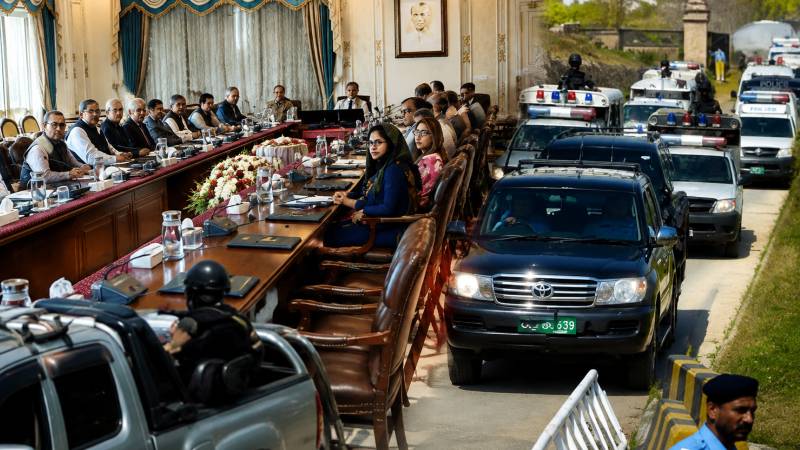
Pakistan has become remarkably adept at explaining away the things that should never have happened in the first place. The latest example is the controversy over the appearance of two Grade-20 civil servants in a horse-drawn carriage apparently reserved for the Head of State during an Independence Day event. The Interior Minister has offered a clarification, but even after that explanation, the fundamental questions remain unanswered. Indeed, the clarification may have addressed the mechanics of what happened without addressing the much more important issue: why did anyone think this was a good idea? That is the real question.
If the two officials were travelling in a vehicle meant for the Head of State, and the Head of State was not present, what made them think it was appropriate for them to occupy it? Were they instructed to do so? If so, by whom? And if they were instructed, did neither of these senior civil servants possess the basic judgment to say: Sir, this may technically be possible, but it will look terrible and should be avoided? This is not really about a buggy.
It is about the culture of official privilege that has become so deeply embedded in Pakistan’s bureaucracy and political establishment that people inside the system can apparently lose the ability to see how their conduct looks to everyone outside it. The criticism was immediate on social media, where images of the “royal” carriage became a subject of ridicule and anger. The controversy was not manufactured by some sophisticated political conspiracy. It was an entirely predictable reaction to an image that, in a country struggling with inflation, unemployment, poverty and a seemingly endless demand for sacrifices from ordinary citizens, looked spectacularly out of touch. And that is precisely why the two officers should have known better.
Grade 20 is not junior service. These are senior civil servants, presumably experienced enough to understand the relationship between public office and public perception. They are expected to exercise judgment, not merely follow instructions mechanically. There is an important distinction between obedience and responsibility. A civil servant cannot reasonably be expected to disobey every instruction with which he disagrees. But senior officials are not robots. Their value to a government lies partly in their ability to anticipate consequences, identify risks and advise political superiors when a particular course of action is unwise.
If someone told them to use the Head of State’s carriage, the appropriate response should have been something along the lines of: With respect, this is likely to create a negative public impression. It would be better for us to use another vehicle. That is not insubordination. That is professional advice. And if nobody told them to use it, the question becomes even more embarrassing: who authorised it, and on what basis?
It is about the culture of official privilege that has become so deeply embedded in Pakistan’s bureaucracy and political establishment that people inside the system can apparently lose the ability to see how their conduct looks to everyone outside it.
The episode also exposes the extraordinary sensitivity of Pakistan’s official culture to hierarchy. Somehow, an official vehicle or facility becomes not merely a means of transportation but a symbol of rank. The closer one gets to the centre of power, the more elaborate the protocol seems to become. Which is why the arrival of Norway’s Foreign Minister Espen Barth Eide in Pakistan could not have provided a more uncomfortable contrast.
Eide arrived in Islamabad on a commercial flight and was photographed carrying his own luggage. The images quickly spread across Pakistani social media, with users contrasting the Norwegian minister’s low-key arrival with the elaborate protocol and personal assistance that often surround Pakistani politicians and officials. The irony is almost too perfect.
A senior European cabinet minister arrives in Pakistan carrying his own bag. In Pakistan, even considerably less senior officials can sometimes appear to require an entourage to perform tasks that most ordinary people would consider entirely within the capabilities of a grown adult. The social-media reaction to Eide’s luggage was telling precisely because it was not really about luggage. People were responding to the symbolism.
Here was a senior minister from a prosperous democratic country behaving as though public office did not entitle him to theatrical displays of importance. His arrival was reportedly without the kind of spectacle that has become associated with VIP culture in Pakistan. That contrast should make us uncomfortable.
Norway does not demonstrate its importance by making its ministers look important. Pakistan too often does. And therein lies the larger problem. We have confused protocol with prestige, public office with personal status, and service with privilege.
The irony is that protocol exists for legitimate reasons. Heads of state require security. Visiting dignitaries require arrangements. Certain constitutional offices necessarily carry ceremonial distinctions. Nobody is suggesting that the President should arrive at an official function by rickshaw. But when protocol begins to extend downward until Grade-20 officials are apparently comfortable occupying a carriage intended for the Head of State, something has gone badly wrong.
The issue is not whether they broke a written rule. The issue is whether anyone involved understood the unwritten rule of public life: don’t do things that make the state look ridiculous. Good governance requires more than regulations. It requires judgment. And judgment requires something increasingly scarce in our official culture: the willingness to tell a superior that an idea is bad. Perhaps the most disturbing question, therefore, is not who sat in the buggy. It is whether anyone in the chain of command paused for even ten seconds to ask how the photograph would look. Apparently not.
And that brings us to the question that should haunt this entire episode: Does no one care? Does no one care that citizens are watching? Does no one care that every extravagant display of official privilege deepens public cynicism? Does no one care that a foreign minister carrying his own luggage can become a more powerful lesson in public service than countless speeches about austerity and governance?
The buggy will soon disappear from the news cycle. The photographs will be replaced by the next controversy. But the culture that produced the photograph will remain. Until officials begin to understand that public office is a responsibility rather than a perk and until senior civil servants feel empowered, and obligated, to tell their political masters when something is simply a bad idea Pakistan will continue to have the same problem. It will not be a shortage of protocol. It will be a shortage of perspective.