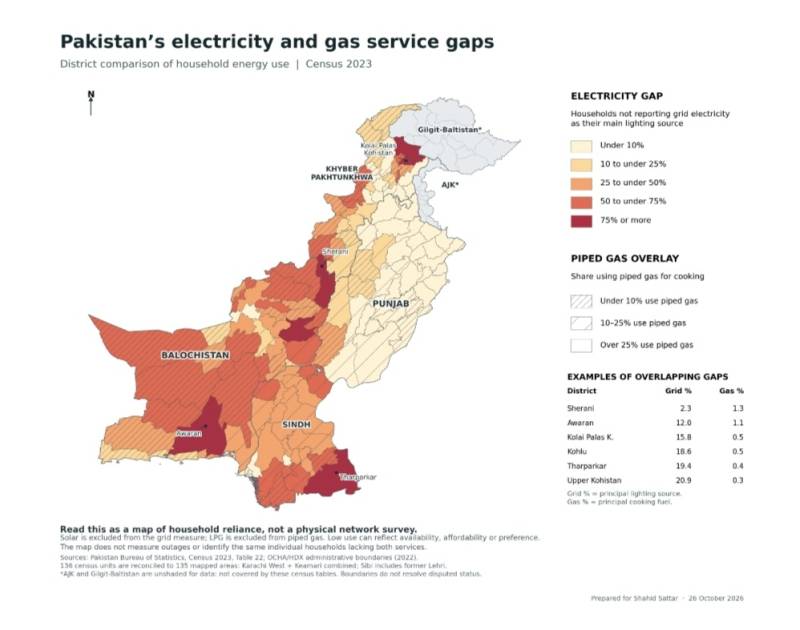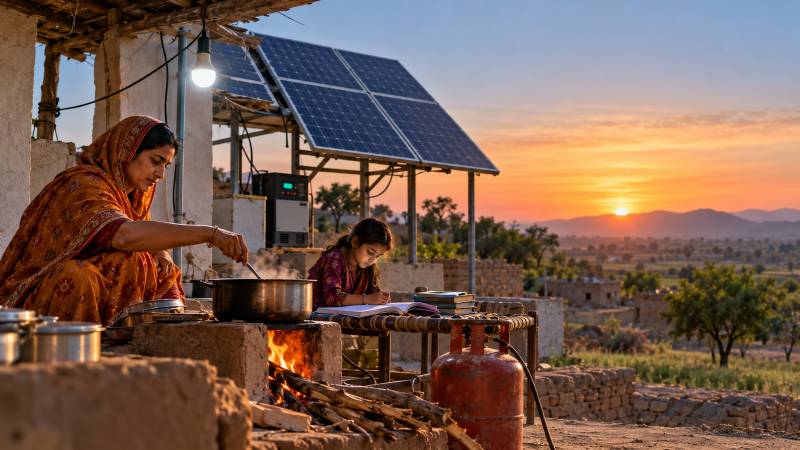
Pakistan’s energy debate too often begins with a utility’s balance sheet and ends with somebody else’s bill. Millions of consumers barely enter the discussion: households buying liquefied petroleum gas (LPG), families collecting firewood, workshops running generators and villages relying on small solar systems. They pay for energy and bear the consequences when it is unaffordable, unsafe or unreliable. Yet without a utility account, they remain largely invisible to a policy agenda organised around networks rather than needs.
Being off the grid does not place a consumer beyond public responsibility. Government and regulators must make adequate, safe and affordable energy services attainable, with clear, funded obligations assigned to suppliers. This need not mean a pipeline to every village or electricity at any price. Where network extension is uneconomic, another delivery system may serve people better. The obligation is to the consumer; infrastructure is the means, not the measure of success. This regulatory blind spot is a fundamental failure of how energy policy judges success. Tariffs, licences and service rules make billed customers visible while those outside utility networks can remain beyond effective protection. Their exclusion is a public-policy failure, not a reason to disclaim responsibility.
LPG already falls within the regulatory framework, and the Oil and Gas Regulatory Authority (OGRA) has a stated consumer-protection remit. A Petroleum Division policy document published in 2024 also addresses off-grid demand and poor households. The problem is therefore not a complete absence of recognition, but the gap between recognition and results. Oversight of suppliers must not be mistaken for protection of people. The scale of the challenge is evident in the latest household evidence. The official release of the 2024–25 Household Integrated Economic Survey reported that clean-fuel use had risen from 35 to 38 per cent—progress, but far short of universal access. The World Bank’s Pakistan Energy Survey, based on fieldwork in 2021–22, assesses electricity and cooking services through a Multi-Tier Framework, looking beyond connection counts. The Pakistan Bureau of Statistics reports that 96 per cent of households used main-grid electricity or solar panels for lighting in 2024–25. Lighting access, however, does not establish reliable supply or enough capacity to refrigerate food, cook or operate machinery.
Pakistan’s solar revolution is already challenging the assumption that electricity access must wait for a grid connection. Solar home systems are bringing lighting, fans and phone charging to remote and underserved communities, including households beyond the network’s reach. The World Bank-supported Sindh Solar Energy Project recognises this opportunity through its focus on affordable systems in areas with little or no electricity access. Government should build on this approach so that families struggling to afford conventional energy can enter the solar economy. Properly designed systems can reduce recurring expenses, support study and small livelihoods, and contribute to poverty alleviation. Basic solar kits cannot replace cooking fuels; that requires appropriately sized supply and efficient appliances. The aim should be to turn solar from an advantage purchased by those with savings into an opportunity accessible to those who need it most.
Table 1 summarises the national indicators. Local assessments must then distinguish household and enterprise needs: a small solar system may provide lighting without supplying the dependable power a workshop requires.
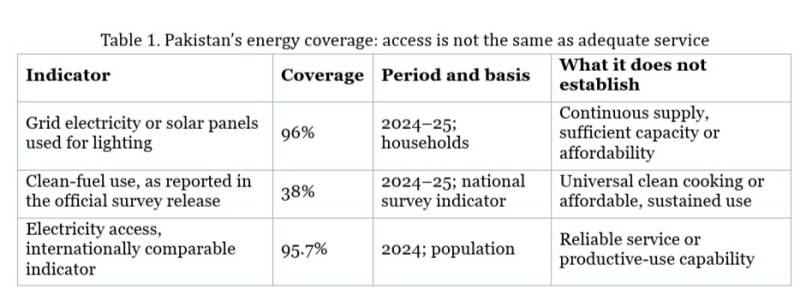
Data note: Pakistan Bureau of Statistics, HIES 2024–25 and its official launch release; World Bank electricity-access data for 2024. Household and population measures have different denominators. None is a measure of piped-gas network coverage or energy affordability.
Table 2 places Pakistan in its regional context using a common electricity-access indicator and year.
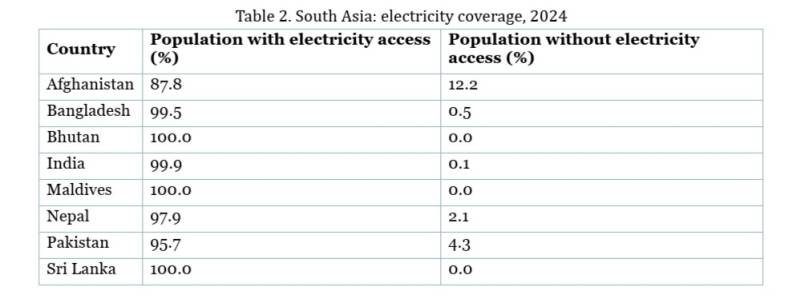
Data note: World Bank, access to electricity (% of population), 2024. Figures are rounded to one decimal place; the share without access is calculated as 100 minus the published access rate. This compares electricity access—not total energy coverage, grid connections alone, clean cooking, reliability or affordability.
Pakistan ranks below six of its seven South Asian neighbours on this measure. Closing that gap matters, but coverage is a starting point for accountability, not its finishing line. Coverage gaps and differences in service should shape assistance. A low-income household buying LPG must find the money for a refill as well as delivery or transport. Support organised around utility accounts can overlook equally pressing needs outside the network. Need does not become less deserving because it is served by a cylinder rather than a pipe. Eligibility should reflect household circumstances and the cost of an essential service, not historical access to infrastructure.
The consequences reach far beyond the monthly energy bill. Unequal access can deepen the rich–poor divide by turning purchasing power into a lasting advantage in reliability and productivity. Households with savings or access to finance can invest in efficient appliances, solar generation and storage. Those without such resources may remain dependent on inadequate supply or recurring fuel purchases they struggle to afford. The issue is not that decentralised energy is inherently unequal; it is that its benefits cannot be inclusive when access depends chiefly on the ability to pay upfront.
That disadvantage can compound over time. Unreliable lighting and power can limit study and digital access; costly fuel competes with spending on food, healthcare and education; interrupted supply constrains small enterprises. Time spent obtaining fuel is time unavailable for other activities. The World Bank identifies outages, higher electricity costs and lost economic opportunities as interconnected consequences of Pakistan’s grid constraints. Energy deprivation can therefore be both a consequence of poverty and a barrier to escaping it. A policy that counts connections while ignoring affordability and useful service risks recording progress even as inequality becomes more entrenched.
Reducing this disadvantage requires supply decisions that reflect how fuels interact. LPG comes from gas processing, refining or imports; it cannot be treated as an afterthought to the piped-gas business. Decisions affecting one fuel can alter the supply and cost of another. Decisions within the piped-gas system also have wider consequences. In its audited FY2025 results, Oil and Gas Development Company Limited (OGDCL) described forced production curtailments by Sui Northern Gas Pipelines Limited (SNGPL) and UPL owing to system load constraints. The company produces oil, gas and LPG. Where output is linked, the effect of gas curtailment must be assessed across associated products, not only pipeline volumes. Consumers who have never received a gas bill still have an interest in these decisions.
Liquefied natural gas (LNG) contracting, power dispatch and domestic production must consequently be assessed together. Procurement should account for changing demand and the costs of contractual inflexibility. LNG and LPG are different products, but both belong to a wider system of production, imports and consumption. Flexible procurement, transparent dispatch, payment discipline and workable access for competing suppliers are essential. Cancelling contracted imports without accounting for the cost is no sounder than curtailing domestic production without valuing its associated output.
Industrial fuel choices illustrate another weakness in treating utility sales as the principal policy measure. When network energy becomes too expensive or unreliable, a business may switch fuels, invest in self-generation or cut production. Each response has different economic and environmental consequences. Falling utility sales cannot, by themselves, distinguish efficiency gains from fuel substitution or lost output. A utility’s accounts may improve without a corresponding improvement in national productivity or public welfare. Nor is domestic coal automatically cheap once mining, dewatering, transport, suitable equipment and pollution control are included. Proposals to convert coal into synthetic gas or dimethyl ether require equally rigorous scrutiny: capital costs, conversion losses, water requirements and subsidy dependence must be disclosed. Replacing an imported fuel with a costlier domestic process does not create an economic saving merely because the feedstock is local.
Industrial cogeneration requires a whole-system comparison. A factory producing electricity and useful steam must be assessed against grid electricity plus separately produced heat. Pakistan’s Off the Grid (Captive Power Plants) Levy Act, 2025 imposes a levy on gas-based captive generation; the accompanying Senate committee report identifies increased grid demand and use of spare capacity among its objectives. That objective does not establish that every transfer saves fuel or preserves competitiveness. Replacement boilers, network capacity and reliability determine the outcome. Using spare generation capacity is worthwhile only when the resulting service makes economic sense.
The same whole-system test applies to solar and electrification. Electric cooking can displace LPG where power is reliable and appliances are affordable. Midday solar generation, however, does not automatically provide an evening meal: storage, network capacity and household routines matter. Solar irrigation can reduce fossil-fuel use, but lower pumping costs can encourage excessive groundwater extraction without adequate safeguards. The Food and Agriculture Organization identifies this risk alongside financing and maintenance needs. Each intervention must be judged by the service delivered, who can afford it and its wider consequences.
For households, the relevant comparison is the cost of a cooked meal, not simply the price of a unit of fuel. Only part of the energy supplied to a stove reaches the cookware as useful heat, and that proportion varies with the appliance, cookware, fuel quality and cooking method. Table 3 shows why gas, firewood, coal and electricity cannot be compared on fuel prices alone: the appliance determines how much cooking service each purchase delivers. Its electricity benchmarks describe efficiency at the cooktop, not losses in generation and delivery.
Comparison note: Gas and electricity figures are indicative US ENERGY STAR and Department of Energy benchmarks, not measurements of Pakistani appliances or a common test across all fuels. Solid-fuel performance is equipment-dependent. Efficiency alone establishes neither the cheapest cooking option nor its safety or emissions.
The table’s policy message is that efficiency can magnify the affordability gap. The energy cost of useful cooking heat is the input-energy price divided by appliance efficiency. In an illustration—not a measured comparison of Pakistani stoves—a 20 per cent-efficient appliance needs four times the energy of an 80 per cent-efficient one to deliver the same heat. If its input energy also costs twice as much, that heat costs eight times more. Actual rankings depend on local prices and equipment, but equal spending plainly does not buy equal cooking service. Households unable to finance efficient appliances can face a double penalty: expensive energy and greater waste.
Assistance must therefore address efficient equipment as well as recurring fuel costs. The principle extends to insulation, motors and industrial steam systems: better equipment delivers more service from existing supply. Efficiency belongs within access policy, supported by affordable financing where justified.
International experience shows why equipment support must be matched by recurring affordability. India’s Ujjwala programme expanded LPG connections, but connections alone do not establish continued clean cooking. A Council on Energy, Environment and Water study published in September 2026 surveyed 2,222 rural households across six states during November 2024–January 2025. It found that 73 per cent had used LPG in the preceding three months, while only 23 per cent used it exclusively. These are survey findings, not a national estimate. High refill costs were a major barrier: distributing equipment is only the beginning of delivering a sustained service.
Britain’s temporary £200 Alternative Fuel Payment during the 2022–23 energy-price crisis recognised eligible households using heating oil, LPG, biomass and other alternatives. Pakistan cannot replicate Britain’s fiscal capacity, but the underlying principle is relevant: households outside mains gas should not be overlooked when energy assistance is designed.
Australia offers a complementary regulatory lesson. The Australian Energy Market Commission’s distributor-led stand-alone power framework was designed to preserve existing consumer protections, including reliability and safety standards, where stand-alone supply was more economical than a grid connection. The Australian Energy Market Operator’s fact sheet confirms that distributor-led systems are recognised within the rules. These arrangements should not be confused with every private solar installation. The principle is nevertheless clear: decentralised supply need not mean abandoning accountable service.
Pakistan should turn these lessons into a funded national energy-service framework. Government must assign responsibility for underserved consumers and establish minimum standards for household and productive needs. District plans should set delivery obligations and deadlines; regulators should report gaps by income and location, require corrective action and provide accessible redress beyond utility customer lists.
The National Socio-Economic Registry administered by the Benazir Income Support Programme (BISP), combined with local evidence of inadequate supply, offers a starting point for a budget-funded clean-energy benefit. Eligibility should allow new registration and appeals, without requiring a utility account or rooftop ownership. The poorest households should receive grants for a quality-assured solar package and installation; others could receive partial grants and affordable instalments. Financing must disclose all charges and allow hardship rescheduling. Support must be additional to—not diverted from—essential household cash assistance.
Procurement should specify lighting hours, appliance capacity and suitable storage, with final supplier payment tied to independently verified performance. Warranties, local repairs, safe battery take-back and a maintenance and replacement allowance for the poorest should keep systems working. Portable or shared systems can serve tenants and households without suitable roofs; grants for viable livelihood equipment should include training and adequate power capacity. Clean-fuel support should continue where solar cannot meet cooking needs. Provincial departments should publish budgets, functioning-system rates, household savings and complaints resolved.
Delivery should reflect local economics and resources. Dense settlements may justify network extension; dispersed communities may need mini-grids, solar with storage and locally appropriate cooking fuels. Privatisation changes ownership, not the obligation to define and enforce service standards. For livestock-owning communities, biogas can complement solar electricity by supplying locally produced cooking gas. Where manure, water and reliable upkeep are available, household or community digesters can reduce reliance on purchased fuels and firewood. Properly managed digestate can also provide fertiliser. Targeted grants, trained installers and after-sales service should support locally assessed projects, with safeguards for operation, leaks and slurry management. Biogas is not suitable everywhere, but where viable it can link affordable energy with farm productivity and stronger rural livelihoods.
Where LPG remains the practical cooking option, protection must be equally concrete. Accountability must extend through storage, supply routes, cylinder testing, traceable filling, correct weights and distribution. Taxes and fees should be assessed against their effect on the cost of useful cooking. A low announced price provides little protection if authorised supplies are unavailable or unsafe refilling becomes the practical alternative. Consumer protection must work along the entire supply chain, not stop at a price notification.
Pakistan needs a genuinely integrated energy policy—not separate sector plans under one title. It must assess fuels and supply options against their uses, availability, geographical reach, adoption, efficiency and affordability, identifying gaps in both supply and the means to use it. A common evidence base should guide coordinated investment in production, imports, networks, decentralised systems and efficient appliances, comparing the full cost of useful service and supply risks. Regulators and federal and provincial governments must align these decisions. Integration must change investment and who benefits, not just policy language.
Financial accountability is equally important. Consumers should pay fairly for the services they receive, while social assistance, operating inefficiencies and legacy contractual liabilities are identified separately. Decisions about who bears each cost must be explicit. Neither cylinder buyers nor remaining grid customers should become convenient recipients of costs government declines to acknowledge. Reform cannot be considered equitable if it protects institutional balance sheets by weakening the purchasing power of those least able to absorb the burden.
Pakistan’s progress depends on affordable, reliable energy and its widespread, efficient use. As the Pakistan Economic Survey 2025–26 recognises, energy underpins production, agriculture, commerce and public services. Energy cannot deliver development alone, but unaffordable equipment operation and unreliable supply leave productive capacity and opportunity unrealised. Affordability must rest on efficient delivery, sound investment and targeted support—not unfunded subsidies.
The test of reform is whether underserved households gain dependable, affordable services—not whether utility sales rise or institutional accounts improve. Regulators cannot claim success while people outside the networks remain invisible; government must close the gaps in authority, funding and delivery. Continued neglect will leave Pakistan’s future bleak: constrained growth, lost livelihoods and a widening rich–poor divide. That outcome is avoidable, but only through action rather than another promise of reform. Public responsibility must follow the consumer. The boundary of a utility network must never become the boundary of opportunity.