

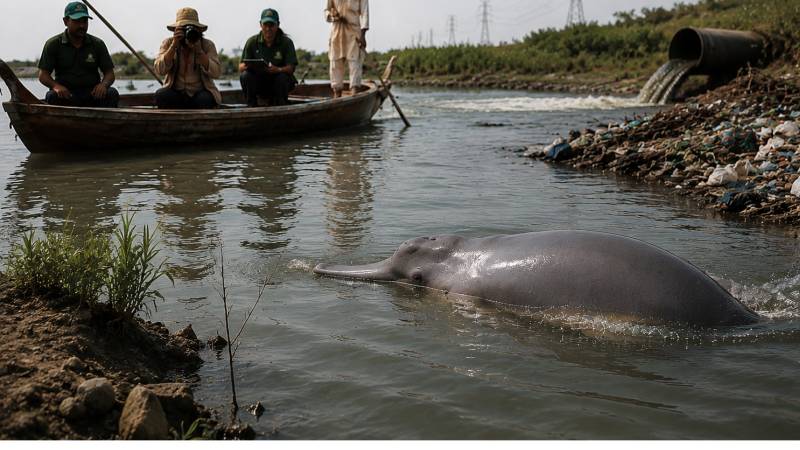
The Indus Dolphin, Platanista gangetica minor, locally known as Bulhan is one of the world’s most rare freshwater cetaceans. Functionally blind, it relies on echolocation to navigate and hunt in the turbid waters of the Indus River. Historically, it occupied the main stem of the Indus and its tributaries, but its distribution has been reduced to about one-fifth of its original range due to hydraulic structure construction, irrigation diversions, and pollution. The species is officially listed as Endangered on the International Union for Conservation of Nature (IUCN) Red List and under Appendix I of the Convention on International Trade in Endangered Species of Wild Fauna and Flora (CITES), obligating Pakistan to ensure strict protection, prevent exploitation, and report conservation progress internationally. Protecting this dolphin is therefore not only a provincial matter but a national responsibility, tied to Pakistan’s commitments under global biodiversity conventions and its image in international conservation.
Population assessments demonstrate cautious recovery. In 2001, about 1,200 dolphins were recorded, rising to 1,550 in 2006 and 1,665 in 2011. A comprehensive survey in 2017 estimated nearly 1,987 individuals. Localized counts between Guddu and Sukkur barrages, the stronghold of the species, showed 918 dolphins in 2011 and 1,419 in 2019. The most recent spatial based mapping and census in February 2026 confirmed 135 dolphins in the Dera Ismail Khan reach between Chashma Barrage and Ramak area, demonstrating localized stability. These figures suggest that targeted interventions have slowed decline and fostered growth, though populations remain fragmented into isolated sub-groups vulnerable to local pressures.
The threats to the Indus dolphin are persistent and national in scale. Canal stranding’s occur when dolphins enter irrigation canals through regulator gates and become trapped during closures, often leading to death without rescue. Fishing net entanglement remains a major cause of mortality, exacerbated by illegal practices such as overnight gillnetting and pesticide poisoning. The discharge of untreated industrial and domestic effluents, combined with agricultural runoff and associated pesticide contamination, continues to adversely affect water quality and may pose risks to the dolphin population. Habitat fragmentation caused by gated structure isolates populations, reducing genetic diversity and resilience. Climate variability and low dry-season discharge further stress the species, making water governance a critical factor in its survival.
Advanced methods now play a crucial role in monitoring and conservation. Traditional boat-based surveys are increasingly complemented by spatial mapping, which allow researchers to track dolphin distribution with precision. Drone-based aerial surveys provide real-time counts and detect illegal fishing activities. Passive acoustic monitoring records echolocation clicks to estimate population density in turbid waters. Genetic sampling assesses population diversity and structure, helping guide conservation actions such as translocation to support small and isolated populations. Continuous water quality monitoring with sensor networks ensures that dissolved oxygen, pH, and pollutant levels remain within safe ranges. These techniques, combined with conventional direct counts, provide a more accurate picture of population trends and threats.
Protecting this dolphin is therefore not only a provincial matter but a national responsibility, tied to Pakistan’s commitments under global biodiversity conventions.
Conservation efforts are supported by multiple organizations. WWF-Pakistan has led rescue programs since 1992, saving stranded dolphins and training local staff. The Sindh and Punjab Wildlife Departments enforce protective regulations in their respective reaches, while the Ministry of Climate Change coordinates biodiversity policy and represents Pakistan in IUCN and CITES forums. Internationally, the IUCN Cetacean Specialist Group provides scientific guidance, while UNDP and the World Bank have supported water resources projects that indirectly benefit dolphin habitats. The Zoological Society of London (ZSL) and Whale and Dolphin Conservation (WDC) have also contributed expertise through collaborative research and awareness campaigns. These partnerships highlight that dolphin conservation is not a provincial issue alone but a matter of national and international responsibility, requiring humility, cooperation, and sustained commitment.
Eco-tourism offers a promising opportunity to link conservation with sustainable development. Carefully managed dolphin-watching tours between Sukkur and Guddu barrages could generate income for local communities, incentivize conservation, and raise global awareness of Pakistan’s unique freshwater biodiversity. Such initiatives must be regulated to avoid disturbance, with strict codes of conduct for boat operators and education programs for visitors. By positioning the Indus dolphin as a flagship species, Pakistan can strengthen both conservation and community livelihoods.
Future priorities should focus on strengthening rescue and monitoring networks, revising fisheries legislation to curb illegal practices, deploying acoustic deterrents at high-risk canal gates, and expanding community engagement. Translocation studies could be explored to enhance genetic diversity in low-density areas, though feasibility assessments are essential. Eco-tourism development should be pursued as a complementary strategy, integrating conservation education with tourism. Long-term success requires embedding dolphin conservation within broader national water governance, ensuring that irrigation, industry, and urban development respect ecological limits. In doing so, Pakistan not only fulfills its obligations under the Convention on Biological Diversity (CBD) but also advances the Sustainable Development Goals (SDGs), particularly SDG 14 (Life Below Water), SDG 15 (Life on Land), and SDG 6 (Clean Water and Sanitation). By aligning dolphin conservation with these frameworks, Pakistan demonstrates its commitment to global biodiversity, enhances its international reputation, and ensures ecological sustainability is integrated into national development planning.
The Indus River dolphin remains a global priority species and a symbol of Pakistan’s freshwater heritage. Its blindness, once seen as a limitation, is in fact an extraordinary adaptation to the muddy waters of the Indus. The 2026 census confirms localized stability in the Chashma-Ramak area, while the Guddu-Sukkur barrages continue to host the largest population. Persistent threats demand urgent, coordinated national action. By combining international best practices, innovative survey methods, and eco-tourism opportunities, Pakistan can secure the long-term survival of this unique cetacean while promoting sustainable development along the Indus River.