

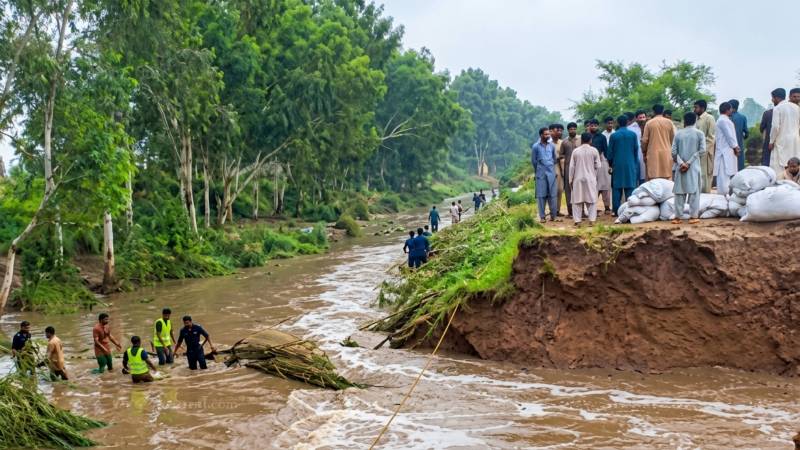
More than 5,000 people have been displaced from Basti Kanjal in Layyah this month after devastating riverbank erosion swept away homes, schools, farmland and essential community infrastructure. What was once a settled village has now been reduced to a story of displacement, loss and uncertainty, with families forced to leave behind the homes and livelihoods they had built over generations.
Riverbank erosion is not an unfamiliar phenomenon in the region. It usually intensifies during the monsoon season, particularly between mid-July and the end of August, when floods hit the River Indus. But the scale of destruction in Basti Kanjal raises a much larger question: when a river changes its course, are governments prepared to understand and manage it according to its natural behaviour?
James C. Scott, an American political scientist and anthropologist, wrote in his book In Praise of Floods, “Floods are not threats to be tamed.” According to Scott, the real problem is not necessarily the flood itself, but the homes, farms and cities built on land that naturally floods.
This raises another question: are those in power managing the river according to the way it naturally behaves? Unfortunately, the state has repeatedly attempted to fit the river into maps created by humans. That approach is bound to fail because it is impossible to confine a living, constantly changing river within boundaries drawn on a map.
Dr Javaid Iqbal Kanjal, a resident of Basti Kanjal, told me by phone that the entire village, comprising more than 500 houses, two schools, and one Basic Health Unit (BHU), has been swept away. According to Kanjal, one girls’ high school and one boys’ primary school have been washed away due to destructive riverbank erosion in the area. He also said that more than 1,000 acres of sugarcane farmland had been eroded this year alone.
Regarding the district administration’s response, Dr Kanjal said, “More than 5,000 people of Basti Kanjal have been displaced due to criminal negligence of the Layyah administration.” He further described the displaced people as “wandering people” because they have no shelter or resources left to rebuild their lives.
Dr Kanjal also stated that hundreds of students, including young girls, have lost access to their schools. Regarding the Layyah-Taunsa Bridge, a major four-lane river-crossing project in Union Council Sumra Nashaib near Basti Kanjal, he said that local residents, including himself, were opposed to the location of the bridge.
He further claimed that the authorities, including the federal government, the Executive Committee of the National Economic Council (ECNEC), and the National Highway Authority (NHA), did not consult the residents of Union Council Sumra Nashaib before approving the project. The displaced people are now “wandering people,” as they have no shelter or resources left to rebuild their lives.
Dr Kanjal concluded that the district administration and the Punjab government had done little for the residents of Basti Kanjal. He said that “locals sold their gold” to pay for the transportation of their families and livestock from the village to other places within the district and neighbouring districts.
Khalid Mirani, a social activist and native of Layyah who was present on the ground, told me, “In this modern era, the displacement of thousands of people due to riverbank erosion is shameful.” He further said that the “Punjab government and district administration’s gross negligence intensified the problems of the people affected by erosion in Basti Kanjal.”
Mirani added that “Basti Kanjal was a modern village in Layyah, but unfortunately, riverbank erosion destroyed the lives of thousands of individuals.” He suggested that the Punjab government could still provide better assistance by offering permanent housing to the residents of Basti Kanjal through different provincial schemes, including the “Apni Chhat Apna Ghar” scheme.
Mirani added that the “people of Basti Kanjal in Layyah are among the most eligible and deserving people for provincial schemes, as they do not have roofs over their heads.” He concluded by saying that the “Punjab government is not serious about people, particularly the people of Saraiki Wasaib (South Punjab).”
Member of the Provincial Assembly (MPA) from Layyah, Somia Atta Shahani of the Pakistan Muslim League-Nawaz (PML-N), said during a phone call that the “Punjab government should invest more in the district’s riverine belt to make the lives of citizens safer.”
She also confirmed that the issue of riverbank erosion in Basti Kanjal had come to the attention of Chief Minister Punjab Maryam Nawaz, adding that the district administration had provided emergency relief to the residents of Basti Kanjal.
Deputy Commissioner (DC) Layyah Asif Ali Dogar disputed the figure of 5,000 displaced people reported by locals and said that between 400 and 500 people had been displaced in Basti Kanjal due to riverbank erosion this month. Speaking to me by phone, he said, “There are no proper structures available in district Layyah to avoid riverbank erosion.”
However, he said that the district administration was currently providing emergency relief to the affected residents in the form of food, shelter, and transportation. He also confirmed that emergency arrangements were underway to control the devastating erosion in Basti Kanjal.
Riverbank erosion may be a natural process, but the question remains: Are governments and those in power prepared to tackle the issue promptly and protect vulnerable communities?
The answer could be yes if governments and relevant authorities stop overlooking the opinions of local communities and involve them before approving the construction of large spurs, dams, bridges, and flood barriers along naturally flowing rivers.
For the people of Basti Kanjal, however, this is no longer merely a debate about engineering or river management. It is about homes that have disappeared, schools that have been washed away, farmland that has been lost, and thousands of people who now have nowhere to call home.