


Some of life's most enduring lessons are taught by people who are never extolled in the media. One such lesson came to me during one of my recent visits to Layyah, a rather less known district in southern Punjab, shaped by the rugged landscape of Thal and the quiet resilience of its people.
Agriculture remains the backbone of life here, and for generations, Layyah’s people have learned to endure the hardships of climate and circumstances with dignity. In such a place, even modest improvements in public life are deeply felt—not merely as administrative achievements of competent local governance, but as renewed reasons to kindle the flickering flare of hope.
During one of my visits, as I drove through the town's narrow streets in the 42°C summer heat, I noticed an elderly potter sitting unobtrusively beside a modest display of earthenware. His face had been sunburned by decades of toiling beneath the merciless Punjab sun, its deep lines speaking of a lifetime that had aspired much and complained little.
To my surprise, as the potter reached to hand me one of his handiworks, I noticed a slight tremor in his ageing hands. A potter's hands, I had imagined, should move with effortless precision; though, despite his fragility, there was a calmness about him that seemed unaffected by either the scorching heat or his advancing years.
I bought a couple of his clay pots and, as is often my habit, struck up a conversation, well aware that some of life's greatest lessons have reached me through people whose names and wisdom most would never know.
A Lesson in Empathy
We spoke for a while about Layyah, its people, and the changes taking place around the district. Before leaving, I asked him casually: “People tell me Layyah has changed in recent months. As someone who has spent a lifetime here, what do you make of life in Layyah under the present set-up led by the Deputy Commissioner?”
Akram Shah, the elderly potter, paused for a moment, gazed into the distance, smiled gently and replied:
“Nawā DC jehrā ae... ehnu lokāṅ dā ehsās ae.” (The new Deputy Commissioner... he feels for his people.)
There was neither praise nor any political undertones in his words; all I could decipher was a matter-of-fact acknowledgement.
Wisdom often resides where the world seldom looks, and authority and humility are not mutually exclusive virtues for public officeholders
I had left him, but the conversation stayed with me, the word ehsās lingering on forever, refusing to surrender itself to translation as I write this piece, signifying something much deeper than mere concern. Ehsās, I could tell from Akram Shah’s utterances, is the subtle awareness that reminds us that before us stands not a title, a profession, or a position, but a human being equipped with empathy. The potter’s words carried the quiet certainty of a lived experience that did not sound like admiration, but conviction.
Humanity in Public Office
Over the years, my own work has brought me into regular contact with local government representatives, public offices, and those entrusted with public authority. Perhaps that is why I found myself reflecting on what Akram Shah had said.
With these thoughts in mind, as I started frequenting the office of Layyah’s Deputy Commissioner, Asif Ali Dogar, I could sense that I was no longer merely experiencing a typical government office replete with rigid hierarchies and red tape.
Day after day, people walked into his office carrying files, cradling years of work, uncertainty, hope, and despair; behind every file stood a family; behind every application, a story; and behind every story were human lives, entrusted, even if only for moments, to the judgement of a human being they all looked up to.
Some entreaties were approved; others were not. That is as it should be. No administration driven and directed by law can always say yes. Yet, there was something quietly distinctive about what I witnessed.
What first caught my attention was not a decision, but gestures galore. The mannerism in which people were received and respected particularly stood out.
An elderly gentleman, well into his later years, struggled to rise from his chair when his turn came. Before anyone else could, the Deputy Commissioner rose from behind his desk, walked towards the old man, gently helped him to his feet, and guided him towards his table, in an unprecedented display of courtesy and concern rarely witnessed in our public offices.
As the days passed, I began noticing other details that might have easily escaped anyone’s attention. Even while addressing his much younger personal secretary, the DC consistently used the respectful Urdu form of address, aap, suggesting that respect was not merely reserved for the higher-ups.
Other encounters reinforced that impression: from the elderly being spared the trouble of laborious and repeated visits to the public office, to those carrying referrals and recommendations from the influential, to those carrying nothing more than hope, the regard shown to all and sundry remained remarkably consistent.
The rules did not change; only that they were implemented with care and politeness as the guiding principle. There were occasions when the law did not permit the outcome an applicant had hoped for. Those decisions remained firm. Yet, they were seldom delivered without explanation. Whenever possible, people were guided towards lawful alternatives that might better serve their interests. Questions were answered with patience, reasons explained with respect. The law remained unchanged; authority intact.
I had already begun to understand what Akram Shah had meant. Ehsās was never about setting the law aside; it was about refusing to set humanity aside while implementing the law.
The Transformation of Layyah
Akram Shah's words might easily have remained a pleasant impression had they not been reflected in what I later observed across Layyah as well.
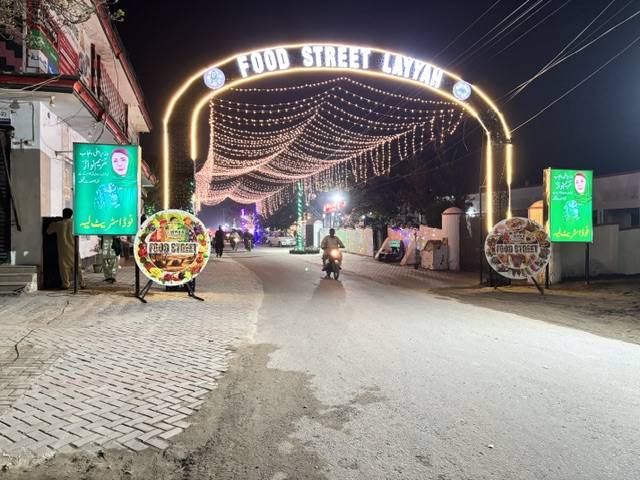
In less than a year since assuming office in December 2025, Deputy Commissioner Asif Ali Dogar, together with his team, had begun leaving a visible imprint on the district. Public parks had come back to life; sports facilities were once again welcoming young athletes; long-neglected hospitals were undergoing rehabilitation.
A digital library was preparing to reopen after years of inaction. More than a hundred public schools had embraced solar energy, while a modern bus terminal, city beautification initiatives, and other public projects reflected an administration committed to improving everyday civic life. Proactive governance, cleanliness drives, and improving local public administration were all a part of the initiatives taken.
Yet, the more time I spent in Layyah, the more convinced I became that the district's most meaningful transformation could not be measured solely in roads, buildings, or public spaces. Infrastructure only improves public substructures. But the manner in which public institutions receive, listen to, and guide the people has the power to bridge the public trust deficit marring our local governance systems.
Perhaps that was what Akram Shah had recognised long before I did. He had not spoken to me about roads, parks, or hospitals; he had spoken to me about the often-missing ehsās. That is where every meaningful transformation truly begins.
Public offices are spaces where people’s grievances should be addressed, not added to. These small gestures demand very little of public officials; yet they often become the very steps paving the road to fulfilling experiences.
The True Mark of Governance
As Pakistan approaches its 79-year mark this August, the pivotal role of bureaucracies and much-ignored local governments in the rise and fall of nations needs to be fully realised. The crass politicisation of local governance in Pakistan has led to a decay triggering corruption, arbitrary decision-making, and a lack of accountability.
Performance in the form of rule of law, efficient delivery systems, public confidence, economic development, and institutional strength can also improve the participation of civil society, leading to better overall governance. A local system with independent financial, political, and legislative powers can, hence, go a long way.
As the elderly potter reminded me that wisdom often resides where the world seldom looks, while the Deputy Commissioner imparted that authority and humility are not mutually exclusive virtues for public officeholders, together, the two made a point for something far greater: every person who crosses our path carries an unseen story, a silent struggle, giving us reason enough to be kind.
Perhaps that is why ehsās refuses to surrender itself to translation as I put pen to paper.