

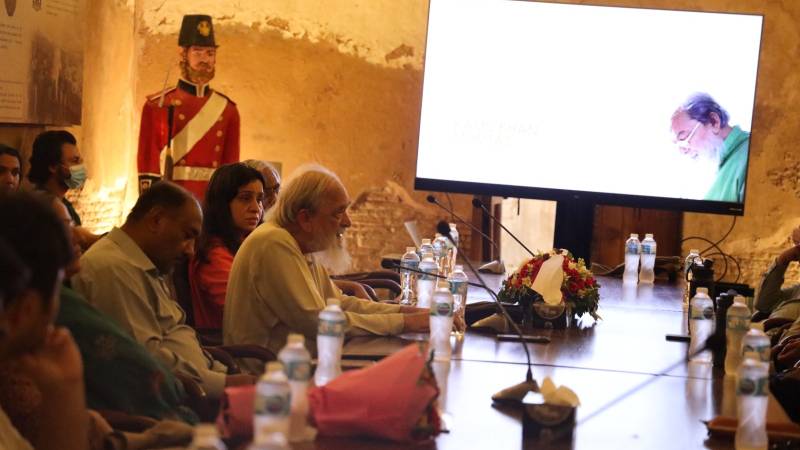
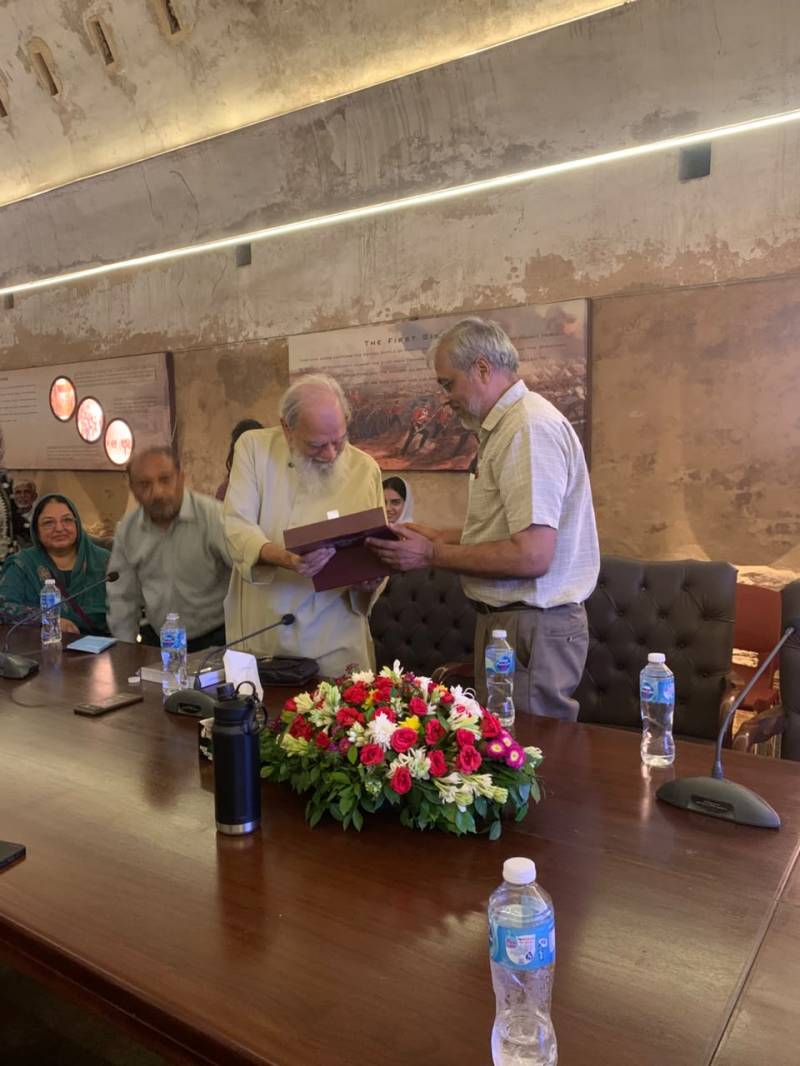
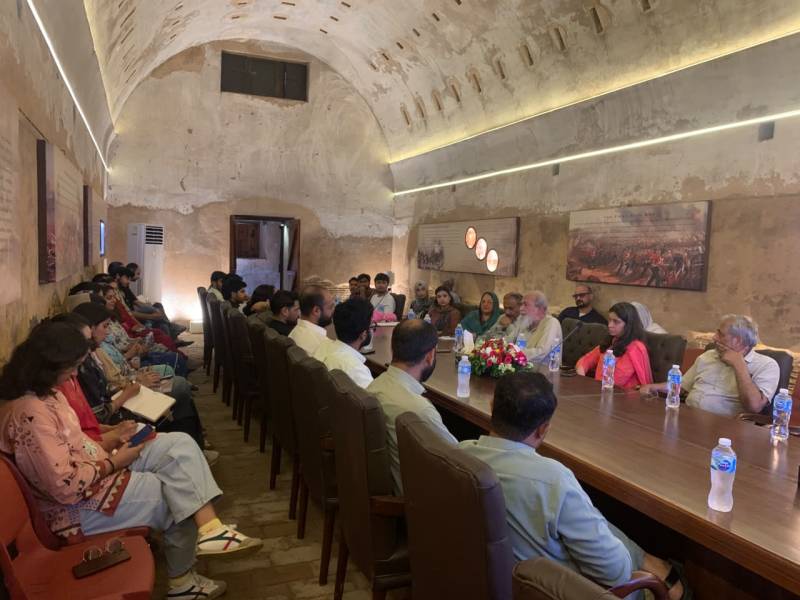
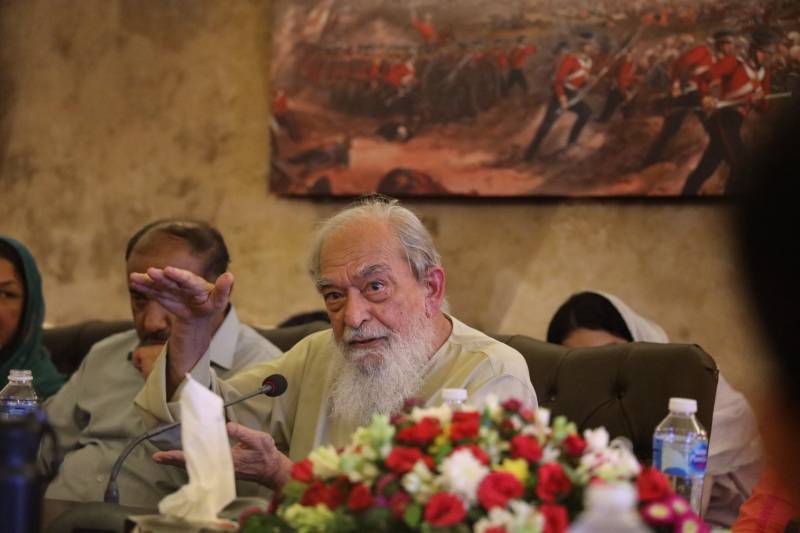
During a recent talk at the Lahore Fort, renowned architect Kamil Khan Mumtaz shared his views on traditionalism versus modernism and the impact of industrialisation on the environment. His formidable portfolio of work draws inspiration from indigenous artistic techniques evident in the Islamic architecture of the region’s ornate heritage sites. The event was organised by the Aga Khan Cultural Service–Pakistan (AKCS-P) in the Fort’s historic Barood Khana as part of its “Café Learning” series.
The talk moved beyond the familiar understanding of conservation as simply preserving historic buildings. For Mumtaz, the question seemed much larger: What kind of society are we trying to build, and what do we understand by progress? Mumtaz argued that conservation should be understood as a resource and integrated into society’s economic development. Around the world, conservation is often justified through its economic value; heritage contributes to tourism, employment, and local economies. Yet, reducing heritage solely to an economic asset risks overlooking the cultural and social relationships that give it meaning.
The tension between conservation and development is therefore, in part, a product of how development itself is understood. Economic growth is rarely questioned. It is globally presented as a natural and necessary path towards a better future. Mumtaz questioned whether such development should be considered the ultimate goal for the success of humankind.
Conservation is not necessarily about resisting the future – it can instead be a way of understanding how to enter the future with the knowledge, resources, and cultural memory of the past intact
“If development is a means of creating better societies, then economic growth is a process rather than an end in itself,” he underscored. This becomes particularly urgent, he added, when considered in the context of the limits of the natural environment. Human societies, he explained, depend upon an exchange of energy and resources with nature, but these resources are finite. The idea of endless or exponential growth, therefore, sits uneasily within an ecological system governed by limits.
Tradition as a Continuity of Knowledge
This idea of limits offers an important connection to conservation. Conservation, at its core, is also about recognising the value of what already exists. It is about repairing rather than replacing, adapting rather than abandoning, and understanding inherited knowledge.
As Mumtaz put it, “Conservation takes you towards riwayat or tradition.” The word riwayat is significant. It points not only to the preservation of old buildings, but to a continuity of knowledge, practices, and cultural memory. At the same time, economic development takes society towards the future. The challenge is hence not to choose between tradition and development, but to understand how the two can inform one another.
Mumtaz’s own interest in this question developed through an attempt to understand the architectural and cultural traditions of South Asia. After returning to Pakistan with a desire to contribute to his country, he found himself looking for literature that could help him understand the region’s architecture and built heritage. The lack of accessible scholarship reinforced a larger concern in him: how can a society build its future when it has lost touch with the knowledge of its own past?
Modernism, Measurement and Mainstreaming
This question also shaped his understanding of modernism. “Modernism is not a style, it is an approach,” he noted. The problem, then, is not modernity itself, but the assumptions upon which modern development has been built. For conservation professionals, this creates an important challenge. Heritage cannot rely only on romantic arguments about beauty, history, or nostalgia.
“Conservation needs clear criteria, measurable standards and a stronger place within the wider social and economic discourse,” Mumtaz explained. It also requires us to question what we choose to measure. A historic building may generate economic value, but it can also carry social memory, environmental knowledge, craftsmanship, identity, and continuity.
Sharing his thoughts on the points raised during the talk, the CEO of AKCS-P remarked: "Today’s session made a strong case for mainstreaming traditional knowledge and techniques. The value of these approaches is evident in the traditional building practices used in historic structures that are climate-friendly and produce resilient structures. Heritage sites across our country have stood the test of time and remain majestic examples of architectural excellence.”
Conservation is not necessarily about resisting the future. It can instead be a way of understanding how to enter the future with the knowledge, resources, and cultural memory of the past intact. Perhaps the question is no longer whether conservation can keep up with development, but whether our understanding of development is broad enough to include conservation in the first place.