

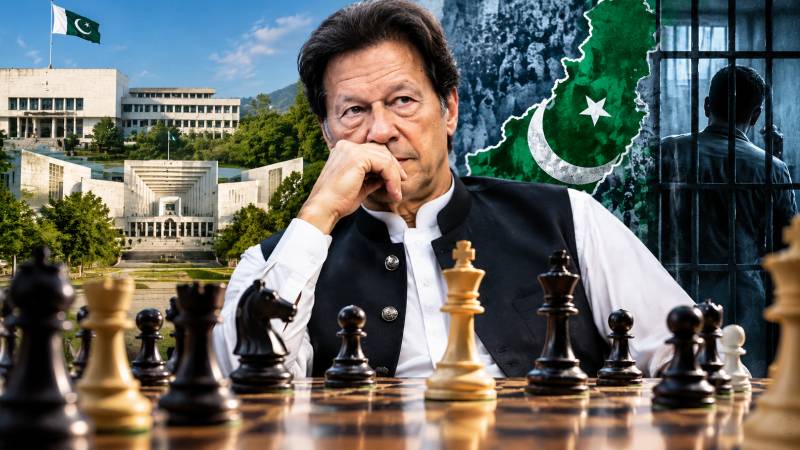
In game theory, a player is rational when he understands the rules, calculates the likely response of other players and chooses the strategy that maximizes his payoff. By that definition, much of Pakistan’s political elite behaved remarkably rationally for decades. Politicians fight elections, make alliances, fall out with the establishment, reconcile with it, go into exile, return to office and learn when to retreat. Governments change, parties rise and fall, generals come and go, but the underlying equilibrium survives. Imran Khan increasingly appears to have chosen something different. He understands the game, but refuses to play according to its unwritten rules. Judged by the conventional objective of remaining in office, avoiding prison and preserving political access, his behaviour appears almost irrational. Judged by a different objective of breaking Pakistan’s existing political equilibrium altogether, it begins to make considerably more sense.
Pakistan’s political game has never been defined entirely by its Constitution. Alongside formal democratic rules has existed an informal architecture of power involving elected politicians, the military establishment, bureaucracy, judiciary, business elites and other institutional actors. Governments can compete intensely within this architecture, but historically successful politicians eventually learn its central lesson that challenge other players, but do not fundamentally challenge the game itself. When defeated, leave yourself a path back. When confrontation becomes too costly, negotiate. Do not turn temporary political adversaries into existential enemies. Most importantly, recognize where the effective vetoes within the system lie.
That equilibrium explains the otherwise bewildering recurrence of Pakistan’s political history. Military governments eventually civilianise themselves. Civilian governments seek accommodation with the military. Politicians once imprisoned return to power. Parties that once accuse one another of corruption and treason eventually form alliances. The same actors repeatedly change positions because survival within a repeated game requires flexibility. Pakistan’s politics may appear chaotic from outside, but beneath the chaos has existed a surprisingly durable equilibrium. Khan has increasingly refused that bargain.
This is what makes him unconventional in a deeper sense than his cricketing background, rhetoric or personality. Particularly since his removal through a so called parliamentary no confidence vote in April 2022, he has progressively transformed his political struggle from a contest over who governs Pakistan into a contest over how Pakistan itself is governed. Instead of accepting defeat, waiting for another turn and rebuilding relationships with the traditional power structure, he challenged the legitimacy of that structure. The rhetoric of Haqeeqi Azadi was therefore politically significant not simply because of its populist appeal, but because it implicitly rejected the rules governing Pakistan’s established equilibrium.
The tragedy is that Pakistan may now be trapped in a classic non-cooperative equilibrium, where every actor behaves rationally according to his own incentives while producing an outcome that is profoundly irrational for the country.
In conventional game theory, that is dangerous behaviour. A repeated game survives partly because players understand that defecting from its fundamental rules carries a penalty. Once a player threatens the equilibrium itself, every other powerful participant acquires an incentive to raise the cost of defection. That is the context in which the extraordinary pressure against Khan must be understood.
It would be intellectually careless to declare that every allegation ever filed against him is necessarily fabricated without examining each case independently. But it would be equally careless to discuss those prosecutions as though they were occurring within a Scandinavian judicial system insulated from political influence. Pakistan’s institutional context matters enormously. In the World Justice Project’s 2025 Rule of Law Index, Pakistan ranks 130th out of 143 countries overall, 129th on civil justice, 128th on fundamental rights and 123rd on absence of corruption. Its overall rule-of-law score is only 0.37 out of 1.0.
Even more damaging is the evidence surrounding Khan’s treatment specifically. Amnesty International reviewed key documents from his cases and spoke to lawyers involved in the proceedings before concluding in 2024 that there had been multiple fair trial violations and a pattern of weaponization of the legal system to keep Khan detained and away from political activity. In August 2026, Amnesty went further, saying Pakistani authorities had systematically denied him a fair trial during three years of detention and reiterating that its earlier investigation had concluded his imprisonment was unlawful and politically motivated.
The United Nations Working Group on Arbitrary Detention independently concluded that Khan’s detention violated international law and called for his immediate release and compensation. It described his imprisonment within a broader campaign of repression against Khan and PTI. These findings do not automatically determine the legal merits of every remaining prosecution. They do, however, make it increasingly difficult to sustain the proposition that what has happened to Khan represents nothing more than the routine application of neutral justice.
Viewed through game theory, the pattern becomes clearer. If a political player refuses to return to equilibrium voluntarily, the system has an incentive to increase the price of resistance in terms of prosecution, imprisonment, disqualification, restrictions on political organization, pressure on associates and the narrowing of avenues through which the challenger can return to power. What appears judicial when examined case by case can therefore become political when viewed as a cumulative strategy. This is the essential meaning of lawfare, not that every allegation must necessarily be invented, but that legal mechanisms collectively become instruments in a political contest. Yet here the strategy encounters a paradox. The punishment imposed on Khan may simultaneously be strengthening the phenomenon it was intended to contain.
Before his imprisonment, Khan was already Pakistan’s most popular individual politician in the last nationally comparable Gallup Pakistan survey. In early 2023, 61 per cent of respondents expressed a positive opinion of him, compared with only 36 per cent for both Nawaz Sharif and Bilawal Bhutto Zardari, 34 per cent for Maryam Nawaz and 32 per cent for Shehbaz Sharif. There is no equally robust current national leader by leader poll that justifies attaching a precise 2026 percentage to his popularity. But subsequent electoral behaviour provides powerful revealed preference evidence. Despite Khan being imprisoned, PTI losing its electoral symbol and its candidates contesting largely as independents, Khan-backed candidates nevertheless emerged as the largest bloc in the February 2024 National Assembly election.
Whatever one thinks of Khan, it is therefore difficult to identify another Pakistani politician today with comparable personal political gravitas. He increasingly towers over the political landscape not because he holds office but because so much of Pakistan’s politics is now organized either around supporting him or preventing his return.
Game theory helps explain why imprisonment may actually reinforce this position. Political credibility suffers from what economists call a signalling problem. Every politician can claim to be courageous while courage is inexpensive. Every opposition leader can declare himself anti-establishment when the consequences remain manageable. But when maintaining the same position results in years of imprisonment, political exclusion and personal hardship, continuing to refuse accommodation becomes a costly signal. The cost itself increases the credibility of the signal.
Khan’s supporters therefore interpret his imprisonment very differently from his opponents. What is intended as evidence that he has been defeated becomes, for them, evidence that he has refused to surrender. Every additional prosecution can reinforce the proposition that the system considers him dangerous. The result is a potentially self-reinforcing cycle. The greater the pressure, the stronger his claim to authenticity. The stronger his support, the greater the perceived threat to the existing equilibrium. And the greater the threat, the stronger the incentive to contain him.
The internationalization of his incarceration adds another dimension. More than 60 Democratic members of the US House wrote to President Joe Biden in 2024 calling for Khan’s release. Other members of Congress subsequently raised similar demands. In Britain, Khan’s imprisonment and treatment have repeatedly reached Parliament, with the UK government publicly stressing Pakistan’s obligations regarding fair trials, due process and humane detention. In December 2025 the UN Special Rapporteur on torture raised concerns about his detention conditions, while Amnesty’s August 2026 intervention again put his treatment before an international audience. This should not be misunderstood as evidence that foreign governments have collectively endorsed Khan’s politics, they have not. Nor should Pakistan’s political future be decided in Washington, London or elsewhere. But the widening international concern matters because it raises the reputational cost of sustaining an equilibrium increasingly perceived outside Pakistan as relying on political exclusion and questionable judicial processes.
The tragedy is that Pakistan may now be trapped in a classic non-cooperative equilibrium. Khan may believe that compromise means political neutralization. The establishment may believe that restoring him to unrestricted political competition could threaten its institutional position. The governing political parties may fear that a genuinely open contest could remove them from power. Khan’s supporters increasingly distrust the institutions that are supposed to referee the contest. Each actor can therefore behave rationally according to his own incentives while producing an outcome that is profoundly irrational for Pakistan. This is precisely how bad equilibria survive.
But Khan introduces an unusual variable because he appears willing to accept a payoff most conventional politicians would regard as intolerable. Prison is ordinarily supposed to change a politician’s calculation. Isolation is supposed to increase the attractiveness of compromise. Political exclusion is supposed to make accommodation rational. Yet, so far, Khan appears unwilling to accept the bargain. That is why calling his behaviour “irrational” requires qualification. He is irrational only if we assume that his objective is to return to power within Pakistan’s existing political game. If his objective is to change the game itself, accepting extraordinary personal costs may be entirely rational.
There is, however, an equally important warning for Khan and his supporters. Destroying an equilibrium is not the same as constructing a better one. Pakistan does not need merely to replace one dominant player with another. A genuine transformation would require rules under which the military, judiciary, bureaucracy, political parties and Imran Khan himself are all constrained by constitutional institutions. If Khan ultimately returns to power only to employ the same instruments against his opponents, the players will have changed but the game will have survived. That is the unresolved question around which Pakistan’s political future may now turn.
Will the extraordinary pressure eventually force Imran Khan to do what generations of Pakistani politicians have done before him? To negotiate, accommodate, accept the unwritten boundaries of power and return to the old equilibrium? Or will his refusal to play by those rules eventually shatter the equilibrium itself? For now, after three years in prison and despite the enormous personal and political price imposed upon him, he appears remarkably unwilling to return to the old game. If anything, he seems increasingly bent on breaking it. Whether Pakistan ultimately remembers that as political recklessness or as the moment an exhausted political equilibrium finally began to collapse will depend on what comes after it.